
ISSUE GUIDE
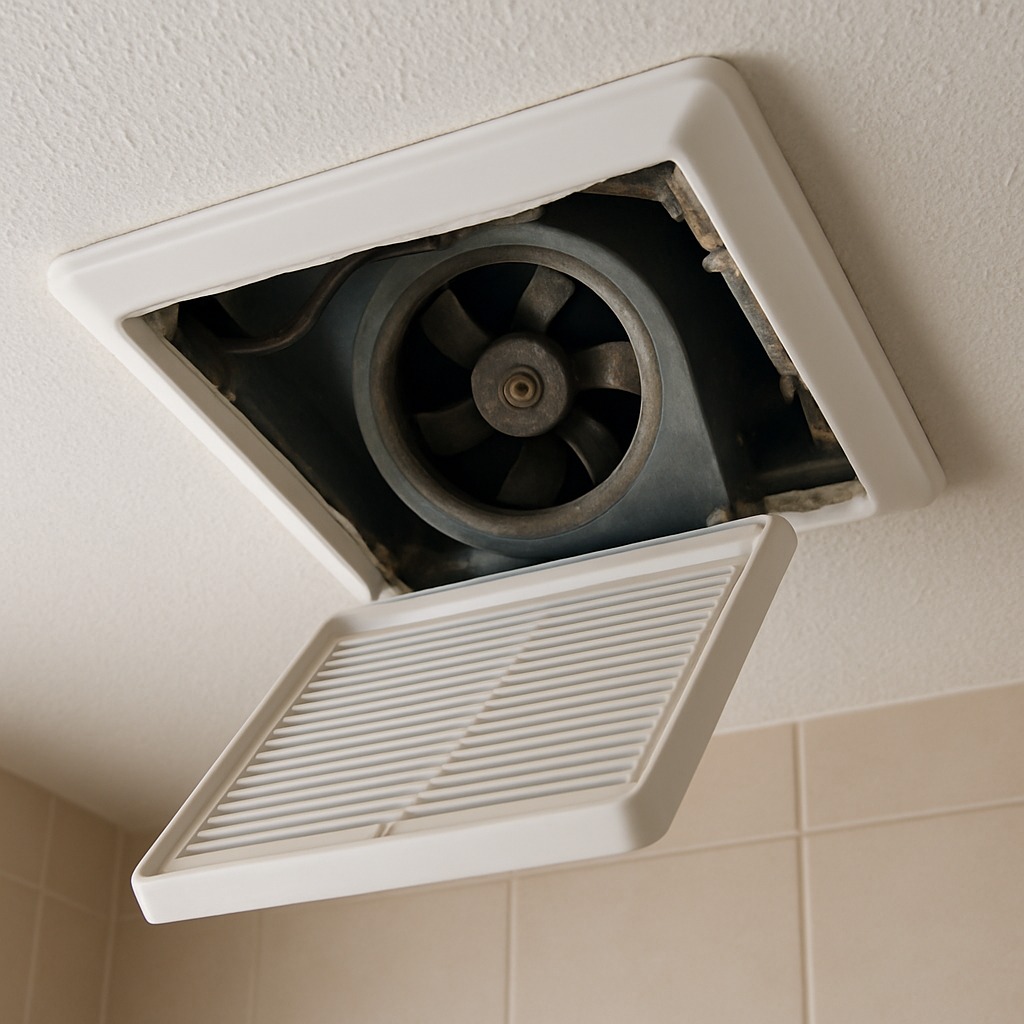
A bathroom exhaust fan that stops working is more than just a minor inconvenience — it's a ventilation failure that can quietly cause serious damage to your home. Your exhaust fan plays a critical role in removing moisture, odors, and airborne contaminants from one of the most humidity-prone rooms in the house. When it fails, that moisture has nowhere to go. Homeowners typically notice the problem in one of several ways: the fan makes no sound at all when switched on, it hums but the blade doesn't spin, it runs but barely moves air, or it rattles and vibrates loudly during operation. Some notice the ceiling or walls near the fan becoming damp or discolored. Others spot early mold growth around the fan cover or on the ceiling corners — a telltale sign that the room has been venting poorly for a while. The causes range from simple to serious. A tripped circuit breaker or a faulty wall switch can mimic a dead fan. A motor clogged with years of dust and debris may seize up or run inefficiently. A disconnected or crushed duct hose means air isn't being expelled even if the fan is spinning. In older homes, the fan may simply have reached the end of its lifespan — most exhaust fans last 10 to 15 years under normal use. Ignoring a non-functional exhaust fan accelerates paint peeling, wood rot in framing and cabinetry, and mold growth inside wall cavities and attic spaces. Mold remediation is significantly more expensive than fan repair or replacement. If you've noticed fogged mirrors that stay foggy long after showers, a musty smell lingering in the bathroom, or visible moisture beading on walls and fixtures, your exhaust fan situation likely needs immediate attention. The sooner this is addressed, the less collateral damage you'll face.
Never attempt to remove the fan housing, access wiring, or inspect the ductwork inside the ceiling without first turning off the dedicated circuit breaker for the bathroom fan at your electrical panel. Even with the wall switch in the off position, wiring inside the junction box may still be energized. Water and electricity are a dangerous combination — if your bathroom has recently experienced a leak or flooding, do not attempt any electrical inspection yourself under any circumstances. Avoid spraying any cleaning products directly into the fan grille while the circuit is live. If you smell burning plastic or notice discoloration around the fan cover, do not attempt to operate the fan — turn off the breaker immediately and keep the bathroom ventilated by opening a window. Old fans may contain components that degrade over time and pose fire risks if forced to operate while failing. If you are unsure which breaker controls the fan, do not experiment by flipping breakers while someone is in contact with the fixture. Label your panel properly and consult a professional if your electrical panel is unlabeled, outdated, or shows signs of heat damage.
The most common reason a bathroom exhaust fan stops working is a failed motor — typically caused by years of dust accumulation that overheats the motor windings and eventually causes them to burn out. Exhaust fans pull air through a grille that collects lint, dust, and debris over time, and most homeowners never clean the interior components. When airflow through the motor is restricted, it runs hotter than designed, dramatically shortening its lifespan. In many cases, a simple cleaning can restore a sluggish fan, but once the motor has seized or burned out, the unit needs to be replaced. Other frequent culprits include a faulty wall switch, a tripped GFCI outlet on the fan's circuit, or a disconnected duct hose that allows the fan to spin freely while exhausting air into the attic or ceiling cavity instead of outdoors.
Before calling a professional or attempting any repair, there are several safe visual and sensory checks you can perform without touching wiring or removing any components. These observations will help you describe the problem accurately and may even reveal a simple fix you can handle yourself.
If your bathroom exhaust fan isn't working, these damage-control steps will help you limit moisture buildup and prepare for a professional repair. These are containment measures — not full repairs — and are safe to perform without electrical knowledge or special tools.
Right now, open your bathroom window and check your electrical panel for a tripped breaker — these two steps cost nothing and may solve the problem immediately.
You should contact a licensed handyman or electrician as soon as possible if resetting the breaker and GFCI outlet did not restore power to the fan, if the fan hums but doesn't spin, or if the unit is more than 10 years old and showing signs of failure. A professional is also necessary if the fan cover shows scorch marks, if you detect a burning or electrical smell near the unit, or if the fan shares a circuit with other bathroom fixtures that are also malfunctioning. Ductwork issues — such as a disconnected, crushed, or improperly routed vent hose running through the ceiling or wall cavity — require a pro to access and correct safely. If your bathroom has no exhaust fan at all and you're experiencing persistent moisture problems, a handyman can evaluate the best installation location and duct routing to meet building code requirements.
Treat this as higher urgency if you can already see visible mold growth on the ceiling, walls, or inside the fan housing, as mold spreads quickly in humid environments and can penetrate drywall and wood framing within days. A burning smell coming from the fan or its switch is an immediate safety concern that warrants turning off the circuit breaker right away and calling a professional before using the bathroom fan again. Similarly, if you notice the ceiling drywall has become soft, discolored, or is beginning to sag near the fan, there may be water intrusion from above — a condition that requires urgent attention to prevent structural damage and potential ceiling collapse.
You should contact a licensed handyman or electrician as soon as possible if resetting the breaker and GFCI outlet did not restore power to the fan, if the fan hums but doesn't spin, or if the unit is more than 10 years old and showing signs of failure. A professional is also necessary if the fan cover shows scorch marks, if you detect a burning or electrical smell near the unit, or if the fan shares a circuit with other bathroom fixtures that are also malfunctioning. Ductwork issues — such as a disconnected, crushed, or improperly routed vent hose running through the ceiling or wall cavity — require a pro to access and correct safely. If your bathroom has no exhaust fan at all and you're experiencing persistent moisture problems, a handyman can evaluate the best installation location and duct routing to meet building code requirements.
Treat this as higher urgency if you can already see visible mold growth on the ceiling, walls, or inside the fan housing, as mold spreads quickly in humid environments and can penetrate drywall and wood framing within days. A burning smell coming from the fan or its switch is an immediate safety concern that warrants turning off the circuit breaker right away and calling a professional before using the bathroom fan again. Similarly, if you notice the ceiling drywall has become soft, discolored, or is beginning to sag near the fan, there may be water intrusion from above — a condition that requires urgent attention to prevent structural damage and potential ceiling collapse.
You should contact a licensed handyman or electrician as soon as possible if resetting the breaker and GFCI outlet did not restore power to the fan, if the fan hums but doesn't spin, or if the unit is more than 10 years old and showing signs of failure. A professional is also necessary if the fan cover shows scorch marks, if you detect a burning or electrical smell near the unit, or if the fan shares a circuit with other bathroom fixtures that are also malfunctioning. Ductwork issues — such as a disconnected, crushed, or improperly routed vent hose running through the ceiling or wall cavity — require a pro to access and correct safely. If your bathroom has no exhaust fan at all and you're experiencing persistent moisture problems, a handyman can evaluate the best installation location and duct routing to meet building code requirements.
Treat this as higher urgency if you can already see visible mold growth on the ceiling, walls, or inside the fan housing, as mold spreads quickly in humid environments and can penetrate drywall and wood framing within days. A burning smell coming from the fan or its switch is an immediate safety concern that warrants turning off the circuit breaker right away and calling a professional before using the bathroom fan again. Similarly, if you notice the ceiling drywall has become soft, discolored, or is beginning to sag near the fan, there may be water intrusion from above — a condition that requires urgent attention to prevent structural damage and potential ceiling collapse.