
ISSUE GUIDE
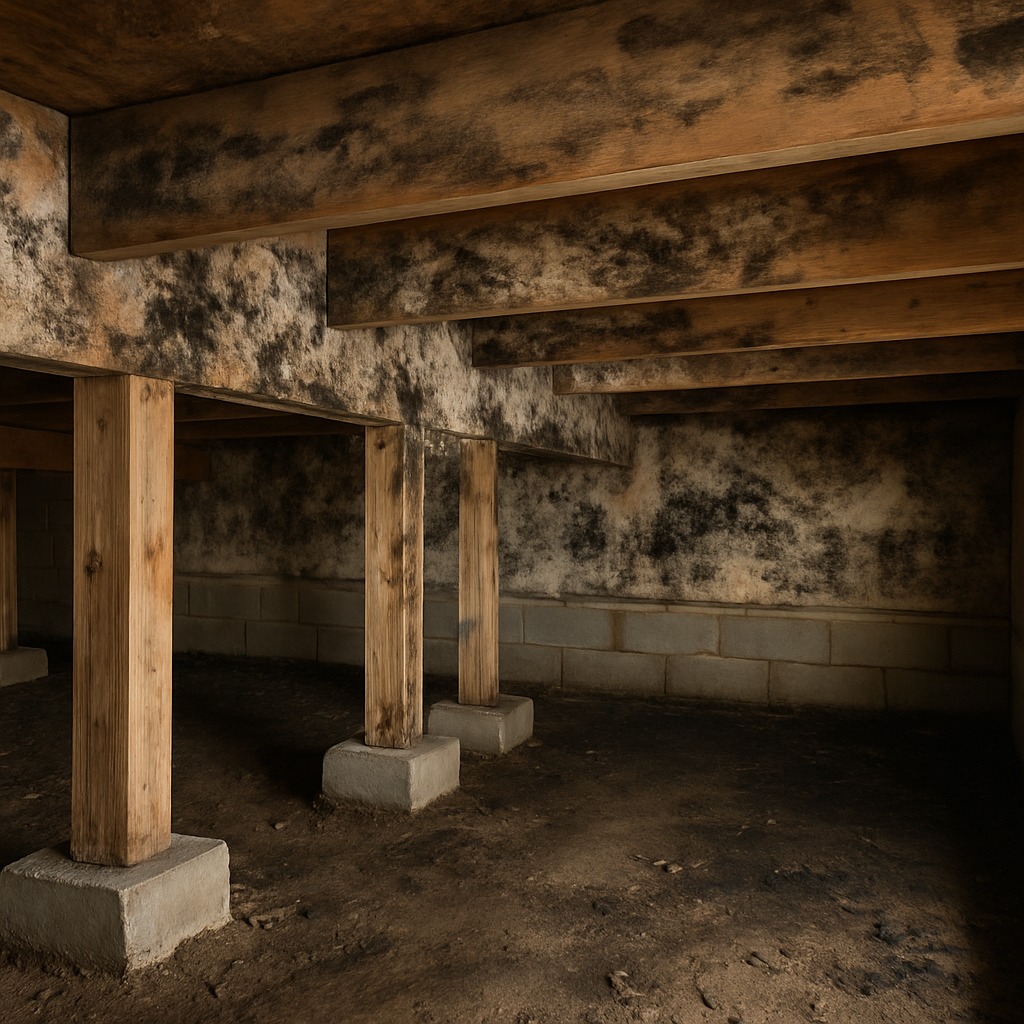
Moisture beneath your home might be invisible from the living areas above, but its effects are anything but subtle. Crawlspace moisture is one of the most destructive and underestimated problems a homeowner can face, quietly rotting structural wood, corroding metal fasteners, triggering mold colonies, and driving up energy costs — all while you go about your daily routine completely unaware. By the time most homeowners notice something is wrong, the damage has often been building for months or even years. The first clues tend to arrive indirectly. You might notice a persistent musty odor seeping up through floors or into lower living areas. Wood floors may begin to feel soft, springy, or slightly uneven underfoot. In some homes, allergy symptoms worsen for no apparent reason, or humidity inside the house feels stubbornly high despite running the HVAC system normally. Occasionally, homeowners spot the actual warning sign — water stains, standing puddles, or dripping condensation — during a routine inspection or when checking on plumbing. Several distinct patterns help narrow down the underlying cause. Moisture that appears mainly after heavy rainfall usually points to surface drainage problems, foundation cracks, or improper grading around the home's perimeter. Moisture that builds up regardless of weather, especially in warmer months, often signals condensation forming when humid outdoor air contacts cooler crawlspace surfaces — a different problem requiring a different solution. Wet insulation sagging from floor joists, white mineral deposits on foundation walls called efflorescence, and rusted metal straps or fasteners are all diagnostic clues that experienced eyes will recognize immediately. Prompt attention matters because crawlspace moisture doesn't stabilize on its own. Wood rot spreads. Mold reproduces. Insects like termites and carpenter ants are drawn to damp wood. What starts as a moisture management problem can escalate into a structural repair project with a significantly larger price tag.
Crawlspace environments present several serious hazards that are specific to this confined, often neglected space. Mold spores become airborne easily when disturbed, and inhaling them without respiratory protection can trigger significant respiratory reactions, particularly in people with asthma or mold sensitivities — if you must enter, wear an N95 respirator at minimum. Radon gas, which is colorless and odorless, accumulates in crawlspaces and can reach dangerous concentrations, particularly in certain geographic regions; never spend extended time in a crawlspace without knowing your home's radon status. Wet soil and standing water can harbor bacteria, and if any sewage odor is present, the space may be contaminated with pathogens requiring hazmat-level handling. Electrical wiring running through crawlspaces can become a shock hazard when moisture is present — never touch wiring, junction boxes, or outlets in a wet crawlspace under any circumstances. Structural weakness caused by wood rot may not be visible from outside; joists that appear intact sometimes fail suddenly under body weight. If you must enter the space, always inform another person and keep the access point unobstructed for emergency exit.
The most common cause of crawlspace moisture is a combination of inadequate vapor barrier coverage and poor exterior drainage working together. When bare or partially covered soil is exposed inside the crawlspace, it continuously releases ground moisture upward through evaporation — a process that never stops regardless of surface weather conditions. This vapor rises into the cooler air of the crawlspace during warmer months and condenses on wood framing, insulation, and foundation surfaces, exactly like a cold drink sweating on a summer day. Simultaneously, if gutters overflow, downspouts discharge near the foundation, or the soil grade slopes toward the house, rainfall is being directed against and beneath the foundation rather than away from it. Most crawlspace moisture situations involve both ground evaporation and surface water intrusion happening at the same time, which is why solutions addressing only one factor often fail to resolve the problem fully.
What you can see at any given moment likely represents only a fraction of the actual damage that has accumulated. Wood rot progresses from the surface inward, so joists and beams that look merely discolored on the exterior may already be significantly compromised in their structural core. Mold colonies visible on surfaces have typically been actively growing for weeks to months, meaning spores have been circulating through the home's air supply long before the colony became visible. Insulation that appears intact but feels dense or compressed has likely already lost most of its thermal resistance value. Efflorescence on concrete walls indicates that water has been moving through the foundation material repeatedly over time, potentially widening hairline cracks with each freeze-thaw cycle. A professional moisture assessment will almost always reveal that the visible damage you observed during your initial check is the leading edge of a more extensive hidden problem requiring comprehensive remediation rather than spot treatment.
Before calling anyone or attempting any fixes, a careful visual inspection of your crawlspace can give you and any professional you contact genuinely useful information. You don't need tools, protective gear beyond basic caution, or any disassembly to gather these observations — just a flashlight, your eyes, and a methodical approach. Document what you find with your phone camera if you can safely do so from the access opening.
The goal at this stage is not to solve the moisture problem permanently — it's to slow further damage, reduce active moisture load, and prepare the space for proper professional assessment or repair. Think of these steps as triage. Avoid the temptation to seal things up permanently or make structural changes before understanding the full cause, since improper fixes can sometimes trap moisture and accelerate the very damage you're trying to prevent.
Open all accessible foundation vents today and photograph every area of moisture, staining, or damaged wood before conditions change.
Contact a water damage restoration specialist or crawlspace professional when you observe any standing water that persists more than 24 hours after rain has stopped, when wood joists show visible soft spots or discoloration suggesting active rot, or when mold growth is visible on structural members, insulation, or vapor barriers. A professional assessment is also warranted when indoor humidity stays elevated above 60 percent consistently despite normal HVAC operation, when floors above the crawlspace feel soft or bouncy in specific locations, or when musty odors have become noticeable inside the living space. If your home has a vapor barrier that is significantly torn, missing entirely, or covered in pooled water, professional remediation is the appropriate next step rather than DIY replacement, since proper installation requires addressing the moisture source first. Homes with older fiberglass batt insulation that has been wet repeatedly also benefit from professional evaluation since saturated insulation loses its thermal value and becomes a significant mold substrate.
Some situations call for faster response rather than a scheduled appointment. If you can see or smell active sewage odor in addition to moisture, a drain line may have failed inside the crawlspace — this is a health emergency requiring immediate professional attention. Visible white or black mold colonies spreading across multiple joists indicate an established colony that requires containment protocols before disturbance. Any crawlspace moisture situation combined with recent pest activity, particularly evidence of termites or carpenter ants, should be treated urgently since those insects accelerate wood degradation dramatically when moisture is also present. Finally, if water is also appearing on basement walls or wicking up through concrete slabs elsewhere in the home, your moisture problem is likely hydrostatic and requires professional waterproofing assessment without delay.
Contact a water damage restoration specialist or crawlspace professional when you observe any standing water that persists more than 24 hours after rain has stopped, when wood joists show visible soft spots or discoloration suggesting active rot, or when mold growth is visible on structural members, insulation, or vapor barriers. A professional assessment is also warranted when indoor humidity stays elevated above 60 percent consistently despite normal HVAC operation, when floors above the crawlspace feel soft or bouncy in specific locations, or when musty odors have become noticeable inside the living space. If your home has a vapor barrier that is significantly torn, missing entirely, or covered in pooled water, professional remediation is the appropriate next step rather than DIY replacement, since proper installation requires addressing the moisture source first. Homes with older fiberglass batt insulation that has been wet repeatedly also benefit from professional evaluation since saturated insulation loses its thermal value and becomes a significant mold substrate.
Some situations call for faster response rather than a scheduled appointment. If you can see or smell active sewage odor in addition to moisture, a drain line may have failed inside the crawlspace — this is a health emergency requiring immediate professional attention. Visible white or black mold colonies spreading across multiple joists indicate an established colony that requires containment protocols before disturbance. Any crawlspace moisture situation combined with recent pest activity, particularly evidence of termites or carpenter ants, should be treated urgently since those insects accelerate wood degradation dramatically when moisture is also present. Finally, if water is also appearing on basement walls or wicking up through concrete slabs elsewhere in the home, your moisture problem is likely hydrostatic and requires professional waterproofing assessment without delay.
Contact a water damage restoration specialist or crawlspace professional when you observe any standing water that persists more than 24 hours after rain has stopped, when wood joists show visible soft spots or discoloration suggesting active rot, or when mold growth is visible on structural members, insulation, or vapor barriers. A professional assessment is also warranted when indoor humidity stays elevated above 60 percent consistently despite normal HVAC operation, when floors above the crawlspace feel soft or bouncy in specific locations, or when musty odors have become noticeable inside the living space. If your home has a vapor barrier that is significantly torn, missing entirely, or covered in pooled water, professional remediation is the appropriate next step rather than DIY replacement, since proper installation requires addressing the moisture source first. Homes with older fiberglass batt insulation that has been wet repeatedly also benefit from professional evaluation since saturated insulation loses its thermal value and becomes a significant mold substrate.
Some situations call for faster response rather than a scheduled appointment. If you can see or smell active sewage odor in addition to moisture, a drain line may have failed inside the crawlspace — this is a health emergency requiring immediate professional attention. Visible white or black mold colonies spreading across multiple joists indicate an established colony that requires containment protocols before disturbance. Any crawlspace moisture situation combined with recent pest activity, particularly evidence of termites or carpenter ants, should be treated urgently since those insects accelerate wood degradation dramatically when moisture is also present. Finally, if water is also appearing on basement walls or wicking up through concrete slabs elsewhere in the home, your moisture problem is likely hydrostatic and requires professional waterproofing assessment without delay.