
ISSUE GUIDE
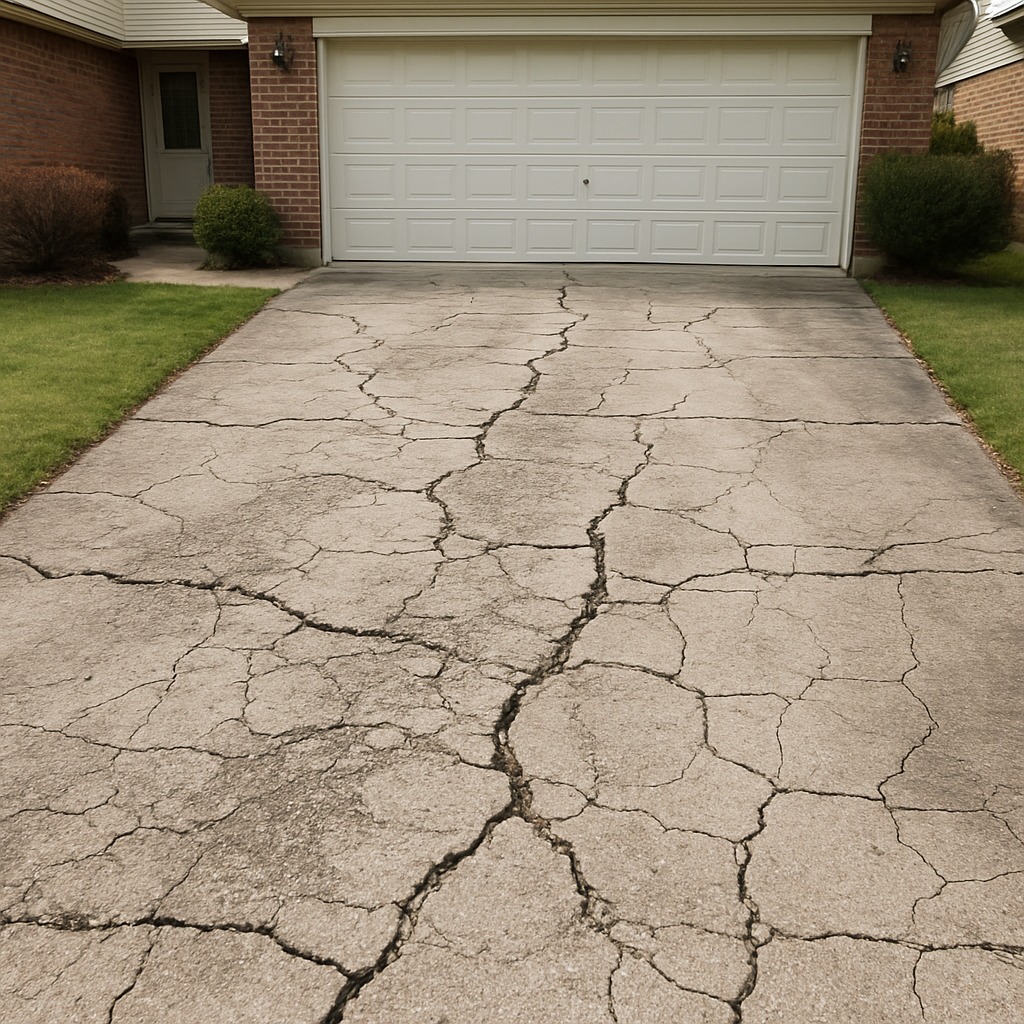
A cracked driveway is one of those problems that can sneak up on a homeowner gradually — a hairline fracture here, a small spider-web pattern there — until one day you're looking at a surface that resembles a jigsaw puzzle. Driveway cracking is more than a cosmetic nuisance. Left unaddressed, cracks allow water to penetrate the surface, freeze in winter, expand the damage, and eventually destabilize the entire slab or asphalt bed beneath. What begins as a minor repair can escalate into a full driveway replacement if ignored long enough. Homeowners typically notice cracking first near the edges of the driveway, at expansion joints, or in areas subjected to heavy vehicle loads. You might also spot isolated cracks running lengthwise down the center or branching out in a pattern resembling alligator skin — a telltale sign of base failure beneath the surface. The cause of cracking matters as much as the crack itself. Thin hairline cracks across concrete are often just normal shrinkage from curing and temperature cycling, and they're largely cosmetic. Wider cracks — anything exceeding a quarter inch — suggest more serious underlying movement, whether from soil settlement, tree root intrusion, poor original installation, or freeze-thaw stress. On asphalt driveways, alligator cracking signals that the flexible base layer has failed and the surface is no longer supported properly. Other clues worth noting: cracks that run parallel to and near the garage slab edge often indicate differential settling between two poured sections. Cracks near tree lines suggest root pressure. Cracks forming in a grid pattern shortly after installation may point to improper curing or inadequate thickness. Paying attention to these patterns helps you and any professional you hire zero in on the real cause and choose the most effective repair path rather than applying a cosmetic fix over a structural problem.
Driveway cracks present several specific safety hazards that go beyond the obvious trip-and-fall risk. Raised or displaced slab edges — even small ones — are a significant tripping hazard, especially for children, elderly family members, or anyone carrying items to and from the vehicle. Mark or barricade any raised sections immediately until they can be repaired. When applying crack fillers or sealants yourself, work in a well-ventilated outdoor area and wear chemical-resistant gloves — many polyurethane and asphalt-based fillers contain solvents that cause skin irritation with prolonged contact. Never apply crack filler to wet or damp surfaces; the material will not bond and may trap moisture beneath, worsening freeze-thaw damage. If you suspect the cracking is related to underground utility movement — gas lines, water mains, or drainage pipes running beneath the driveway — contact your utility provider before any digging or invasive repair work begins. Asphalt crack filler in liquid form can remain tacky for longer than expected; keep children and pets away from freshly treated surfaces until fully cured to avoid burns or material transfer to skin and paws.
The most common cause of driveway cracking is the natural cycle of thermal expansion and contraction combined with an inadequately prepared or thinly poured base. Concrete and asphalt both expand in summer heat and contract in winter cold, and when the material lacks proper thickness — typically at least four inches for residential concrete — or when the compacted gravel subbase beneath it was not deep or dense enough, the surface simply cannot handle that movement without fracturing. This is why cracking so often appears first at the edges and at expansion joints, which are the thinnest and most stress-exposed points of any poured driveway. Soil moisture and drainage also play a major role: soil that retains water swells when saturated and shrinks when dry, creating a constantly shifting foundation that the driveway surface cannot follow without cracking over time.
What the visible cracking on the surface tells you about hidden damage depends heavily on pattern and displacement. A single hairline crack with no vertical offset and no branching pattern is almost always a surface-only issue with no underlying structural concern. But when cracks form a network — especially the interconnected alligator pattern common in asphalt — it means the base layer beneath has lost its load-bearing capacity across that entire zone, not just at the crack lines themselves. Any vertical displacement between crack edges confirms that the soil or subbase has moved unevenly, which means the problem zone is broader than the visible crack suggests. In practical terms, this means a repair that addresses only what you can see on the surface will likely fail within one to two seasons unless the underlying base issue is corrected simultaneously.
Before calling anyone or spending a dollar, take thirty minutes to walk your driveway carefully and document what you're actually dealing with. A thorough visual inspection in good daylight will tell you an enormous amount about severity, cause, and urgency — and it requires no tools, no special knowledge, and no risk of making things worse. Bring your phone to photograph everything you find. The goal here is information gathering, not repair.
While a permanent fix for significant driveway cracking typically requires professional materials and equipment, there are meaningful containment steps you can take right now to slow deterioration, prevent water intrusion from worsening things, and prepare the surface for proper repair. Think of these actions as buying time and protecting your investment — not as substitutes for a real fix when one is warranted.
Walk your driveway today in full daylight, photograph every crack with a coin for scale, and note any sections where edges feel unstable underfoot.
Call a general contractor or driveway specialist when cracks exceed 1/4 inch in width, when you observe any vertical displacement between crack edges, or when alligator-pattern cracking covers more than a few square feet of the surface. These conditions indicate that the problem has moved beyond surface-level shrinkage into structural territory — meaning the base layer, subgrade soil, or the slab itself is compromised. Similarly, if cracks are actively growing, reappearing shortly after you've filled them, or multiplying rapidly, professional diagnosis is essential before any more money is spent on stopgap sealants. A contractor can core-sample the driveway, assess subbase depth and condition, identify drainage failures, and recommend whether sectional repair or full replacement is the more economical choice long-term. Ignoring structural cracking typically leads to exponentially higher replacement costs within two to five years.
Faster response is warranted when cracking is occurring near your garage foundation, home foundation walls, or retaining structures — because settlement or water infiltration in those zones can escalate into foundation damage that far exceeds any driveway repair cost. Also respond quickly if you notice the ground beneath the driveway edge has visibly eroded, if sections of the driveway have begun to sink noticeably, or if large chunks are breaking free and creating safety hazards. Winter is a particular accelerant — a crack that seems manageable in October can triple in width after a hard freeze cycle. If you're heading into cold months with unaddressed wide cracks, treat it as an urgent repair rather than a spring project.
Call a general contractor or driveway specialist when cracks exceed 1/4 inch in width, when you observe any vertical displacement between crack edges, or when alligator-pattern cracking covers more than a few square feet of the surface. These conditions indicate that the problem has moved beyond surface-level shrinkage into structural territory — meaning the base layer, subgrade soil, or the slab itself is compromised. Similarly, if cracks are actively growing, reappearing shortly after you've filled them, or multiplying rapidly, professional diagnosis is essential before any more money is spent on stopgap sealants. A contractor can core-sample the driveway, assess subbase depth and condition, identify drainage failures, and recommend whether sectional repair or full replacement is the more economical choice long-term. Ignoring structural cracking typically leads to exponentially higher replacement costs within two to five years.
Faster response is warranted when cracking is occurring near your garage foundation, home foundation walls, or retaining structures — because settlement or water infiltration in those zones can escalate into foundation damage that far exceeds any driveway repair cost. Also respond quickly if you notice the ground beneath the driveway edge has visibly eroded, if sections of the driveway have begun to sink noticeably, or if large chunks are breaking free and creating safety hazards. Winter is a particular accelerant — a crack that seems manageable in October can triple in width after a hard freeze cycle. If you're heading into cold months with unaddressed wide cracks, treat it as an urgent repair rather than a spring project.
Call a general contractor or driveway specialist when cracks exceed 1/4 inch in width, when you observe any vertical displacement between crack edges, or when alligator-pattern cracking covers more than a few square feet of the surface. These conditions indicate that the problem has moved beyond surface-level shrinkage into structural territory — meaning the base layer, subgrade soil, or the slab itself is compromised. Similarly, if cracks are actively growing, reappearing shortly after you've filled them, or multiplying rapidly, professional diagnosis is essential before any more money is spent on stopgap sealants. A contractor can core-sample the driveway, assess subbase depth and condition, identify drainage failures, and recommend whether sectional repair or full replacement is the more economical choice long-term. Ignoring structural cracking typically leads to exponentially higher replacement costs within two to five years.
Faster response is warranted when cracking is occurring near your garage foundation, home foundation walls, or retaining structures — because settlement or water infiltration in those zones can escalate into foundation damage that far exceeds any driveway repair cost. Also respond quickly if you notice the ground beneath the driveway edge has visibly eroded, if sections of the driveway have begun to sink noticeably, or if large chunks are breaking free and creating safety hazards. Winter is a particular accelerant — a crack that seems manageable in October can triple in width after a hard freeze cycle. If you're heading into cold months with unaddressed wide cracks, treat it as an urgent repair rather than a spring project.