
ISSUE GUIDE
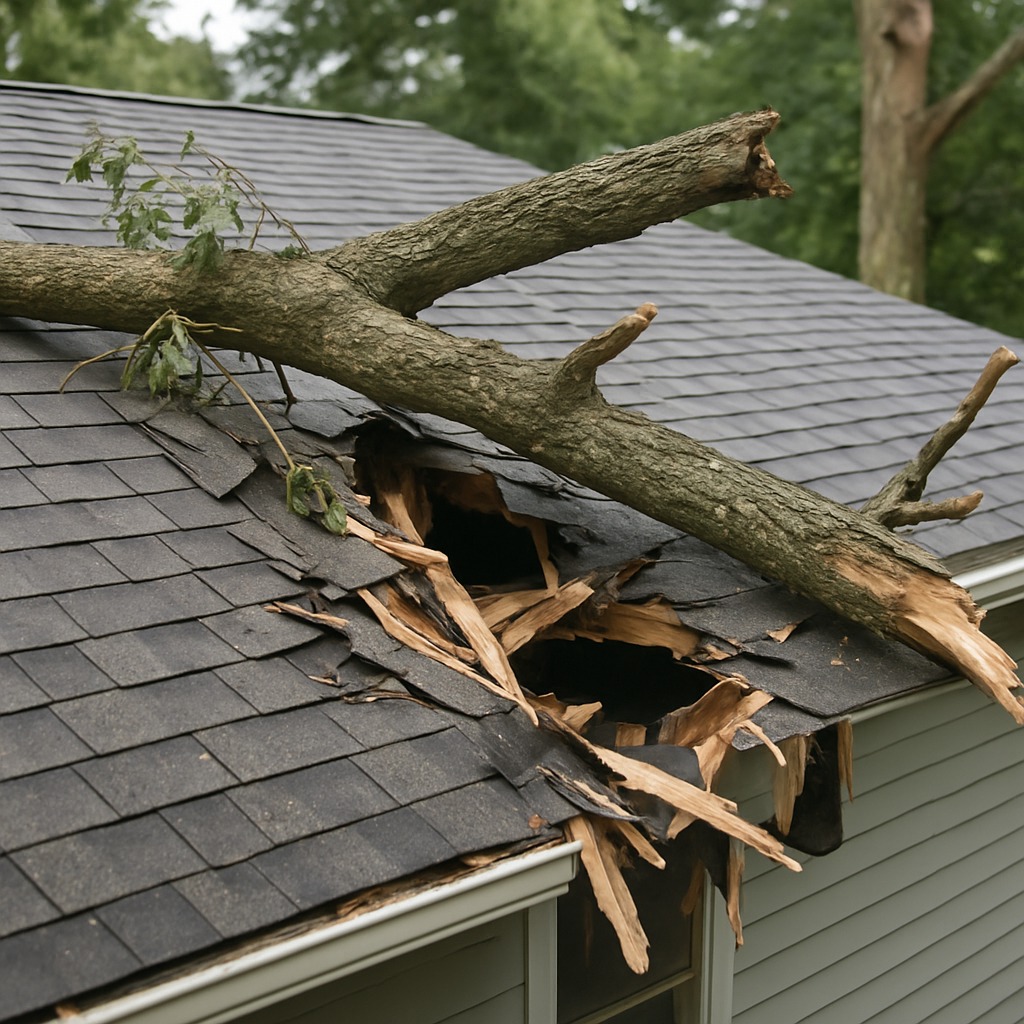
When a tree falls on your home, the immediate shock can make it hard to think clearly — but the decisions you make in the first few hours matter enormously. This is one of the most serious structural events a homeowner can face, combining roof damage, potential framing compromise, water intrusion risk, and in some cases, hazards to occupants. The scale of damage ranges widely: a small limb landing on asphalt shingles may cause localized punctures, while a large trunk crashing through the roof deck can compromise rafters, ceiling joists, interior walls, and even load-bearing elements. Homeowners typically notice the obvious first — a loud impact, visible debris on the roof, a hole in the ceiling, or daylight where there should be none. But the damage you can see is rarely the full picture. Hidden structural shifts, cracked rafters, displaced flashing, and saturated insulation often extend well beyond the visible impact zone. Even a tree that appears to have landed gently can transfer enormous force across a wide area of your roof system. Certain patterns help indicate severity. A tree that fell during a storm may have already stressed your roof with wind uplift before impact, worsening hidden damage. Trees with large root balls that pulled up as they fell can indicate saturated soil, which may also affect your foundation. The angle of the fall matters too — a tree hitting a ridge line transfers force differently than one that punches straight through a single rafter bay. Prompt attention is critical for two reasons: ongoing structural risk and water intrusion. Even a small opening in your roof allows rain, humidity, and pests to begin degrading framing, insulation, and drywall within hours. The longer the exposure, the more expensive and extensive the eventual repair will be. Acting quickly protects both your home and your insurance claim.
Do not re-enter any room directly beneath the tree impact until a licensed professional confirms the structure is stable. A tree resting on a roof creates a dynamic load situation — the weight may be partially supported by the tree itself, and removing the tree without shoring the structure first can cause immediate secondary collapse of the roof or ceiling. Do not attempt to cut, push, or move any part of the fallen tree yourself. Keep children and pets completely away from the exterior near the impact zone in case of widow-maker branches or further tree movement. If your home uses gas appliances and you smell gas or hear hissing near the affected area, leave immediately, leave doors open behind you, do not operate any switches or electronics, and call your gas utility and 911 from outside the home. Turn off electricity to impacted zones at the breaker panel rather than from inside those rooms. During or after rain, water pooling in an impacted ceiling can add hundreds of pounds of weight, dramatically increasing collapse risk — do not stand beneath visibly wet or sagging ceilings regardless of how intact they appear.
The most common scenario when a tree falls on a house involves a combination of storm-weakened root systems, saturated soil, and wind forces that exceed what an otherwise healthy tree can withstand. In many cases, the tree was already compromised — by disease, prior storm damage, root decay, or shallow planting near the home — and a moderate storm event provided the final trigger. This matters for homeowners because it affects both liability questions and future risk assessment. Arborists can often identify whether remaining trees on the property pose similar risks, and addressing those proactively is far less expensive than a second impact event. The point of contact between tree and roof is almost always the worst single point of damage, but force distribution through the roof framing means secondary damage radiates outward from that point in ways that aren't immediately visible.
What you can see on the roof and ceiling surface represents only a fraction of the actual damage in most significant impact events. When a tree breaches the roof deck, it typically displaces or cracks rafters across multiple bays, shears fasteners in the sheathing, breaks the waterproof continuity of underlayment well beyond the visible hole, and in many cases compresses or dislodges insulation in the attic cavity. Even shingles that look intact within a few feet of the impact zone have often been cracked, lifted, or had their seals broken by the shock wave of the impact. This is why post-impact inspections consistently find damage that extends significantly farther than the visible entry point — and why repair estimates often increase after the tree is removed and the full extent of framing and sheathing damage becomes visible.
Before any professional arrives, there are meaningful observations you can make from safe positions — outdoors, at a distance, or from interior rooms that are clearly undamaged. Do not attempt to climb onto the roof, enter rooms directly beneath the impact zone, or touch the tree itself. Your goal at this stage is information-gathering, not repair. These observations will help your contractor and insurance adjuster understand the scope of damage and will support a faster, more accurate assessment.
The homeowner's role after a tree falls on a house is not to fix the damage — it is to prevent that damage from getting significantly worse while professionals are arranged. Water intrusion, secondary collapse, and interior contamination are your immediate enemies. Every action you take should focus on containment, documentation, and safety rather than any attempt at structural repair. Keep these steps methodical and don't rush into hazardous spaces.
Right now, photograph all visible damage from safe positions outside and call your homeowner's insurance company to open an emergency claim immediately.
A tree falling on your house is not a DIY repair scenario under any circumstances — this situation requires a licensed roofer at minimum, and depending on the extent of structural damage, may also require a structural engineer, general contractor, or arborist to remove the tree safely before roofing work can begin. Call a licensed roofer immediately for emergency assessment and tarping, even before your insurance adjuster arrives. You should also contact a licensed arborist or tree service to evaluate whether the tree can be safely removed without causing additional damage to the structure — cutting a tree incorrectly when it is load-bearing against your roof can cause a secondary collapse. If the damage involves walls, load-bearing framing, or any visible racking of the structure, request a structural engineer evaluation before any repair work begins. Your insurance company will likely require professional documentation of all damage categories, so having qualified professionals assess each aspect protects your claim as well as your home.
Certain signs indicate you need professional help faster than a standard next-day appointment. If the tree has punched fully through the roof deck and ceiling into living space, if any part of the ceiling is actively sagging or has collapsed, or if you hear continued cracking or movement, treat the situation as an emergency and call a 24-hour emergency roofing or restoration contractor immediately. Rain in the forecast within the next 12 hours is also an emergency trigger — unprotected structural openings can allow water damage that doubles or triples your total repair cost in a single storm event. If gas lines run through the affected area, call your utility company before any other contractors arrive.
A tree falling on your house is not a DIY repair scenario under any circumstances — this situation requires a licensed roofer at minimum, and depending on the extent of structural damage, may also require a structural engineer, general contractor, or arborist to remove the tree safely before roofing work can begin. Call a licensed roofer immediately for emergency assessment and tarping, even before your insurance adjuster arrives. You should also contact a licensed arborist or tree service to evaluate whether the tree can be safely removed without causing additional damage to the structure — cutting a tree incorrectly when it is load-bearing against your roof can cause a secondary collapse. If the damage involves walls, load-bearing framing, or any visible racking of the structure, request a structural engineer evaluation before any repair work begins. Your insurance company will likely require professional documentation of all damage categories, so having qualified professionals assess each aspect protects your claim as well as your home.
Certain signs indicate you need professional help faster than a standard next-day appointment. If the tree has punched fully through the roof deck and ceiling into living space, if any part of the ceiling is actively sagging or has collapsed, or if you hear continued cracking or movement, treat the situation as an emergency and call a 24-hour emergency roofing or restoration contractor immediately. Rain in the forecast within the next 12 hours is also an emergency trigger — unprotected structural openings can allow water damage that doubles or triples your total repair cost in a single storm event. If gas lines run through the affected area, call your utility company before any other contractors arrive.
A tree falling on your house is not a DIY repair scenario under any circumstances — this situation requires a licensed roofer at minimum, and depending on the extent of structural damage, may also require a structural engineer, general contractor, or arborist to remove the tree safely before roofing work can begin. Call a licensed roofer immediately for emergency assessment and tarping, even before your insurance adjuster arrives. You should also contact a licensed arborist or tree service to evaluate whether the tree can be safely removed without causing additional damage to the structure — cutting a tree incorrectly when it is load-bearing against your roof can cause a secondary collapse. If the damage involves walls, load-bearing framing, or any visible racking of the structure, request a structural engineer evaluation before any repair work begins. Your insurance company will likely require professional documentation of all damage categories, so having qualified professionals assess each aspect protects your claim as well as your home.
Certain signs indicate you need professional help faster than a standard next-day appointment. If the tree has punched fully through the roof deck and ceiling into living space, if any part of the ceiling is actively sagging or has collapsed, or if you hear continued cracking or movement, treat the situation as an emergency and call a 24-hour emergency roofing or restoration contractor immediately. Rain in the forecast within the next 12 hours is also an emergency trigger — unprotected structural openings can allow water damage that doubles or triples your total repair cost in a single storm event. If gas lines run through the affected area, call your utility company before any other contractors arrive.