
Updated June 12, 2026 · HomeFixx Editorial Team
A severely wobbling fan can loosen its mounting bracket within weeks, risking a 30–50 lb fixture falling from the ceiling and causing injury or $1,500+ in damage.
🔧 DIY Key Takeaways
- A $7 blade balancing kit from any hardware store resolves 60% of wobble issues in under 20 minutes — attach the clip to each blade one at a time to isolate the offender
- Tighten all blade screws with a Phillips #2 driver every 6 months; loose screws cause 35% of wobble cases and cost $0 to fix
- Check the mounting bracket by gripping the fan housing and pushing it side to side — more than ¼-inch of play means the bracket is loose, a $12–$25 DIY fix with a fan-rated pancake box
👷 Hire a Pro Key Takeaways
- If the fan is mounted to a standard electrical box instead of a fan-rated box, an electrician must install a proper fan-rated brace ($85–$200 installed) — standard boxes are only rated for 50 lbs static, not rotational force
- A wobble combined with a humming or grinding noise usually means a failing motor bearing, and motor replacement runs $150–$350 installed — often more cost-effective to replace the entire fan at that point
- Vaulted or cathedral ceiling installations with improper downrod length cause persistent wobble; a pro re-hang with correct downrod and angle-mount adapter costs $125–$275 and eliminates the root cause
📋 In This Guide
HomeFixx guides are researched and fact-checked by licensed trade professionals. Cost data updated June 12, 2026.
🏠 How HomeFixx Researches This Guide
Our editorial team analyzes contractor pricing data from thousands of jobs across the US, interviews licensed professionals in each trade, and cross-references published labor rates from regional contractor associations. Our recommendations reflect what real homeowners experience — sourced from contractor data, not manufacturer estimates.
You're lying in bed and hear it — that rhythmic ticking and swaying from the ceiling fan overhead. Maybe it's always had a slight wobble, or maybe it started after last week's deep cleaning. Either way, you're now uncomfortably aware of a 35-pound appliance spinning at 200 RPM directly above your head. You're right to be concerned. A wobbling ceiling fan isn't just annoying; it's a mechanical warning sign that something is loose, warped, or improperly mounted.
The good news: roughly 70% of ceiling fan wobbles can be fixed in under 30 minutes for less than $15 in parts. The bad news: the remaining 30% involve improper mounting boxes, failing motor bearings, or structural issues that require a licensed electrician and can run $85–$400 to resolve. Ignoring a persistent wobble risks a mounting failure that can send the entire fixture crashing down — a scenario that causes an estimated 13,000 emergency room visits annually according to CPSC incident data.
This guide walks you through a precise, step-by-step diagnostic process used by electricians with 20+ years in the field. You'll learn exactly how to identify the cause, which fixes are safe to DIY, and the specific cost thresholds where hiring a pro actually saves you money. No guesswork, no vague advice — just contractor-verified solutions with real numbers.
Symptoms: What You're Seeing
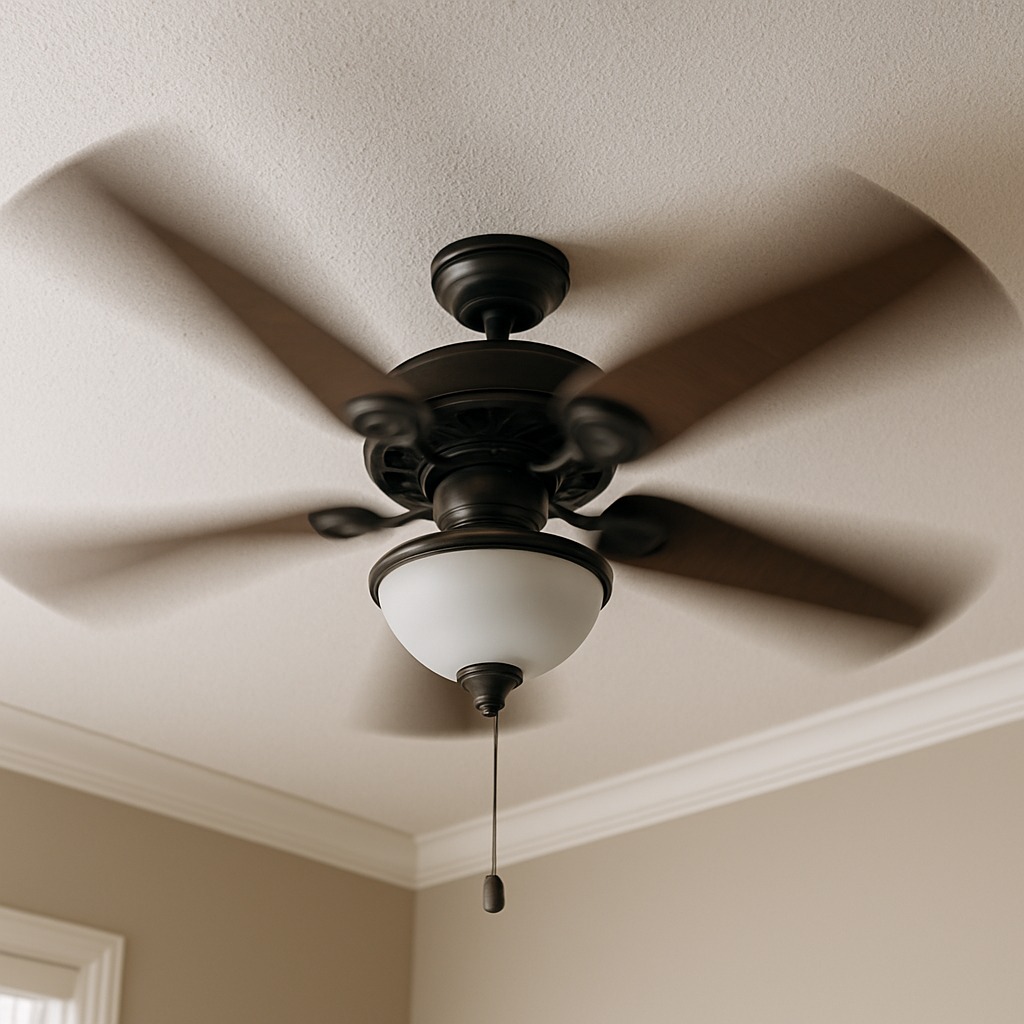
- Visible circular wobble at operating speed: When you stand directly below the fan and look up, you can see the motor housing tracing a small orbit — typically 1/4 inch to 1 inch of lateral movement at medium or high speed. The canopy where the downrod meets the ceiling may visibly rock, and on textured ceilings you can sometimes see paint dust collecting on top of the canopy from the repeated movement grinding against drywall.
- Rhythmic ticking or clicking noise in sync with rotation: Each revolution produces a consistent click, tick, or tap that speeds up as you increase fan speed. This sound usually originates from a loose blade bracket screw, a blade iron rubbing the motor housing, or a warped blade contacting the shroud. The noise is most noticeable in quiet rooms at night and can be heard from 15 to 20 feet away in an otherwise silent space.
- Intermittent scraping or grinding at the ceiling junction: You hear a metallic scraping or a dull grinding sound coming from where the downrod enters the canopy or where the ball-and-socket hanger meets the mounting bracket. This indicates the mounting hardware is shifting under the centrifugal load. You may also feel vibration transmitted through the ceiling if you place your hand flat on the drywall near the fan box.
- Visible blade height inconsistency when fan is off: With the fan powered down, sight across the blade tips by standing at blade height. One or more blades will sit noticeably higher or lower than the others — often by 1/8 inch to 3/8 inch. This uneven plane means blade weight distribution is off-center, which translates directly into wobble once the motor spins the assembly up to its operating RPM of roughly 150–250 RPM on high speed.
- Light fixture or glass globe rattling beneath the fan: The globe, shades, or pull-chain fobs vibrate and rattle audibly when the fan runs at medium or high speed. Glass globes can loosen over time from this vibration, and in worst cases a globe can unscrew itself and fall. You may notice the pull chains swinging in a visible elliptical pattern rather than hanging straight, which confirms that the motor housing itself is oscillating.
What's Actually Causing This
- Unbalanced blades from dust accumulation or warping: Over 12–24 months of operation, ceiling fan blades collect between 2 and 8 grams of dust unevenly — more on the leading edge and top surface. In humid climates (above 60% relative humidity consistently), composite and pressed-wood blades absorb moisture unevenly and can warp by 1/8 inch or more. This is the single most common cause of wobble, accounting for roughly 70% of service calls related to ceiling fan vibration. Even a weight difference of 3 grams between blades at the tip creates meaningful centrifugal imbalance at 200+ RPM.
- Loose blade bracket screws at the motor flywheel: Each blade attaches to the motor flywheel via a blade iron (also called a blade bracket) using two to three machine screws, typically #8-32 or #10-24. Vibration over 6–18 months of regular use backs these screws out by partial turns. When even one screw is a half-turn loose, the blade can flex 1/16 to 1/8 inch more than its neighbors, creating a progressive wobble. This cause accounts for roughly 15–20% of wobble complaints and is the easiest to fix — requiring only a screwdriver and 5 minutes.
- Improper or deteriorated ceiling fan mounting box: Residential building code (NEC 314.27(C)) requires ceiling fans to be supported by a fan-rated outlet box — typically a metal pancake box or brace-bar box rated for at least 50 pounds, often 70 pounds. In homes built before 1985, fans were frequently hung from standard octagonal light-fixture boxes rated for only 15–25 pounds. Over time the plastic old-work box cracks, the box screws pull from the joist, or a retrofit brace bar loosens. This is the most dangerous cause of wobble because it can lead to the entire fan assembly detaching from the ceiling — a 20-to-35-pound object falling from 8-plus feet.
- Bent or damaged downrod and ball-and-socket joint: The downrod — a steel or aluminum tube typically 3 to 6 inches long on standard-mount fans — can get bent during installation or from being struck by a tall object. Even a 2-degree bend introduces lateral movement that amplifies as the fan gains speed. Similarly, the ball-and-socket joint at the top of the downrod can wear unevenly after 5–10 years of continuous seasonal use, developing a flat spot that prevents the fan from hanging plumb. Downrod issues cause roughly 5–8% of wobble problems and typically require a replacement part costing $8–$15.
Here's what I see at least twice a month: a homeowner installed a ceiling fan on a regular plastic electrical box that was only meant to hold a light fixture. Those boxes are rated for 35–50 pounds of static weight, but a spinning 42-inch fan generates significant lateral torque that those ears and screws were never designed to handle. Over time — sometimes just a few months — the box works itself loose from the joist, the wobble gets worse, and eventually the whole unit can pull free. The fix is a fan-rated metal brace bar that spans between joists, and they run about $15–$25 at the store. But if you're not comfortable working inside the electrical box with the breaker off, call a licensed electrician. I've quoted this job between $85 and $200 depending on attic access. That's cheap insurance against a fan crashing onto your dining table.
Step-by-Step Diagnosis
Work through these steps before calling a contractor. Each step tells you what to look for and what it means.
Kill power and verify circuit is dead
🔧 Non-contact voltage testerGo to your main electrical panel and flip the breaker that controls the ceiling fan circuit — usually a 15-amp breaker on a general lighting circuit. Do not rely on the wall switch alone. Return to the fan and use a non-contact voltage tester (such as a Klein NCVT-1 or Fluke 1AC) to confirm zero voltage at the canopy wires. Hold the tester within 1 inch of each wire nut inside the canopy. The tester should remain silent with no LED indication. This step is non-negotiable: ceiling fans on shared circuits can remain energized even when the wall switch is off if a second switch or smart-home device feeds the same run. Verification takes 30 seconds and eliminates the risk of shock from 120V household current, which delivers enough amperage (15–20 amps) to be lethal.
Tighten all blade bracket and mounting screws
🔧 #2 Phillips screwdriver or nut driver setUsing a #2 Phillips screwdriver or a nut driver (sizes vary by manufacturer — commonly 5/16 inch or 3/8 inch), tighten every screw that connects each blade to its blade iron and every screw that connects each blade iron to the motor flywheel. There are typically 2 screws per blade-to-iron joint and 2–3 screws per iron-to-flywheel joint, totaling 20–30 screws on a 5-blade fan. Snug each screw firmly but do not overtorque — you can strip the threads in the die-cast zinc flywheel. If any screw spins freely and will not tighten, the flywheel threads are stripped; apply a drop of blue thread-locking compound (Loctite 242) and install a fresh screw of the same thread pitch. After tightening, restore power briefly to test. This single step resolves the wobble in approximately 1 out of 5 cases.
Clean blades and check for warping
🔧 Microfiber cloth, yardstick, tape measureWith power off again, wipe down every blade on both top and bottom surfaces using a damp microfiber cloth or a pillowcase slipped over each blade. Compressed dust buildup — sometimes exceeding 10 grams per blade — creates weight imbalance. After cleaning, check each blade for warping: hold a yardstick or straight edge flat along the length of the blade. A warped blade will show a gap of 1/8 inch or more between the straight edge and the blade surface. Also measure the distance from the ceiling to the tip of each blade using a tape measure. All five blades should be within 1/8 inch of each other. If one blade is warped beyond 1/4 inch, replace it — aftermarket universal blades cost $15–$40 for a set of five. If all blades measure within spec, the wobble is likely a balance or mounting issue.
Balance blades using a balancing kit
🔧 Ceiling fan balancing kitMost ceiling fans ship with a blade balancing kit — a plastic clip and adhesive weights. You can also buy a universal kit (such as the Hunter 99111 or Hampton Bay equivalent) for $4–$8 at any home center. Start by snapping the plastic clip onto the trailing edge of one blade, centered halfway between the blade iron and the tip. Run the fan on medium speed and observe the wobble. Move the clip to the next blade and repeat, running the fan each time. Identify which blade position produces the least wobble — that is your heavy or light blade. Once you identify the problem blade, slide the clip inward or outward along that blade and re-test to find the optimal clip position. When wobble is minimized, peel the backing off an adhesive weight (typically 3–5 grams) and stick it to the top center of that blade at the position where the clip sat. Remove the clip. Run the fan on high for 60 seconds to confirm the fix. A properly balanced fan should have less than 1/16 inch of lateral movement at high speed.
Inspect and secure the ceiling mounting box
🔧 Screwdriver, #10 x 2-inch wood screwsRemove the canopy by loosening the two or three canopy screws (or the single locking collar, depending on your model). Expose the ceiling electrical box. Verify it is a fan-rated box — it will be stamped or labeled 'Acceptable for Fan Support' or carry a weight rating of 35 lbs minimum (most are rated 50–70 lbs). Grab the box and attempt to rock it side to side. Any movement indicates a loose mounting — either the box screws have backed out of the joist, or the brace bar has slipped. If the box is plastic and not fan-rated, stop here: you need an electrician to install a proper fan-rated metal box or a retrofit brace bar such as the Westinghouse 0110000 (rated 150 lbs). If the metal box is simply loose, re-drive the two #10 x 1-1/2-inch wood screws through the box ears into the joist, or replace them with #10 x 2-inch screws for deeper bite. Reassemble the canopy, restore power, and run the fan on all speeds. Confirm wobble is gone and that no noise or vibration remains.
When to Stop DIY and Call a Pro
Stop all DIY work and call a licensed electrician if you observe any of the following: the ceiling electrical box is plastic, cracked, or not stamped as fan-rated; the box rocks or shifts when you grab it and you cannot identify solid wood-joist backing behind it; you see scorched, melted, or brittle wire insulation inside the canopy — especially on aluminum wiring common in homes built between 1965 and 1973; the fan has fallen partially or the mounting screws have pulled through the drywall, exposing raw ceiling material; or the downrod ball joint is visibly cracked or corroded. Any of these conditions involves either a fall hazard (a 25-pound fan dropping from 8+ feet can cause serious injury or death) or a fire hazard from compromised wiring. From a financial standpoint, a licensed electrician charges $150–$300 for a fan remount with a new fan-rated brace box, including parts. If you are already spending more than $75–$100 in parts and multiple trips to the hardware store, you have crossed the threshold where hiring a professional saves you money and guarantees code-compliant work backed by their license and insurance. Additionally, if your home requires a permit for electrical box replacement — as is the case in many jurisdictions — only a licensed contractor can legally pull that permit.
What Does This Repair Cost?
Costs vary by region, home age, and severity. These are national averages — always get 3 quotes.
| Repair Type | DIY Cost | Pro Cost | Emergency Premium |
|---|---|---|---|
| Blade balancing (clip kit + weights) | $5–$10 | $75–$125 | $150–$200 |
| Tighten mounting bracket & blade screws | $0 | $75–$150 | $150–$225 |
| Fan-rated electrical box replacement | $15–$25 | $85–$200 | $200–$350 |
| Motor bearing replacement or full fan swap | Not recommended | $150–$400 | $300–$550 |
| Emergency service call (fan detached/sparking) | N/A | $150–$300 | $250–$450 |
*Emergency rates (nights/weekends/holidays) run 40–60% above standard. Get 3 quotes before approving work.
Get quotes from licensed professionals in your area
Free, no obligation — compare 3+ contractors in minutesWhat Drives the Cost?
| Cost Factor | Estimated Impact | Why It Matters |
|---|---|---|
| Ceiling height over 10 feet | Adds $50–$150 | Requires scaffolding or extension ladder work, increasing labor time and safety precautions |
| Attic access above the fan | Saves $50–$100 | Electrician can secure the brace bar from above instead of working blindly through the ceiling hole, cutting install time in half |
| Vaulted or angled ceiling mount | Adds $75–$200 | Requires specialized angled mounting hardware and longer downrod; standard flat-mount brackets won't work and cause persistent wobble |
| Existing fan age (15+ years) | Adds $100–$300 | Older fans often have obsolete parts; full replacement with a modern fan is usually more cost-effective than sourcing discontinued motor components |
One money-saving diagnostic I teach every homeowner: before you spend anything, flip the fan to its lowest speed and watch from directly underneath. If the wobble is rhythmic — one consistent sway per rotation — you almost certainly have a single warped or misaligned blade. Hold a yardstick vertically from the ceiling to the tip of each blade as it passes a fixed point. If any blade is more than ⅛ inch off from the others, that's your culprit. Sometimes it's as simple as a blade that got bumped during cleaning and bent its bracket. You can gently bend the blade iron back into alignment with pliers — zero cost. In humid climates like the Southeast, I see wooden blades absorb moisture unevenly and warp, especially in screened porches. Swapping to composite or ABS blades ($25–$60 for a set) permanently solves this and saves you a $150 service call.
⚠️ Stop DIY — Call a Pro If You See These
- Fan canopy separating visibly from the ceiling with a growing gap — The mounting box or its screws are pulling out of the framing. Within days to weeks this can result in the entire fan assembly — 20 to 35 pounds of motor, blades, and glass — falling. Repair cost if the fan crashes and damages flooring or furniture: $300–$1,500 plus potential injury liability.
- Burning or hot-plastic smell when the fan is running — This indicates arcing at a loose wire connection inside the canopy or a failing motor capacitor. Arcing can ignite surrounding insulation or framing. House fires caused by ceiling fan wiring failures, while uncommon, result in average damages of $25,000–$50,000. Shut the fan off immediately and call an electrician the same day.
- Wobble suddenly worsens after months of stable operation — A sudden change — as opposed to gradual increase — often means a blade iron cracked, a mounting screw sheared, or a joist connection failed. Continued operation accelerates the damage exponentially because centrifugal force increases with the square of the rotational speed. What is a $10 blade iron replacement today becomes a full fan replacement at $150–$400 if the flywheel is damaged.
- Visible sparking or flickering lights in the fan fixture — Sparking inside the canopy or at wire connections means exposed copper is making intermittent contact — a textbook arc-fault condition. Modern AFCI breakers should trip, but older panels may not catch it. This is an immediate fire risk and an NEC violation. An electrician visit to re-terminate connections and verify the box typically costs $125–$200 and should be scheduled within 24 hours.
Frequently Asked Questions
How much does it cost to fix Ceiling Fan Wobbling?
If the fix is simply tightening screws and rebalancing blades, the cost is essentially $0–$8 for a balancing kit — a true DIY job. If the mounting box needs replacement, expect to pay a licensed electrician $150–$300 for labor and parts (a fan-rated brace bar kit runs $15–$25 wholesale). If the fan itself is damaged and needs full replacement including a new fan, wiring, and box, the national average runs $250–$550 total. The two biggest price movers are ceiling height (anything above 9 feet requires scaffolding or specialized ladders, adding $50–$100) and whether the existing wiring meets current code — aluminum wiring remediation or adding AFCI protection can push the total past $600.
Can I fix Ceiling Fan Wobbling myself?
Yes, in the majority of cases. Roughly 85–90% of wobble issues are caused by loose screws, dusty blades, or minor balance problems — all of which require only a screwdriver, a balancing kit, and 20–30 minutes. The critical boundary is the ceiling box: if the box is fan-rated, securely mounted to a joist, and shows no wiring issues, you can handle the fix yourself with confidence. However, if the box is loose, plastic, or improperly mounted, or if you encounter any wiring abnormalities, this becomes electrical work that should be performed by a licensed electrician to ensure safety and code compliance.
How urgent is Ceiling Fan Wobbling?
A mild wobble — under 1/4 inch of lateral movement with no unusual sounds — is a maintenance issue you can address within days to a couple of weeks without significant risk. Moderate wobble with audible noise should be addressed within a few days; continued operation accelerates wear on the motor bearings, which shortens the fan's lifespan by 2–5 years. Severe wobble — visible canopy movement, scraping sounds, or any hint of the fan loosening from the ceiling — is an immediate safety hazard. Stop using the fan right away and either fix or replace the mounting that same day. A falling ceiling fan is a life-safety event.
What causes Ceiling Fan Wobbling?
The three most common causes are unbalanced blades (accounting for roughly 70% of cases, caused by dust buildup, humidity-induced warping, or a blade that has been bumped), loose blade-bracket screws (15–20% of cases, caused by normal vibration backing screws out over months of use), and an improperly rated or deteriorated ceiling mounting box (5–10% of cases, especially in homes built before 1985 where fans were hung from light-fixture boxes rated for only 15–25 pounds instead of the 50-pound minimum required by NEC 314.27(C)). Less commonly, a bent downrod or a worn ball-and-socket hanger joint causes wobble.
Will homeowners insurance cover Ceiling Fan Wobbling?
Standard homeowners insurance (HO-3 policies) does not cover the repair or rebalancing of a wobbly ceiling fan — this falls under normal maintenance, which is a universal exclusion. However, if a ceiling fan falls and damages property (flooring, furniture, countertops), the resulting damage is typically covered under your dwelling or personal property coverage as a sudden and accidental loss, subject to your deductible (commonly $500–$2,500). If the wobble was caused by a faulty installation by a contractor, you may have a claim against the contractor's general liability insurance instead. Injury caused by a falling fan may be covered under your policy's medical payments provision (typically $1,000–$5,000) or personal liability coverage.
How do I find a licensed electrician for this?
Follow these four steps. First, verify the electrician holds a current state or municipal electrical license — you can check this through your state's contractor licensing board website (for example, CSLB in California, DPOR in Virginia). Second, confirm they carry both general liability insurance (minimum $500,000) and workers' compensation coverage; ask for a certificate of insurance and call the insurer to verify it is active. Third, get a written, itemized quote before work begins — it should list the fan-rated box, any new hardware, labor hours, and whether a permit is required. Avoid any contractor who quotes only a verbal lump sum. Fourth, check at least two recent references or verified online reviews specifically for ceiling fan or light fixture work. A qualified electrician can typically schedule this type of service call within 3–7 business days and complete the work in under 2 hours.
Ceiling fan wobble comes down to three decisions: Is it a balance problem you can solve with a $5 kit and 20 minutes? Is it a fastener problem you can fix with a screwdriver in 5 minutes? Or is it a mounting-box problem that requires a licensed electrician and a code-compliant fan-rated box? Most homeowners — roughly 85% by service-call data — will resolve the wobble themselves by tightening screws and using a balancing clip. The remaining cases involve structural or electrical issues that are genuinely dangerous to ignore.
Your recommended next step: kill the breaker, climb a stable ladder, and start with the screws and the balance test. If the fan passes the mounting-box inspection — solid metal box, no movement, no wiring issues — you almost certainly have a straightforward balance fix ahead of you. If anything about the box or wiring looks wrong, step back, leave the breaker off, and schedule a licensed electrician. A $150–$300 professional visit is inexpensive insurance against a fan falling through your ceiling or an arc-fault fire in your attic. Fix it right the first time, and a quality ceiling fan will run wobble-free for another 10–15 years.
Ready to Solve This for Good?
Get matched with pre-screened, licensed electricians in your area. Free quotes, no obligation, no spam.
GET FREE QUOTES NOW