
Updated June 12, 2026 · HomeFixx Editorial Team
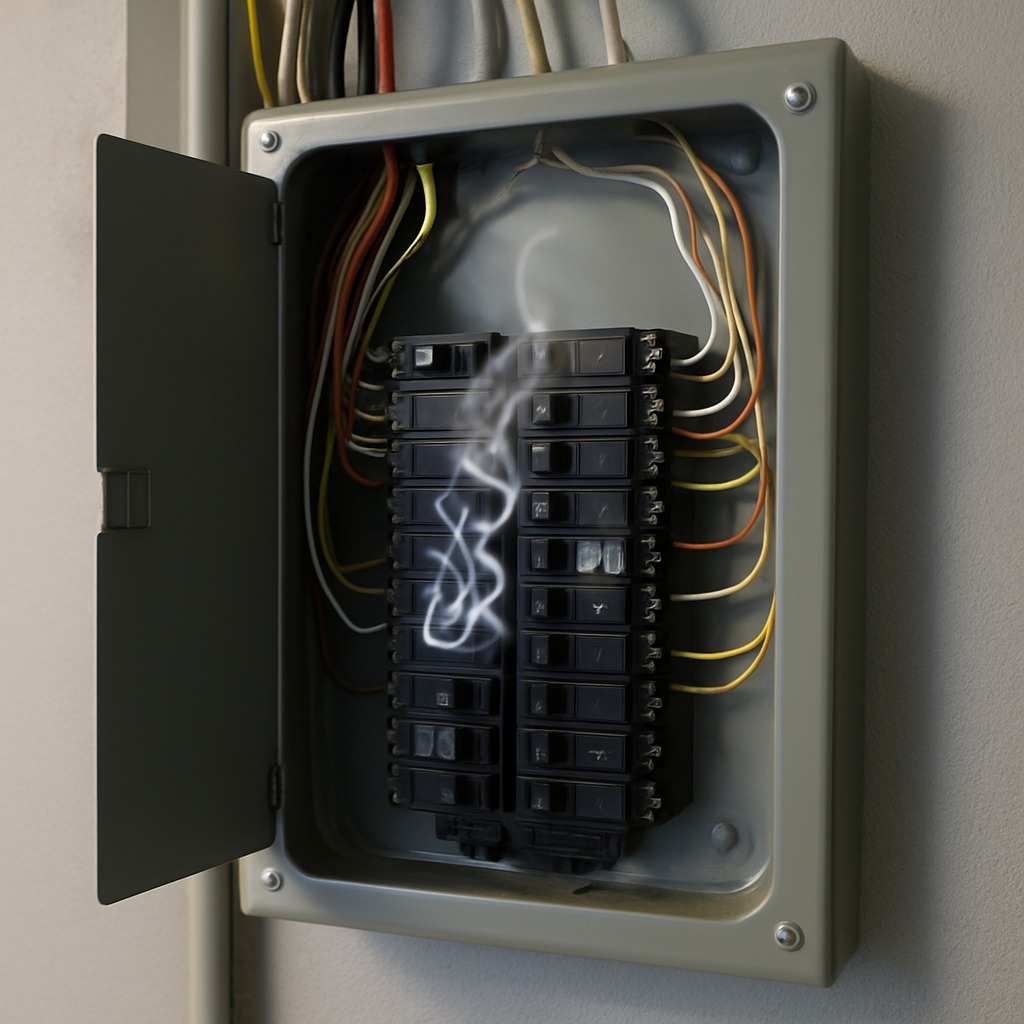
A buzzing or humming panel can indicate arcing or a failing breaker, which poses a fire risk within days to weeks if left unaddressed.
🔧 DIY Key Takeaways
- Identify the noise type — a faint 60Hz hum is normal transformer vibration, but loud buzzing, crackling, or sizzling signals an immediate hazard costing $0 to diagnose yourself
- Tighten the panel cover screws with a standard screwdriver to eliminate resonance-based rattling, a free 2-minute fix that resolves roughly 10% of noise complaints
- Use a $15–$30 non-contact voltage tester (like a Klein NCVT-1) near each breaker to check for unusual readings before calling a pro, potentially saving $150+ on a diagnostic visit
👷 Hire a Pro Key Takeaways
- A single failing breaker replacement runs $150–$350 installed, but if an electrician finds evidence of arcing or melted bus bar contacts, a full panel replacement ($1,800–$4,500) becomes unavoidable
- Loose bus bar connections are the #1 cause of dangerous buzzing — retorquing lugs to manufacturer specs requires a licensed electrician and typically costs $200–$500, but prevents a $15,000–$50,000 house fire
- If your panel is a Federal Pacific Stab-Lok, Zinsco, or Challenger model and making noise, insurers may deny future claims — full replacement plus permit and inspection runs $2,200–$4,500 in most markets
📋 In This Guide
HomeFixx guides are researched and fact-checked by licensed trade professionals. Cost data updated June 12, 2026.
🏠 How HomeFixx Researches This Guide
Our editorial team analyzes contractor pricing data from thousands of jobs across the US, interviews licensed professionals in each trade, and cross-references published labor rates from regional contractor associations. Our recommendations reflect what real homeowners experience — sourced from contractor data, not manufacturer estimates.
You're standing in the garage or basement and you hear it — a persistent buzzing, humming, or crackling coming from your electrical panel. Maybe it's been going on for weeks and you've been ignoring it. Maybe it just started after a storm. Either way, that noise is your home's electrical system trying to tell you something, and the answer ranges from a harmless $0 non-issue to a $4,500 panel replacement that's preventing a house fire.
Electrical panel noises are one of the most anxiety-inducing issues homeowners face because the stakes are genuinely high. According to the National Fire Protection Association, electrical failures cause over 46,000 home fires annually, and a significant percentage originate at the panel. But not every noise is a crisis — and understanding the difference can save you from a $150 panic call to an emergency electrician on a Saturday night.
This guide breaks down every type of panel noise by urgency level, walks you through safe DIY diagnosis steps, tells you exactly when to call a licensed electrician, and gives you contractor-verified cost data so you know what to expect before anyone hands you an invoice. We consulted master electricians with 15–25 years of field experience to build this — let's get into it.
Symptoms: What You're Seeing
- Buzzing or humming from the panel: A persistent, low-frequency hum or buzzing sound emanating from behind the panel cover, often most noticeable in a quiet house at night. The sound may be steady or fluctuate when large appliances like HVAC units, dryers, or ovens cycle on and off. A faint 60-Hz hum from a transformer is normal, but anything louder than a whisper from three feet away warrants investigation.
- Clicking or popping sounds: Audible clicking, snapping, or popping noises coming from inside the breaker panel, sometimes rhythmic and sometimes irregular. This often indicates a breaker that is tripping and attempting to reset, or an arc forming at a loose connection. You may notice lights dimming or flickering in sync with each click, which points to intermittent contact somewhere in the circuit.
- Crackling or sizzling noise: A sharp crackling, frying, or sizzling sound that resembles bacon in a hot pan. This is one of the most dangerous symptoms because it usually means an active electrical arc is occurring between a conductor and a terminal, bus bar, or neutral connection. You may also detect a faint acrid or metallic smell near the panel, indicating insulation or metal is being heated beyond safe limits.
- Scorched or burnt smell near the panel: A distinct odor of burning plastic, melting insulation, or overheated metal detectable within a few feet of the electrical panel. The smell may come and go depending on load conditions. On visual inspection you might see discoloration, brown or black marks around a breaker slot, or melted plastic on the panel cover or wire insulation inside the box.
- Vibrating panel cover or enclosure: The metal cover plate or the entire panel box physically vibrates or rattles when you place your hand on it. This can be caused by loose mounting hardware, a failing main breaker, or a loose neutral bus bar connection. The vibration often intensifies when heavy-draw circuits like an electric range, hot water heater, or central air conditioner are running at full load.
What's Actually Causing This
- Loose wire connections or terminal lugs: Over time, the thermal expansion and contraction cycles that occur every time a circuit heats up under load and cools down when idle can loosen the set screws and lugs that hold conductors to breakers and bus bars. The National Electrical Manufacturers Association (NEMA) estimates that loose connections are responsible for a significant percentage of residential electrical fires. When a wire is not firmly seated, current must arc across a tiny air gap, generating heat, noise, and progressive damage to the terminal. This is the single most common cause electricians find when diagnosing a noisy panel — roughly 40–50 percent of service calls for panel noise trace back to a loose connection on either the branch circuit breaker terminal, the neutral bus, or the main lugs.
- Overloaded circuit breaker: A breaker rated for 15 or 20 amps that is consistently carrying loads at or above 80 percent of its rating — the continuous-load threshold defined by NEC 210.20 — will generate excess heat. The bimetallic strip inside the breaker begins to flex under sustained thermal stress, producing a buzzing or humming sound. Electricians see this most often on kitchen small-appliance circuits or home-office circuits loaded with computers, monitors, printers, and space heaters. Roughly 20–25 percent of noisy-panel calls involve at least one overloaded breaker. Left unaddressed, the breaker's internal components fatigue, and it may fail to trip during a genuine overload, creating a fire risk.
- Failing or defective circuit breaker: Breakers have a finite mechanical life — most residential breakers are rated for roughly 6,000–10,000 operations. After years of tripping and resetting, internal springs weaken, contact surfaces pit and corrode, and the breaker can no longer make solid contact with the bus bar stab. This creates an intermittent connection that buzzes, clicks, or arcs. Certain breaker brands, including Federal Pacific Stab-Lok and Zinsco/Sylvania panels manufactured from the 1950s through the 1980s, have well-documented failure rates. A single failed breaker is typically a $150–$350 repair including parts and labor, but a panel full of defective breakers usually justifies a full panel replacement at $1,800–$4,000.
- Magnetostriction in the main breaker or transformer: The laminated steel cores inside the panel's main breaker or any nearby transformer — such as a doorbell transformer mounted on the panel knockout — undergo a physical phenomenon called magnetostriction, where the metal expands and contracts at 60 Hz as alternating current passes through. This produces a low hum. While a barely audible hum is considered normal, a hum that grows noticeably louder over time suggests the laminations are separating, the core is saturating due to harmonic distortion from LED drivers or VFDs, or the mounting hardware has loosened. Harmonic distortion from modern electronics has made this cause more common over the past decade.
After 20 years in residential electrical, I can tell you the most overlooked cause of panel noise is thermal cycling on aluminum feeder wires. Aluminum expands and contracts more than copper, and over hundreds of heating-cooling cycles, the main lugs lose torque. A competent electrician will use a calibrated torque wrench — not just 'snug it down' — to hit the manufacturer's spec, usually 25–35 ft-lbs on a 200-amp main. This $200–$400 service call every 5–7 years prevents the kind of arcing that causes the $3,000+ bus bar damage I see at least twice a month. Ask your electrician to apply anti-oxidant compound on aluminum terminations while they're in there — a $12 tube of Noalox that buys you another decade of safe connections.
Step-by-Step Diagnosis
Work through these steps before calling a contractor. Each step tells you what to look for and what it means.
Turn off non-essential loads and listen
🔧 Clamp meter (e.g., Klein CL800)Before touching anything inside the panel, start by narrowing down the source. Go to each room and turn off or unplug high-draw appliances: HVAC system, electric dryer, oven, space heaters, and window AC units. Return to the panel after each step and listen. If the noise stops when a specific appliance is disconnected, you have likely identified an overloaded circuit. Use a clamp meter on the feed wire of the suspect circuit to confirm amperage — anything above 80 percent of the breaker's rating (e.g., above 16 amps on a 20-amp breaker) confirms overloading. Write down which circuit the appliance is on by reading the panel schedule. This diagnostic step costs nothing and takes 15–20 minutes. Success looks like isolating the noise to a specific breaker slot or eliminating load-related causes entirely.
Visually inspect panel exterior for damage
🔧 Non-contact voltage tester (e.g., Fluke 1AC II)With the panel door closed, examine the exterior of the enclosure. Look for rust, corrosion, scorch marks, melted plastic, or any sign of heat damage on or around the panel cover. Place the back of your hand near — but not touching — the panel cover and each breaker handle to feel for unusual warmth. A breaker that is noticeably hot to the touch through the cover is a red flag. Check the panel label to identify the manufacturer and model. If you see the names Federal Pacific, Zinsco, Sylvania, Pushmatic, or Challenger, note this — these brands have documented safety concerns and any noise from these panels should prompt an immediate call to a licensed electrician. Use a non-contact voltage tester (NCVT) near the seams of the panel cover to verify the enclosure is not energized, which would indicate a ground fault. This step takes 5–10 minutes.
Remove panel cover with power on carefully
🔧 Insulated screwdriver, Class 00 electrical gloves, rubber matThis step carries real risk. If you are not comfortable working near live 120/240-volt bus bars, stop here and call a licensed electrician. If you proceed: stand on a dry rubber mat, wear safety glasses and electrical-rated gloves (Class 00 minimum, rated to 500V), and remove the four to six panel cover screws with an insulated screwdriver. Carefully lift the cover straight off without tilting it into the bus bars. Set it aside. You are now looking at the breakers, bus bars, neutral bar, ground bar, and incoming service conductors. Do NOT touch any wires, lugs, or bus bars. Visually scan for discolored wires, melted insulation, green corrosion on copper, white oxidation on aluminum, black arc marks on the bus bar stabs, or any breaker that appears misaligned or not fully seated on the bus bar. Note the location of anything abnormal. Take a photo for reference before replacing the cover.
Use infrared thermometer to check hot spots
🔧 Infrared thermometer (e.g., Fluke 62 MAX) or thermal imaging cameraWith the panel cover removed and all circuits under their normal load, use an infrared (IR) thermometer or thermal imaging camera to scan each breaker, each lug, and the neutral and ground bus bars. Normal operating temperature for a residential breaker is 85–105°F (30–40°C) depending on load. Any breaker or connection reading above 130°F (55°C) indicates a problem — usually a loose connection or an overloaded circuit. A reading above 175°F (80°C) is an emergency that requires immediate de-energization of that circuit and a call to an electrician. Document each reading by breaker number. This data is extremely valuable for the electrician because it pinpoints the exact failure point, which can reduce diagnostic labor time by 30–60 minutes and save you $75–$150 on the service call.
Re-secure panel cover and document findings
After your visual and thermal inspection, carefully replace the panel cover. Align the screw holes, re-insert all screws, and snug them finger-tight plus a quarter turn — do not overtighten, as this can strip the threads in the panel box. Close the panel door. Write a summary of everything you found: which breakers appeared discolored, which connections were hot, which circuits silenced the noise when de-energized, and the panel manufacturer and model number. If you identified any hot spots above 130°F, any scorch marks, any smell of burning insulation, or any brand on the known-defective list, your next step is to call a licensed electrician. Share your notes and photos to expedite the diagnosis. If the noise was purely load-related and you reduced the load below 80 percent of the breaker rating, monitor the situation for 48 hours to confirm the noise has stopped.
When to Stop DIY and Call a Pro
Call a licensed electrician immediately if you hear crackling, sizzling, or popping from the panel — these sounds indicate active arcing, which can ignite surrounding materials within minutes. Stop all DIY work and call a professional if you detect a burning smell, see scorch marks or melted plastic on any breaker or wire, observe sparks inside the panel, or measure any connection temperature above 130°F with an IR thermometer. If your panel is a Federal Pacific Stab-Lok, Zinsco, Sylvania, Pushmatic, or Challenger brand, do not attempt any DIY work; these panels have documented failure rates as high as 25–60 percent in independent testing and should be evaluated by a licensed electrician regardless of symptoms. From a financial standpoint, a single breaker replacement costs $150–$350, while a full panel upgrade runs $1,800–$4,000. If you have three or more failing breakers, a panel replacement is almost always more cost-effective than individual repairs. Attempting to tighten live lugs yourself risks electrocution — residential panels carry 100–200 amps at 240 volts, enough to be fatal. The labor savings of DIY on internal panel work rarely justify the safety risk.
What Does This Repair Cost?
Costs vary by region, home age, and severity. These are national averages — always get 3 quotes.
| Repair Type | DIY Cost | Pro Cost | Emergency Premium |
|---|---|---|---|
| Single breaker replacement | $8–$30 | $150–$350 | $250–$500 |
| Lug retorquing & connection tightening | Not recommended | $200–$500 | $350–$700 |
| Bus bar repair or partial panel rebuild | Not recommended | $600–$1,500 | $900–$2,200 |
| Full panel replacement (200A) | Not recommended | $1,800–$4,500 | $2,800–$5,500 |
| Emergency diagnostic call (after hours) | N/A | $150–$300 | $250–$450 |
*Emergency rates (nights/weekends/holidays) run 40–60% above standard. Get 3 quotes before approving work.
Get quotes from licensed professionals in your area
Free, no obligation — compare 3+ contractors in minutesWhat Drives the Cost?
| Cost Factor | Estimated Impact | Why It Matters |
|---|---|---|
| Panel brand & age | Adds $500–$2,000 | Obsolete panels (Federal Pacific, Zinsco) require full replacement with modern equipment — no repair option exists |
| Permit & inspection requirements | Adds $75–$400 | Most jurisdictions require a permit for panel replacements; skipping it can void insurance and complicate home sales |
| Service upgrade (100A to 200A) | Adds $800–$2,500 | If your panel is undersized and noisy under load, upgrading amperage during replacement avoids paying for two separate jobs |
| After-hours or weekend service | Adds $100–$250 | Emergency electricians charge 1.5x–2x standard rates; if the noise is a steady hum with no burning smell, scheduling a weekday visit saves real money |
Here's something This Old House won't tell you: the noise itself is your diagnostic tool. A steady 60Hz hum that never changes is almost always benign transformer magnetostriction in the main breaker — cosmetic, not dangerous. But a buzzing that gets louder when you turn on your dryer or AC means a breaker is struggling under load and its internal contacts are pitting. That breaker has maybe 30–90 days before it either welds shut (won't trip during a fault) or fails open and kills that circuit permanently. Record the sound on your phone and note which appliance triggers it — this saves your electrician 30–45 minutes of diagnostic time, which at $85–$150/hour translates to $50–$110 off your bill. In humid climates like the Southeast, also check for green corrosion on the neutral bus — moisture intrusion into the panel is a separate $400–$800 fix that amplifies noise issues.
⚠️ Stop DIY — Call a Pro If You See These
- Crackling or sizzling sound that persists under load — Active electrical arcing can reach temperatures above 10,000°F at the arc point, capable of igniting wood framing or insulation within the wall cavity in as little as a few minutes. Ignoring this symptom risks a structure fire; emergency electrician callout runs $250–$500, but fire damage averages $50,000–$80,000 per NFPA data.
- Burning plastic or metallic smell from the panel area — This means wire insulation or breaker components are actively melting. Damaged insulation exposes bare copper or aluminum conductors, which increases the risk of short circuits and ground faults. If left for days to weeks, the damage compounds and can require a full panel replacement ($1,800–$4,000) rather than a single breaker swap ($150–$350).
- Breaker that trips repeatedly and will not stay reset — A breaker that trips more than twice in an hour is either protecting an overloaded or short-circuited wire, or the breaker itself has failed internally. Forcing it to stay on — such as by holding the handle or using tape — bypasses the overcurrent protection entirely and can cause wire insulation to melt and ignite within the wall. Replace the breaker or identify the fault within 24 hours.
- Visible discoloration, melting, or heat damage on a breaker face — Brown, black, or blistered plastic on a breaker indicates sustained temperatures above 300°F — well beyond the 167°F (75°C) rating of most residential wire terminations. The internal trip mechanism is likely compromised, meaning the breaker may no longer trip during an actual overload. This is a time-critical failure; have an electrician replace the breaker within 24–48 hours to restore overcurrent protection.
Frequently Asked Questions
How much does it cost to fix Electrical Panel Making Noise?
The national average cost to diagnose and repair a noisy electrical panel ranges from $150 to $400 for a straightforward fix like tightening a loose connection or replacing a single defective breaker. On the low end, a service call with minimal parts runs $150–$200. On the high end, if the noise reveals multiple failing breakers or a compromised bus bar, repairs can run $500–$1,200. If a full panel replacement is needed — common with obsolete brands like Federal Pacific or Zinsco — expect $1,800–$4,000 depending on your region, panel amperage (100A vs. 200A), and permit requirements. Two factors that move the price significantly: the age and brand of your existing panel, and whether the utility company needs to disconnect and reconnect the service (which can add $200–$500 in coordination fees).
Can I fix Electrical Panel Making Noise myself?
You can safely perform diagnostic steps from outside the panel: identifying which circuits correlate with the noise, turning off overloaded circuits, and using an IR thermometer through the panel cover. However, any work that involves touching wires, lugs, breakers, or bus bars inside the panel should be done by a licensed electrician. Residential panels carry 100–200 amps at 240 volts — contact with an energized bus bar can cause fatal electrocution. Most jurisdictions require an electrical permit for panel work, and DIY repairs on panels can void your homeowners insurance if a fire results. The only safe DIY fix is redistributing loads across circuits to resolve a simple overload condition.
How urgent is Electrical Panel Making Noise?
It depends on the type of noise. A faint, steady 60-Hz hum — the same tone as a transformer — is normal and not urgent. A buzzing that appears only when heavy loads are running suggests an overloaded circuit; you have days to weeks to address it by redistributing loads or having the circuit upgraded. Clicking or popping noises warrant attention within 24–48 hours, as they suggest intermittent connections. Crackling, sizzling, or any noise accompanied by a burning smell is an emergency — de-energize the panel immediately if safe and call an electrician the same day. Waiting on crackling noise can lead to an electrical fire within hours to days, as arc temperatures exceed 10,000°F.
What causes Electrical Panel Making Noise?
The three most common causes are loose wire connections, overloaded breakers, and failing breakers. Loose connections account for roughly 40–50 percent of noisy-panel service calls; the set screw or lug holding a wire to a breaker or bus bar backs out over time due to thermal cycling, creating a small air gap where current arcs and buzzes. Overloaded breakers — those running above 80 percent of their amp rating continuously — generate heat and audible humming from the bimetallic strip flexing inside. Failing breakers with worn contacts or weakened springs produce clicking and popping as they lose and regain contact with the bus bar stab. Less commonly, magnetostriction in the main breaker or harmonic distortion from modern electronics can amplify the normal 60-Hz hum.
Will homeowners insurance cover Electrical Panel Making Noise?
Standard homeowners insurance (HO-3 policies) covers sudden and accidental damage — for example, if a failed breaker causes a fire or power surge that damages appliances, the resulting damage is typically covered after your deductible. However, insurance does not cover maintenance, wear and tear, or the cost of upgrading an outdated panel. If the noise is caused by a known-defective panel brand like Federal Pacific, some insurers may deny coverage entirely or require you to replace the panel as a condition of continued coverage. If you file a claim for fire damage and the adjuster determines the cause was a loose connection you knew about and ignored, coverage can be denied for negligence. Document any professional inspections and repairs to protect your claim eligibility.
How do I find a licensed electrician for this?
Follow this four-step process. First, verify the electrician holds a valid state or local license — check your state's contractor licensing board website by entering their license number. Second, confirm they carry both general liability insurance (minimum $1 million) and workers' compensation coverage; ask for a certificate of insurance. Third, get a written quote that itemizes the diagnostic fee, parts, and labor separately — a reputable electrician will charge $75–$150 for a diagnostic visit and apply it toward the repair. Fourth, check references and reviews: look for at least 10 reviews on Google or verified platforms, and ask for two recent references for panel work specifically. Avoid any electrician who diagnoses over the phone, quotes a flat price without seeing the panel, or pressures you into an immediate full panel replacement without explaining the findings.
When your electrical panel makes noise, three decisions matter most. First, identify what type of sound you are hearing — a faint hum is normal, buzzing under load suggests an overloaded circuit, and crackling or sizzling means active arcing that demands immediate action. Second, decide whether the fix is within your safe capability: load redistribution is DIY-appropriate, but anything inside the panel cover is electrician territory. Third, evaluate whether you need a single breaker replacement ($150–$350) or a full panel upgrade ($1,800–$4,000), especially if your panel is an obsolete brand with documented failure rates.
Your recommended next step: turn off non-essential loads, listen to isolate the noise, and visually inspect the panel exterior for scorch marks, melted plastic, or unusual warmth. If you find any of those, or if the noise is a crackling or sizzling sound, call a licensed electrician today — not next week. Share the notes and photos from your inspection to help the electrician diagnose faster and save you money on labor. A noisy panel is your electrical system telling you something is wrong; the cost of listening now is always less than the cost of ignoring it.
Ready to Solve This for Good?
Get matched with pre-screened, licensed electricians in your area. Free quotes, no obligation, no spam.
GET FREE QUOTES NOW