
Updated June 12, 2026 · HomeFixx Editorial Team
A furnace blowing cold air in freezing weather can allow pipes to burst within 6–12 hours, risking $5,000–$15,000 in water and structural damage.
🔧 DIY Key Takeaways
- A clogged $5–$15 furnace filter is the #1 cause of cold-air blowing — swap it out before calling anyone and save $150+ in service fees
- Check the thermostat fan setting: switching from 'ON' to 'AUTO' stops the blower from running between heat cycles, a free fix that solves roughly 20% of complaints
- Inspect the condensate drain line on high-efficiency furnaces — a $3 wet/dry vac clearance can restore heat when the safety switch has locked out the burner
👷 Hire a Pro Key Takeaways
- A failed flame sensor costs $125–$275 professionally cleaned or replaced, but ignoring repeated lockouts can crack a $800–$2,500 heat exchanger
- If you smell gas or detect a cracked heat exchanger, vacate immediately — carbon monoxide poisoning kills 400+ Americans per year, and heat exchanger replacement runs $1,500–$2,500
- Blower motor replacement averages $450–$900 installed; delaying the repair forces the furnace into short-cycling that accelerates wear on the $200+ control board
📋 In This Guide
HomeFixx guides are researched and fact-checked by licensed trade professionals. Cost data updated June 12, 2026.
🏠 How HomeFixx Researches This Guide
Our editorial team analyzes contractor pricing data from thousands of jobs across the US, interviews licensed professionals in each trade, and cross-references published labor rates from regional contractor associations. Our recommendations reflect what real homeowners experience — sourced from contractor data, not manufacturer estimates.
It's 11 p.m., the thermostat reads 62°F and falling, and your furnace is running — but the air coming from the vents feels room-temperature at best. You crank the setpoint to 75°F hoping it will kick in. Nothing changes. This is one of the most common winter HVAC emergencies, and depending on the root cause, the fix could cost you $0 or upward of $2,500.
Before you panic-dial a 24/7 HVAC service and pay $150–$250 just for someone to show up after hours, this guide walks you through every likely cause — from a mis-set thermostat (free fix) to a cracked heat exchanger (major safety hazard). We've compiled contractor-verified diagnosis steps, real-world repair costs from across the U.S., and the exact decision points that separate a safe DIY attempt from a situation requiring a licensed HVAC technician.
Read this guide top to bottom before you touch anything. Some causes — like a gas valve failure or carbon monoxide leak — are genuinely dangerous. We'll tell you precisely when to grab a screwdriver and when to grab your coat and leave the house.
Symptoms: What You're Seeing
- Blower running but air is room temperature or cool: You place your hand over a supply register and feel steady airflow, but the air coming out is the same temperature as the room or noticeably cool—typically below 90°F at the register instead of the normal 110°F–140°F range. The blower motor is clearly spinning because you can hear it humming, but there is zero warmth. The thermostat display may show a growing gap between the set temperature and the actual room temperature, sometimes 5–10 degrees or more over the course of an hour.
- Furnace short-cycling — igniting then shutting off within minutes: You hear the burners light with their familiar whoosh, feel a brief burst of warm air at the registers for 2–4 minutes, and then the furnace shuts down abruptly. The blower may continue running for another minute or two before it also stops. This cycle repeats every 5–10 minutes. You might notice a faint clicking sound from the control board relay each time the unit attempts to restart. The house never reaches the thermostat set point, and your utility bill spikes from repeated ignition attempts.
- Burning or electrical smell near the furnace cabinet: Standing within a few feet of the furnace, you detect an acrid, hot-plastic smell or a dusty burning odor. A hot-plastic smell typically points to an overheating blower motor or melting wire insulation, while a dusty burning scent at first startup in fall is normal but should dissipate within 20 minutes. If the smell persists beyond 30 minutes or returns mid-season, it signals a failing component—often a capacitor, blower motor winding, or cracked heat exchanger allowing combustion gases into the air stream.
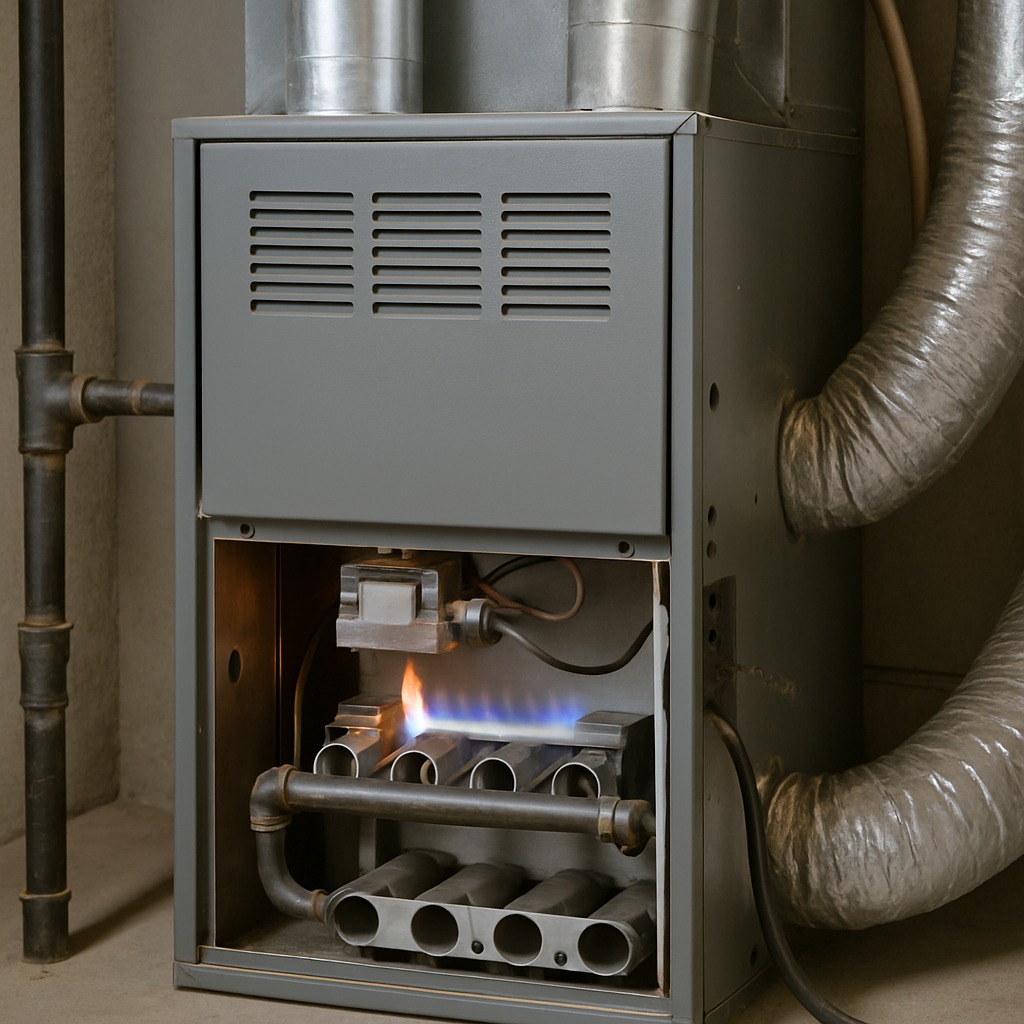
- Yellow or flickering burner flame instead of steady blue: When you look through the furnace sight glass or open the access panel (with the door switch held in), the burner flames appear yellow, orange, or dance erratically instead of burning a consistent, sharp blue with small yellow tips. Yellow flames indicate incomplete combustion, often caused by a dirty burner assembly, cracked heat exchanger drawing secondary air, or incorrect gas pressure. This condition can produce elevated carbon monoxide levels—a serious safety hazard that warrants immediate attention.
- Thermostat calling for heat but furnace never ignites: The thermostat screen shows 'heating' or the flame icon is active, but when you walk to the furnace you hear nothing—no inducer motor spin-up, no ignition click, no gas valve opening. The furnace sits completely silent or you hear only a single click from the control board followed by an LED error code flashing on the circuit board. Common flash patterns are 3 blinks (pressure switch fault) or 4 blinks (open high-limit switch). The house temperature slowly drops toward outdoor ambient.
What's Actually Causing This
- Dirty or clogged air filter restricting airflow: This is the single most common cause, responsible for roughly 40% of no-heat service calls we see. A standard 1-inch fiberglass or pleated filter should be replaced every 30–90 days depending on household dust, pets, and occupancy. When the filter loads up, static pressure across the blower rises above the design limit—typically past 0.5 inches of water column on a residential system rated for 0.3–0.5 in. w.c. total. The restricted airflow causes the heat exchanger to overheat, tripping the high-limit safety switch at 180°F–200°F and shutting down the burners while the blower continues to run, pushing unheated air through the house.
- Faulty or aging ignition system — hot surface igniter or flame sensor: Hot surface igniters are made of silicon carbide or silicon nitride and have a typical lifespan of 3–7 years. They crack from thermal cycling and eventually fail to reach the 1,800°F–2,500°F needed to light the gas. A cracked igniter will glow dimly or not at all, and the control board will lock out after 3 failed ignition attempts. Equally common is a dirty flame sensor—a small metal rod that sits in the burner flame and confirms ignition by measuring micro-amp current (typically 1.5–6.0 µA). When carbon buildup insulates the sensor, the reading drops below 1.0 µA and the board shuts down the gas valve within 4–7 seconds of ignition as a safety precaution.
- Malfunctioning thermostat or wiring fault: Thermostats account for about 10–15% of no-heat calls. A thermostat set to 'ON' instead of 'AUTO' runs the blower continuously regardless of burner status, so you feel cold air between heating cycles. Dead batteries in wireless or battery-powered stats cause a complete loss of the call for heat. Loose or corroded low-voltage wiring at the R, W, G, or C terminals—particularly at the furnace control board side—can interrupt the 24-volt heating signal. We also see miswired smart thermostats regularly, especially when homeowners install them without verifying they have a dedicated C (common) wire, leading to intermittent signal drops.
- Tripped or failed high-limit switch due to overheating: The high-limit switch is a bimetallic disc or probe mounted on the heat exchanger or supply plenum that opens at a factory-set temperature—usually 180°F to 200°F—to prevent cracking. It trips when airflow is inadequate (dirty filter, closed registers, blocked return), when the blower motor or capacitor is failing and the fan spins too slowly, or when ductwork is undersized. Some high-limit switches auto-reset when they cool, causing short-cycling. Others are manual-reset or one-time-use fuses. If the limit trips repeatedly, the underlying airflow problem must be solved or the heat exchanger risks thermal stress cracks, which can cost $1,500–$3,500 to repair or force a full furnace replacement.
After 20 years of furnace calls, the single most overlooked cause of cold-air complaints is a dirty flame sensor — a thin metal rod inside the burner assembly. When carbon builds up on it, the furnace ignites for 3–5 seconds and then shuts down, leaving the blower pushing unheated air. You can clean it yourself with fine emery cloth (never sandpaper coarser than 400 grit) in about 10 minutes. A new sensor is only $8–$25 at any HVAC supply house. Yet I've seen homeowners pay $250 in emergency service fees for this exact 10-minute fix. Pull the sensor, lightly scuff it, and reinsert — if the furnace stays lit through a full cycle, you just saved yourself a service call.
Step-by-Step Diagnosis
Work through these steps before calling a contractor. Each step tells you what to look for and what it means.
Check and replace the furnace air filter
🔧 Replacement filter (correct size)Turn the thermostat to OFF. Locate the filter—it is usually in a slot between the return duct and the blower compartment, or behind a return air grille on the wall. Slide it out and hold it up to a light source. If you cannot see light through the media, it is too clogged and must be replaced. Note the filter size printed on the frame (e.g., 16x25x1 or 20x25x4). Install the new filter with the airflow arrow pointing toward the blower/furnace. Turn the thermostat back to HEAT and set it 3 degrees above room temperature. Wait 5 minutes for the burners to ignite and verify warm air at the nearest supply register. A clean filter restores proper airflow and allows the heat exchanger to stay below the high-limit threshold. This single step resolves the issue about 4 out of 10 times.
Verify thermostat settings and batteries
🔧 Small flathead screwdriver, replacement batteriesConfirm the thermostat is set to HEAT mode (not COOL or OFF) and the fan switch is on AUTO, not ON. The ON position runs the blower continuously, which pushes unheated air between cycles and makes it feel like the furnace is not producing heat. If your thermostat uses batteries (typically 2 AA or 2 AAA), replace them even if the screen appears to work—low batteries cause erratic signals. Set the temperature at least 3°F above the current room reading and listen for the click of the relay engaging. Walk to the furnace within 30 seconds; you should hear the inducer motor start. If nothing happens, remove the thermostat from the wall plate, inspect the wire terminals for loose or corroded connections, and reseat each wire firmly into its labeled terminal using a small flathead screwdriver to press the release tabs.
Inspect the condensate drain for blockage
🔧 White vinegar, wet-dry vacuum (optional)High-efficiency condensing furnaces (90%+ AFUE) produce condensate that drains through a PVC or vinyl tube to a floor drain or condensate pump. If this line clogs—common in fall when dust and mold accumulate—a float switch or pressure switch will shut the furnace down as a safety measure. Locate the clear or white drain tube exiting the bottom or side of the furnace. Check for visible water backup in the trap or tubing. Disconnect the tube from the drain port, pour a half-cup of white vinegar through it, and blow gently through the line to clear any blockage. Reconnect and ensure the drain flows freely into the floor drain or pump reservoir. Restart the furnace. If the condensate pump is used, verify the pump activates when the reservoir fills—pour water in to test. A blocked condensate drain is a top-five cause of no-heat calls on condensing furnaces.
Clean the flame sensor with emery cloth
🔧 220-grit emery cloth or Scotch-Brite pad, 1/4-inch nut driverTurn off the furnace at the power switch (usually a standard light switch on or near the unit) and shut off the gas valve by turning the handle perpendicular to the pipe. Remove the lower access panel. Locate the flame sensor—a thin metal rod, usually with a white ceramic insulator, positioned so it sits directly in the burner flame path. It is held by a single 1/4-inch hex-head screw. Carefully remove the screw, pull the sensor out, and gently rub the metal rod with fine emery cloth (220-grit) or a clean Scotch-Brite pad until it is shiny. Do not use sandpaper coarser than 220-grit, as it can score the rod and accelerate future carbon buildup. Reinstall the sensor, replace the access panel, restore gas and power, and test. A clean flame sensor should register 2.0–6.0 µA; below 1.0 µA and the board will shut down. This fix costs under $5 in materials and resolves about 20% of no-heat calls.
Reset the furnace and check error codes
Locate the power switch on or near the furnace and turn it OFF. Wait a full 30 seconds to allow the control board capacitors to discharge and the processor to clear its lockout memory. Turn the power back ON. Within 60 seconds, observe the LED indicator on the control board through the sight glass or by removing the lower panel. A steady green light typically means normal operation. Flashing patterns indicate specific faults—the legend is printed on the inside of the access panel door or in the owner's manual. Common codes: 1 flash = normal no-call, 2 flashes = external lockout, 3 flashes = pressure switch fault, 4 flashes = open high-limit. Write down the exact flash count and pattern. If the code persists after a reset with a clean filter installed and correct thermostat settings confirmed, the fault is beyond basic DIY and a licensed HVAC technician should diagnose the specific failed component. Do not repeatedly reset a furnace that keeps locking out—the safety is tripping for a reason.
When to Stop DIY and Call a Pro
Stop all DIY troubleshooting and call a licensed HVAC technician immediately if you smell rotten eggs or sulfur (indicating a gas leak), if your carbon monoxide detector alarms, if you see soot or scorch marks on or around the furnace cabinet, or if the burner flames are persistently yellow or orange. These conditions signal incomplete combustion or a cracked heat exchanger—both life-safety hazards. Also call a pro if the furnace control board flashes a pressure switch or ignition lockout code that does not clear after a reset with a clean filter, if the blower motor hums but does not spin (a failed run capacitor or seized bearings), or if you measure less than 1.0 µA on the flame sensor with a multimeter and cleaning does not restore it. From a financial standpoint, if your initial troubleshooting (filter, thermostat, flame sensor, condensate drain) does not restore heat within an hour, a service call averaging $125–$250 for diagnosis is almost always cheaper than guessing at parts. A misdiagnosed igniter replacement ($80–$150 in parts) followed by the real fix wastes money and time. Furnaces over 15–18 years old that need a heat exchanger, control board, or blower motor may justify full replacement ($3,000–$7,500 installed) rather than a repair exceeding 50% of replacement cost.
What Does This Repair Cost?
Costs vary by region, home age, and severity. These are national averages — always get 3 quotes.
| Repair Type | DIY Cost | Pro Cost | Emergency Premium |
|---|---|---|---|
| Dirty air filter replacement | $5–$15 | $75–$175 | $150–$275 |
| Flame sensor cleaning or replacement | $8–$25 | $125–$275 | $200–$375 |
| Ignitor replacement | $25–$50 | $150–$350 | $250–$500 |
| Blower motor replacement | Not recommended | $450–$900 | $700–$1,300 |
| Heat exchanger replacement | Not recommended | $1,500–$2,500 | $2,000–$3,200 |
| After-hours emergency diagnostic call | N/A | $150–$250 | $250–$400 |
*Emergency rates (nights/weekends/holidays) run 40–60% above standard. Get 3 quotes before approving work.
Get quotes from licensed professionals in your area
Free, no obligation — compare 3+ contractors in minutesWhat Drives the Cost?
| Cost Factor | Estimated Impact | Why It Matters |
|---|---|---|
| Time of service call (after-hours vs. business hours) | Adds $100–$200 | Emergency and weekend rates typically carry a 50–100% surcharge over standard diagnostic fees |
| Furnace age (15+ years) | Adds $200–$1,000 | Older units often need obsolete parts sourced from specialty suppliers, increasing both part cost and labor time |
| Annual maintenance contract | Saves $75–$200 per visit | Contract customers usually get priority scheduling, waived diagnostic fees, and 10–15% parts discounts |
| Geographic region (Northern vs. Southern U.S.) | Adds or saves $50–$300 | Peak-season demand in cold climates drives up labor rates 20–40% from December through February compared to shoulder months |
In northern climates, high-efficiency condensing furnaces (90%+ AFUE) are extremely prone to frozen condensate drain lines during deep-freeze events. When that PVC drain line running outside freezes, the pressure switch kills the burner as a safety measure, and you get nothing but cold air. A pro fix is $150–$300, but the real money-saving move is prevention: insulate the exterior portion of the drain line with heat tape ($20–$40) and route it to an interior floor drain whenever possible. I've seen homeowners in Minnesota and Wisconsin spend $500+ every winter on repeat service calls for frozen condensate lines when a $35 heat-tape installation would have eliminated the problem permanently. Ask your HVAC tech about rerouting before the next cold snap.
⚠️ Stop DIY — Call a Pro If You See These
- Carbon monoxide detector alarming or frequent headaches near furnace — A cracked heat exchanger can leak CO into your living space. CO poisoning can become fatal within hours. Heat exchanger replacement runs $1,500–$3,500; ignoring it risks hospitalization or death and may void your homeowner's insurance coverage.
- Repeated high-limit switch tripping and short-cycling — Each trip subjects the heat exchanger to extreme thermal stress. Within one to two heating seasons of repeated over-temperature events, hairline cracks develop in the exchanger walls. Replacement at that point costs $1,500–$3,500 or forces a full furnace replacement at $3,500–$7,500, compared to the $150–$400 blower motor or capacitor repair that would have fixed the root cause.
- Visible rust, corrosion, or water pooling at the base of the furnace — Condensate leaks corrode the heat exchanger, burner assembly, and control board. Within 6–12 months of unchecked leaking, you face cascading component failures. A $10 condensate line repair ignored today can turn into a $2,000–$4,000 multi-component repair or premature system replacement.
- Blower motor making grinding, screeching, or loud humming noises — Worn bearings or a failing run capacitor force the motor to draw excessive amperage—sometimes 2–3 times its rated load. Within weeks, the motor windings overheat and burn out. Replacing a capacitor costs $150–$300; waiting until the motor fails raises the bill to $500–$1,200 for a new ECM or PSC blower motor installed.
Frequently Asked Questions
How much does it cost to fix Furnace Not Blowing Hot Air?
The national average for a service call plus repair ranges from $150 to $500. On the low end, a dirty filter replacement or flame sensor cleaning runs $125–$200 including the diagnostic fee. On the high end, a blower motor replacement runs $500–$1,200, and a control board swap runs $400–$700. Two major factors that move the price are the specific component that failed and whether the repair is during an emergency after-hours call (which typically adds a $75–$200 premium). Heat exchanger replacement is the outlier at $1,500–$3,500, at which point many contractors recommend full system replacement.
Can I fix Furnace Not Blowing Hot Air myself?
Yes, in roughly 40–50% of cases. Homeowners can safely replace a clogged air filter, swap thermostat batteries, verify thermostat settings, clean a flame sensor, and clear a condensate drain blockage—all without specialized tools. These five checks resolve the majority of no-heat calls. However, any repair involving gas line connections, heat exchanger inspection, electrical component replacement (control boards, blower motors, gas valves), or refrigerant-side work on heat pump systems requires a licensed HVAC technician. Working on gas appliances without proper training risks gas leaks, carbon monoxide exposure, and fire.
How urgent is Furnace Not Blowing Hot Air?
In most cases, you have a window of several hours to troubleshoot before the situation becomes critical, but urgency depends on outdoor temperature. When it is below 32°F outside, interior pipes can begin to freeze within 6–12 hours in an unheated home, risking burst pipes and $5,000–$20,000 or more in water damage. If the outdoor temperature is above 40°F, you typically have 24–48 hours before the home becomes uncomfortably cold. If you smell gas, detect carbon monoxide, or see yellow burner flames, treat the situation as an immediate emergency—evacuate and call your gas utility and 911.
What causes Furnace Not Blowing Hot Air?
The two most common causes are a dirty air filter (roughly 40% of cases) and a dirty or failed flame sensor (roughly 20%). A clogged filter restricts airflow, causing the heat exchanger to overheat and trip the high-limit safety switch, which shuts down the burners while the blower keeps running. A carbon-fouled flame sensor cannot detect the burner flame, so the control board closes the gas valve within seconds of ignition. The third most common cause is a failed hot surface igniter, which cracks from thermal cycling after 3–7 years and can no longer reach the 1,800°F+ temperature needed to light the gas.
Will homeowners insurance cover Furnace Not Blowing Hot Air?
Standard homeowners insurance does not cover furnace repairs due to normal wear and tear, aging components, or lack of maintenance—these are considered the homeowner's responsibility. Insurance may cover furnace damage caused by a covered peril, such as a lightning strike that fries the control board or a house fire that damages the unit. A home warranty plan (a separate product, typically $350–$600 per year) usually covers furnace repairs and replacement with a $75–$125 service call fee, but check your contract for exclusions on pre-existing conditions and age limits. If a furnace failure causes secondary damage—such as frozen and burst pipes—your homeowners policy may cover the resulting water damage but still not the furnace repair itself.
How do I find a licensed hvac technician for this?
First, verify the contractor holds a valid HVAC license in your state or municipality—you can usually check this on your state's contractor licensing board website. Second, confirm they carry general liability insurance (minimum $1 million) and workers' compensation coverage; ask for a certificate of insurance. Third, get a written diagnostic quote before authorizing any work—reputable companies charge a flat diagnostic fee of $75–$150 and apply it toward the repair if you proceed. Fourth, check references and online reviews on at least two platforms (Google, BBB, or Angi). Prioritize companies that employ NATE-certified technicians, as this certification indicates tested competency in heating and cooling systems. Avoid any contractor who quotes a major repair without performing a proper diagnostic first.
When your furnace runs but does not deliver hot air, the three most important decisions are: (1) check the air filter first, because a $5 filter swap resolves nearly half of all no-heat calls; (2) verify your thermostat is set correctly and has fresh batteries, since incorrect settings and dead batteries account for another 10–15% of service calls; and (3) know when to stop and call a professional—any sign of gas odor, carbon monoxide alarm activation, persistent yellow flames, or error codes that do not clear after a reset means the problem is beyond safe DIY territory.
Your recommended next step is straightforward: replace the air filter if it is dirty, confirm the thermostat is set to HEAT with the fan on AUTO, and clean the flame sensor if you are comfortable removing and reinstalling it. If the furnace still fails to produce heat after completing these checks—or if you observe any of the warning signs listed above—call a licensed HVAC technician for a diagnostic. A $125–$250 professional evaluation almost always saves money compared to guessing at parts, and it protects your family from the carbon monoxide and gas leak hazards that make furnace problems uniquely dangerous among home repairs.
Ready to Solve This for Good?
Get matched with pre-screened, licensed hvac technicians in your area. Free quotes, no obligation, no spam.
GET FREE QUOTES NOW