
Updated June 13, 2026 · HomeFixx Editorial Team
A burning smell from an outlet signals arcing or melting wiring that can ignite a wall fire within minutes.
🔧 DIY Key Takeaways
- Immediately cut power at the breaker panel — a $0 action that eliminates the ignition source and buys you time until a pro arrives
- Use a non-contact voltage tester ($12–$18 at any hardware store) to confirm the circuit is truly dead before touching the outlet or cover plate
- Replacing a single discolored or melted outlet yourself costs $3–$8 for the receptacle, but ONLY if inspection confirms no wiring damage behind the plate
👷 Hire a Pro Key Takeaways
- A licensed electrician's diagnostic visit ($150–$250) includes thermal imaging to identify hidden hot spots inside walls that a visual check misses entirely
- If the burning smell is caused by aluminum-to-copper wiring contact (common in 1965–1973 homes), a whole-house remediation with COPALUM connectors runs $3,000–$8,000 — but ignoring it carries a 55x higher fire risk per CPSC data
- Failing to get a permitted repair can void your homeowner's insurance fire coverage, leaving you personally liable for $150,000+ in average fire-damage losses
📋 In This Guide
HomeFixx guides are researched and fact-checked by licensed trade professionals. Cost data updated June 13, 2026.
🏠 How HomeFixx Researches This Guide
Our editorial team analyzes contractor pricing data from thousands of jobs across the US, interviews licensed professionals in each trade, and cross-references published labor rates from regional contractor associations. Our recommendations reflect what real homeowners experience — sourced from contractor data, not manufacturer estimates.
You walk into your kitchen and catch a sharp, acrid smell — like melting plastic mixed with hot metal — radiating from the wall near an outlet. Maybe the cover plate is warm to the touch. Maybe you notice faint discoloration or a brief flicker from the lamp plugged into it. This is not a situation where you Google for 20 minutes. A burning smell from an electrical outlet means something inside that wall is overheating right now, and the window between "odd smell" and "structure fire" can be disturbingly short.
Nationally, electrical failures cause over 46,000 home fires per year, and faulty outlets and receptacles are among the top ignition sources according to the NFPA. Repairs range from a simple $3 outlet swap (if the wiring is sound) to $1,500–$2,500 for circuit rewiring when damaged conductors are found inside the wall cavity. Emergency after-hours electrician calls typically run $250–$500 for the first hour.
This guide gives you the exact triage steps to take in the next 60 seconds, explains the six most common causes ranked by severity, and breaks down every cost scenario — so you know whether you're looking at a $150 service call or a major panel-and-wiring overhaul before the electrician even arrives.
Symptoms: What You're Seeing
- Acrid burning smell near outlet: You notice a sharp, plasticky or fish-like odor within 2–3 feet of a wall outlet. It may come and go depending on what is plugged in. The smell intensifies when the circuit is under heavy load — running a space heater, hair dryer, or window AC unit. It is distinctly different from dust burning off a furnace register; this odor has a chemical, melting-insulation quality that lingers even after you unplug devices.
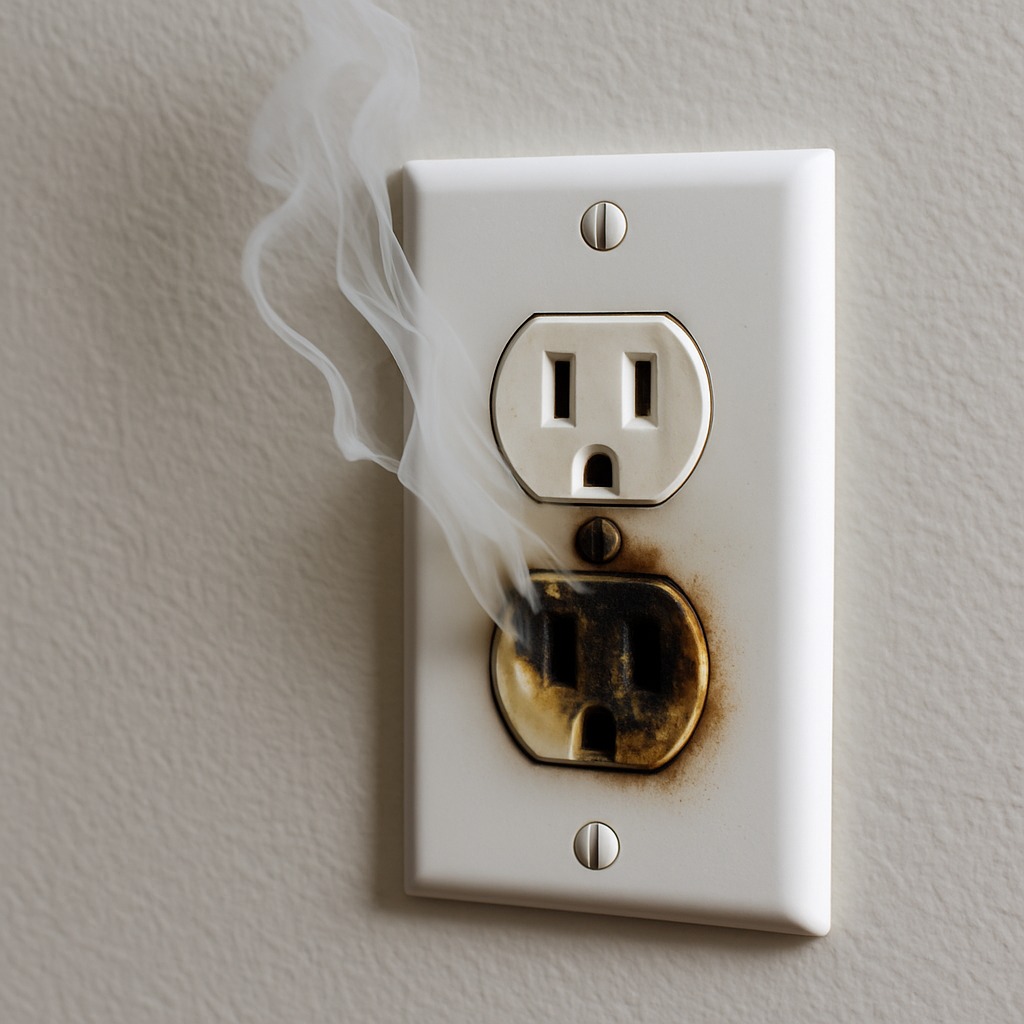
- Discolored or melted outlet faceplate: The plastic wall plate shows yellowing, browning, or visible warping around one or both plug slots. You may see a dark scorch mark radiating outward from the slot. In advanced cases, the nylon faceplate has bubbled or partially melted, and you can feel the texture change with your fingertip — the surface is rough or tacky instead of smooth. This is direct evidence that sustained heat above 300°F has been present behind the cover.
- Warm or hot outlet and wall plate: When you place the back of your hand near or on the outlet cover, you feel noticeable warmth — sometimes uncomfortably hot, over 110°F to the touch. The surrounding drywall may also feel warm in a 4–6 inch radius. A properly functioning outlet should be room temperature or only very slightly warm when powering a light load. Anything above body temperature (98.6°F) is abnormal and indicates excessive resistance or arcing in the wiring connections.
- Intermittent sparking or buzzing sound: You hear a faint crackling, sizzling, or buzzing noise coming from inside the outlet box, particularly when a plug is inserted or wiggled. The sound may be constant on a loaded circuit or occur in short bursts. Sparking visible at the plug prongs when inserting or removing a cord — beyond the tiny normal static arc — signals a loose connection or damaged contact that is generating heat. This audible arcing is a fire precursor.
- Tripping breaker or flickering lights on the circuit: The circuit breaker feeding that outlet trips repeatedly without an obvious overload, or lights on the same circuit flicker or dim when you plug something into the affected outlet. A standard 15-amp breaker trips at roughly 15–18 amps; if it trips well below that, the fault is generating enough heat to create resistance that mimics an overload. This symptom often accompanies the burning smell and confirms a wiring issue rather than a simple appliance failure.
What's Actually Causing This
- Loose wire connections at the outlet terminals: This is the number-one cause electricians find — accounting for roughly 50–60% of burning-smell outlet calls. Over time, the screw terminals or backstab (push-in) connections on the receptacle loosen due to thermal cycling. Every time the wire heats under load and cools afterward, the metal expands and contracts. After years of this cycle, a backstab connection can lose clamping force entirely. A loose connection creates high electrical resistance at that point, which converts energy into heat instead of passing it downstream. Once the connection point exceeds 200°F, it begins degrading the wire insulation and the receptacle body, producing the characteristic burning odor. Backstab connections on builder-grade 59-cent receptacles are especially prone; screw-terminal or spec-grade receptacles rated for 20 amps hold up significantly better.
- Overloaded circuit beyond rated amperage: A standard residential outlet in the U.S. is wired with 14-gauge copper on a 15-amp breaker, rated for a continuous load of 12 amps (80% of breaker rating per NEC 210.20). When homeowners daisy-chain power strips, plug in a 1,500-watt space heater (12.5 amps alone) alongside other devices, or run multiple high-draw appliances, the total draw can exceed 15 amps. The wiring and connections heat beyond their safe operating range. Even if the breaker does not trip immediately — breakers are designed to allow brief surges — the sustained overcurrent degrades insulation and receptacle contacts. Older homes with only 6–8 circuits are most vulnerable because more outlets share fewer breakers.
- Damaged or deteriorated wiring insulation: In homes built before 1975, the original thermoplastic insulation on NM (Romex) cable can become brittle and crack, especially in hot attic or exterior wall runs where ambient temperatures regularly exceed 90°F. When bare copper is exposed, it can arc to a grounded junction box, another conductor, or even a nail or staple in the stud bay. Aluminum wiring — installed in roughly 2 million U.S. homes between 1965 and 1973 — oxidizes at connections, creating resistive points that generate extreme heat. The CPSC estimates aluminum-wired homes are 55 times more likely to have fire-hazard conditions at outlets. Even modern wiring can suffer damage from rodents chewing through insulation or from nail/screw penetration during renovation work.
- Faulty or worn-out receptacle: Residential-grade receptacles are manufactured to a lifespan of roughly 15–25 years under normal use. The internal spring-metal contacts that grip the plug prongs lose tension over time, especially with frequent plug insertions and removals. Once the contacts cannot grip tightly, micro-arcing occurs every time current flows. That arcing pits and erodes the contact surfaces, increasing resistance and heat in a self-reinforcing cycle. A receptacle that has been painted over — common in rental properties — can also have paint contamination inside the slots, preventing proper contact. Replacing a worn receptacle costs $3–8 for parts; ignoring it can lead to $5,000–50,000 in fire damage.
Every electrician I've worked with over 20 years says the same thing: the most dangerous burning-outlet calls are the ones where the homeowner says 'it only smelled for a second and then stopped.' That usually means the arc flash melted through the connection completely and the wire is now sitting loose inside the box — no longer making contact but positioned millimeters from combustible wood framing. We use FLIR thermal cameras ($50 diagnostic add-on in most markets) to scan the wall cavity around the outlet. If we see a heat signature above 120°F behind the drywall, we're opening that wall up immediately. I've pulled charred framing out of walls where the homeowner had no visible damage on the surface. The $50 thermal scan has saved clients from $40,000+ fire restoration jobs.
Step-by-Step Diagnosis
Work through these steps before calling a contractor. Each step tells you what to look for and what it means.
Kill power and confirm circuit is dead
🔧 Non-contact voltage tester (Klein NCVT-2 or equivalent, about $18–25)Go to your electrical panel and switch off the breaker feeding the affected outlet. If your panel is not labeled, turn off the main breaker to de-energize the entire house — do not guess. Return to the outlet and insert a non-contact voltage tester (NCVT) probe into each slot. The tester should show no voltage; if it beeps or lights up, you have the wrong breaker or there is a second circuit feeding the box (common in older homes where two circuits share a double-gang box). Plug in a known-working lamp or phone charger to double-confirm there is no power. Safety note: more DIY electrical injuries happen from failing to verify dead circuits than any other cause. Never rely on the breaker label alone. Expect this step to take 5–10 minutes.
Remove faceplate and inspect the receptacle
🔧 Flathead and Phillips screwdriver, flashlightUnscrew the single center faceplate screw and pull the plate away from the wall. Look at the receptacle face: note any discoloration, melting, scorching, or cracked plastic. Then remove the two 6-32 mounting screws holding the receptacle to the box and gently pull the receptacle straight out. Do not yank — wires in a residential box only have about 6–8 inches of slack. Inspect all wire connections: check screw terminals for blackened or corroded wire ends, check backstab holes on the back for signs of arcing (black soot marks or melted plastic around the entry point). Look at the wire insulation within 3 inches of the receptacle — if it is melted, brittle, or crumbles when touched, the damage extends beyond the receptacle itself. Use a flashlight to look inside the box for any burned insulation or heat damage on other wires passing through. Take a photo of the wiring configuration before you disconnect anything.
Check connections with a multimeter
🔧 Digital multimeter (Klein MM400 or equivalent, about $30–40)With the breaker still off, set your digital multimeter to continuity (Ω) mode. Place one probe on the hot (brass) screw terminal and one on the narrow (hot) slot face — you should read near-zero ohms, indicating a solid connection. Repeat for the neutral (silver screw to wide slot) and the ground (green screw to ground slot or bare copper). Any reading above 1–2 ohms indicates a high-resistance connection that is generating heat. If you have backstab connections, this test is critical because you cannot visually confirm contact quality. If the wire ends look blackened, use wire strippers to cut back 1/2 inch and re-strip to fresh copper. Oxidized or heat-damaged copper appears black or dark brown instead of its normal bright salmon-pink color. This step takes about 5 minutes and tells you definitively whether the connection is the heat source.
Replace receptacle with spec-grade unit
🔧 Wire strippers, needle-nose pliers, spec-grade receptacleIf the receptacle shows any damage, or if you found backstab connections (the wires push into holes in the back rather than wrapping around screw terminals), replace it. Purchase a spec-grade (also called commercial-grade) receptacle — UL-listed, rated for 20 amps on 12-gauge wire or 15 amps on 14-gauge wire. These cost $3–8 at any hardware store versus 59 cents for builder-grade. Connect wires to the screw terminals only — never use backstab connections on a replacement. Strip 3/4 inch of insulation, form a clockwise hook with needle-nose pliers, wrap the hook around the screw terminal clockwise (so tightening the screw pulls the wire tighter), and torque each screw firmly — roughly 12 inch-pounds, which means snug-plus-a-quarter-turn with a standard screwdriver. Hot (black) wire to brass screw, neutral (white) wire to silver screw, ground (bare or green) to green screw. Fold wires accordion-style back into the box and mount the receptacle.
Restore power and verify safe operation
🔧 Non-contact voltage tester, three-light outlet tester, hair dryer (as test load)With the new receptacle mounted and the faceplate reinstalled, go back to the panel and flip the breaker on. Return to the outlet and use your non-contact voltage tester to confirm power is present in the hot slot. Plug in a load — a hair dryer on high (about 12.5 amps) is a good test appliance. Let it run for 5 full minutes, then feel the faceplate and surrounding wall area with the back of your hand. The outlet should be at or very close to room temperature. If you feel any warmth above 90°F, or if you detect any odor, kill the breaker immediately — the problem is in the wiring upstream of the receptacle and you need a licensed electrician. If the outlet remains cool, plug in a three-light outlet tester ($7–12) and verify all three lights show correct wiring (two amber lights). Monitor the outlet for the next 48 hours, checking for warmth or smell at least twice daily.
When to Stop DIY and Call a Pro
Stop all DIY work and call a licensed electrician immediately if you encounter any of these conditions: (1) the burning smell persists even after you replace the receptacle, which means the fault is in the wire run inside the wall, potentially at a splice, staple point, or junction box you cannot access without opening drywall; (2) you find aluminum wiring (silver-colored conductors instead of copper), which requires specialized COPALUM or AlumiConn connectors and techniques — improper aluminum-to-copper connections cause house fires; (3) you see charring or heat damage on more than one wire or extending into the insulation more than 2 inches from the receptacle; (4) the outlet box itself is a metal box with no ground wire and the wiring is cloth-covered (pre-1965 installation), as this indicates knob-and-tube or early Romex that may have systemic insulation failure. From a cost perspective, a licensed electrician charges $150–300 for a single outlet diagnosis and replacement, and $200–500 if wiring repair is needed in the wall. That is trivial compared to the average residential electrical fire loss of $67,400 (NFPA 2023 data) or the roughly $1.4 billion in total annual property damage from home electrical fires. If you have any doubt about your diagnosis, the $150 service call is the best money you will ever spend. Additionally, unpermitted DIY electrical work can void your homeowners insurance and create disclosure liabilities when you sell the house.
What Does This Repair Cost?
Costs vary by region, home age, and severity. These are national averages — always get 3 quotes.
| Repair Type | DIY Cost | Pro Cost | Emergency Premium |
|---|---|---|---|
| Single outlet replacement (receptacle only) | $3–$8 | $150–$250 | $250–$400 |
| Outlet + wiring repair (single circuit) | Not recommended | $250–$500 | $400–$750 |
| Circuit rewire (outlet to panel) | Not recommended | $600–$1,500 | $1,000–$2,500 |
| Emergency diagnostic call (after-hours) | N/A | $150–$300 | $250–$500 |
*Emergency rates (nights/weekends/holidays) run 40–60% above standard. Get 3 quotes before approving work.
Get quotes from licensed professionals in your area
Free, no obligation — compare 3+ contractors in minutesWhat Drives the Cost?
| Cost Factor | Estimated Impact | Why It Matters |
|---|---|---|
| Time of call (after-hours/weekend) | Adds $100–$250 | Emergency electricians charge 1.5x–2x standard rates for nights, weekends, and holidays |
| Wall opening & drywall repair | Adds $150–$400 | If the electrician must cut drywall to access burned wiring, patching and repainting add labor and materials |
| Aluminum wiring present | Adds $1,500–$5,000+ | Homes built 1965–1973 may need COPALUM or AlumiConn remediation on every connection in the circuit or house |
| Permit & inspection required | Adds $75–$200 | Many jurisdictions require a permit for any wiring modification; skipping it can void insurance and complicate resale |
Here's something most guides won't tell you: backstabbed connections — where the wire is pushed into a spring-loaded hole on the back of the outlet rather than wrapped around the screw terminal — account for roughly 70% of the burning-smell calls I respond to. The spring weakens over time, the connection loosens, and arcing begins. Builders love backstabs because they save 30 seconds per outlet during rough-in, but they're a ticking clock in any home over 15 years old. When I rewire an outlet, I always pigtail with a wire nut and use the screw terminals — it takes 3 extra minutes but creates a connection rated for the full life of the home. If your electrician quotes you for re-terminating all backstabbed outlets on a single circuit, expect $200–$350, which is cheap insurance against a house fire.
⚠️ Stop DIY — Call a Pro If You See These
- Burning smell that intensifies over minutes or returns after outlet replacement — Indicates an in-wall wiring fault — arcing or high-resistance connection behind drywall that can ignite framing lumber within 30 minutes to several hours. Average fire damage from an electrical outlet fire: $67,400 per NFPA data. Call 911 if the smell is accompanied by visible smoke.
- Visible blackening or melting extending onto the drywall around the outlet — Means sustained temperatures above 400°F have reached the wall surface. Drywall paper ignites at approximately 450°F, and wood framing behind it at 500°F. This is an active fire risk — not a next-week repair. De-energize the circuit immediately and do not restore power until a licensed electrician inspects and clears the wiring.
- Breaker will not stay on or trips within seconds of being reset — Signals a short circuit or ground fault in the wiring — a dead short draws hundreds of amps and generates extreme heat at the fault point. Each time you reset a tripping breaker, you send another surge of current through the damaged wiring, potentially worsening the fault. Repeated resetting can also damage the breaker itself ($8–15 for standard, $35–50 for AFCI), turning a $200 repair into a $500–800 panel repair.
- Multiple outlets on the same circuit show warmth or smell — Points to a systemic wiring problem — either an overloaded circuit, a failing connection at the panel, or widespread insulation degradation in the wire run. When multiple points on a circuit are affected, the repair scope typically jumps from $200–300 (single outlet fix) to $1,500–4,000 (circuit re-wire through walls), and delay increases the chance of a concealed fire starting in a wall cavity where you cannot see or smell it until it breaks through.
Frequently Asked Questions
How much does it cost to fix Outlet Burning Smell?
For a straightforward receptacle replacement with secure screw-terminal connections, expect $150–300 from a licensed electrician, including the service call, diagnosis, and parts. If the wiring inside the wall is damaged and needs to be spliced or partially re-run, costs rise to $300–600. A full circuit re-wire from panel to all outlets — necessary if the wire insulation is systemically degraded — runs $800–2,500 depending on the number of outlets and accessibility (open basement ceiling vs. finished walls requiring drywall repair). Two factors that move the price most: (1) whether the wiring is accessible from an attic or basement, and (2) whether aluminum wiring is present, which requires specialized connectors adding $30–50 per connection point across every outlet, switch, and junction in the circuit.
Can I fix Outlet Burning Smell myself?
Yes, but only if the problem is limited to the receptacle itself — a loose connection or worn-out outlet that you can see and access after removing the cover plate. If you are comfortable working with de-energized circuits, own a non-contact voltage tester, and the damage does not extend beyond the receptacle and the first 2 inches of wire, replacing the outlet is a 20–30 minute job well within the average homeowner's ability. Stop and call a pro if: you find aluminum wiring, the wiring insulation is damaged inside the wall, there are no ground wires, or the burning smell continues after replacement. In many jurisdictions, homeowners can legally perform their own electrical work but must pull a permit (typically $25–75) for anything beyond a like-for-like receptacle swap.
How urgent is Outlet Burning Smell?
This is a same-day issue — treat it as urgent. A burning smell means something is generating enough heat to decompose plastic or wire insulation, which occurs at 300°F+. Electrical fires can start in wall cavities and smolder undetected for hours before breaking through drywall. The moment you identify the smell, unplug all devices from that outlet and turn off the circuit breaker. Do not restore power until the outlet has been inspected and repaired. If you see visible smoke, discoloration on the wall, or the smell is strong and persistent, call 911 before calling an electrician. According to the NFPA, electrical distribution equipment (outlets, wiring, breakers) causes an average of 34,000 home fires per year in the United States.
What causes Outlet Burning Smell?
The two most common causes are loose wire connections and worn-out receptacles — together they account for roughly 70–80% of cases electricians encounter. A loose screw terminal or backstab connection creates electrical resistance, converting current to heat at that point. Over time, the heat melts the nylon receptacle body and chars wire insulation, producing the acrid smell. The third most common cause is circuit overloading — plugging devices that draw more than 12 amps continuous into a 15-amp circuit generates excess heat throughout the wiring and at connection points. In older homes (pre-1975), deteriorated or damaged wire insulation inside walls is also a frequent culprit, especially in hot attic runs or where rodents have chewed through the sheathing.
Will homeowners insurance cover Outlet Burning Smell?
Homeowners insurance generally covers sudden and accidental damage caused by electrical faults — if a faulty outlet causes a fire that damages your home, the repair and restoration are typically covered under your dwelling coverage (HO-3 policy). However, insurance does not cover the cost of preventive repair or maintenance — meaning the $200–500 to fix the outlet itself is your out-of-pocket expense. If an insurer determines the fire resulted from deferred maintenance or known hazardous conditions (such as documented aluminum wiring you never addressed), they may deny or reduce the claim. Unpermitted DIY electrical work can also be grounds for claim denial. Always document your repairs with photos, receipts, and permit records. Some insurers offer discounts (2–5%) for homes with AFCI-protected circuits.
How do I find a licensed electrician for this?
Follow this four-step process: (1) Verify the license — search your state or county contractor licensing board website by name or license number; every legitimate electrician can provide this on the spot. (2) Confirm insurance — ask for a certificate of general liability insurance ($1 million minimum) and workers' compensation coverage; a reputable electrician will email this within hours. (3) Get a written quote — a professional should provide a written estimate detailing scope, materials, labor rate ($75–150/hour is typical nationally), and warranty (look for at least one year on labor). (4) Check references or reviews — look for at least 20 reviews on Google or a verified platform, and ask for two recent customer references for similar work. Avoid any electrician who refuses to pull a permit when one is required, asks for full payment upfront, or cannot provide a license number immediately.
An outlet that smells like it is burning is telling you something is generating dangerous heat behind your wall plate. The three most important decisions you face are: first, whether to de-energize the circuit immediately (yes — do it now, before you do anything else); second, whether the problem is limited to the receptacle or extends into the in-wall wiring (your visual inspection and multimeter check will tell you); and third, whether to handle the repair yourself or call a licensed electrician (if the damage goes beyond the receptacle or you find aluminum wiring, call a pro without hesitation).
Your recommended next step: turn off the breaker to that outlet right now, unplug everything from it, and perform the visual inspection described above. If the receptacle shows scorch marks, melted plastic, or loose backstab connections — and the wire insulation looks intact — replace it with a spec-grade receptacle using screw terminals. Total parts cost: under $10. Total time: 30 minutes. If you see anything beyond a simple receptacle failure — damaged wiring, aluminum conductors, charring inside the box, or a smell that persists after replacement — stop work and call a licensed electrician for a same-day service call. The $150–300 diagnostic visit is negligible compared to the average $67,400 in damage from an electrical outlet fire. Do not put this off.
Ready to Solve This for Good?
Get matched with pre-screened, licensed electricians in your area. Free quotes, no obligation, no spam.
GET FREE QUOTES NOW