
Updated June 12, 2026 · HomeFixx Editorial Team
Unchecked moisture behind musty odors can trigger toxic mold colonization within 48–72 hours, leading to $3,000–$15,000 in remediation costs and serious respiratory health risks.
🔧 DIY Key Takeaways
- A $12 hygrometer from any hardware store reveals whether your basement humidity exceeds the critical 60% threshold — the exact point where mold spores begin active colonization on drywall and joists.
- Sealing visible foundation cracks with hydraulic cement ($8–$15 per tube) stops minor seepage and eliminates up to 30% of moisture sources fueling that musty odor.
- Running a 50-pint dehumidifier ($230–$350) with a gravity drain hose 24/7 can drop basement humidity below 50% in 2–3 days, halting active mold growth without calling a pro.
👷 Hire a Pro Key Takeaways
- If you detect musty smell AND see white mineral deposits (efflorescence) on foundation walls, hydrostatic pressure is forcing groundwater through concrete — an interior French drain system ($3,500–$8,500) is likely needed before structural damage escalates.
- Mold colonies larger than 10 square feet require licensed remediation ($1,500–$6,000) per EPA guidelines; DIY disturbance of large colonies can release millions of spores into your HVAC system and living spaces above.
- A waterproofing contractor should perform a full perimeter inspection ($150–$350 diagnostic fee, often credited toward work) — 40% of musty basements have exterior grading issues that no amount of interior treatment will solve.
📋 In This Guide
HomeFixx guides are researched and fact-checked by licensed trade professionals. Cost data updated June 12, 2026.
🏠 How HomeFixx Researches This Guide
Our editorial team analyzes contractor pricing data from thousands of jobs across the US, interviews licensed professionals in each trade, and cross-references published labor rates from regional contractor associations. Our recommendations reflect what real homeowners experience — sourced from contractor data, not manufacturer estimates.
You walk downstairs to grab something from storage and it hits you — that damp, earthy, unmistakable musty smell. Maybe it's been creeping upstairs into your living room. Maybe your guests have noticed. What you're smelling is microbial volatile organic compounds (MVOCs), the chemical off-gassing produced by mold and mildew actively feeding on moisture trapped in your basement. It's not just unpleasant — it's a direct warning sign that conditions in your basement are deteriorating, and every week you ignore it, the problem compounds.
The cost gap between early intervention and delayed action is staggering. A $230 dehumidifier and $15 in crack sealant can resolve the issue if caught early. Wait six months, and you could be facing $3,000–$6,000 in professional mold remediation, $3,500–$8,500 for a French drain system, and real questions about your home's resale value — musty basements are the #1 deal-killer flagged by home inspectors, reducing offers by 10–20% on average.
This guide gives you the exact diagnostic steps a licensed waterproofing contractor uses on a first visit, the specific cost thresholds where DIY stops making sense, and the repair sequences that actually eliminate the smell permanently — not just mask it with a plug-in air freshener. We verified every cost figure and technique with contractors averaging 15+ years in basement waterproofing and mold remediation.
Symptoms: What You're Seeing
- Persistent earthy or damp odor: The moment you open the basement door, a stale, earthy smell hits you — sometimes described as wet cardboard or old newspapers left in a damp garage. It intensifies after rain or during humid summer months. The odor clings to stored clothing, furniture, and boxes. It does not go away with ventilation alone and often worsens overnight when air circulation drops.
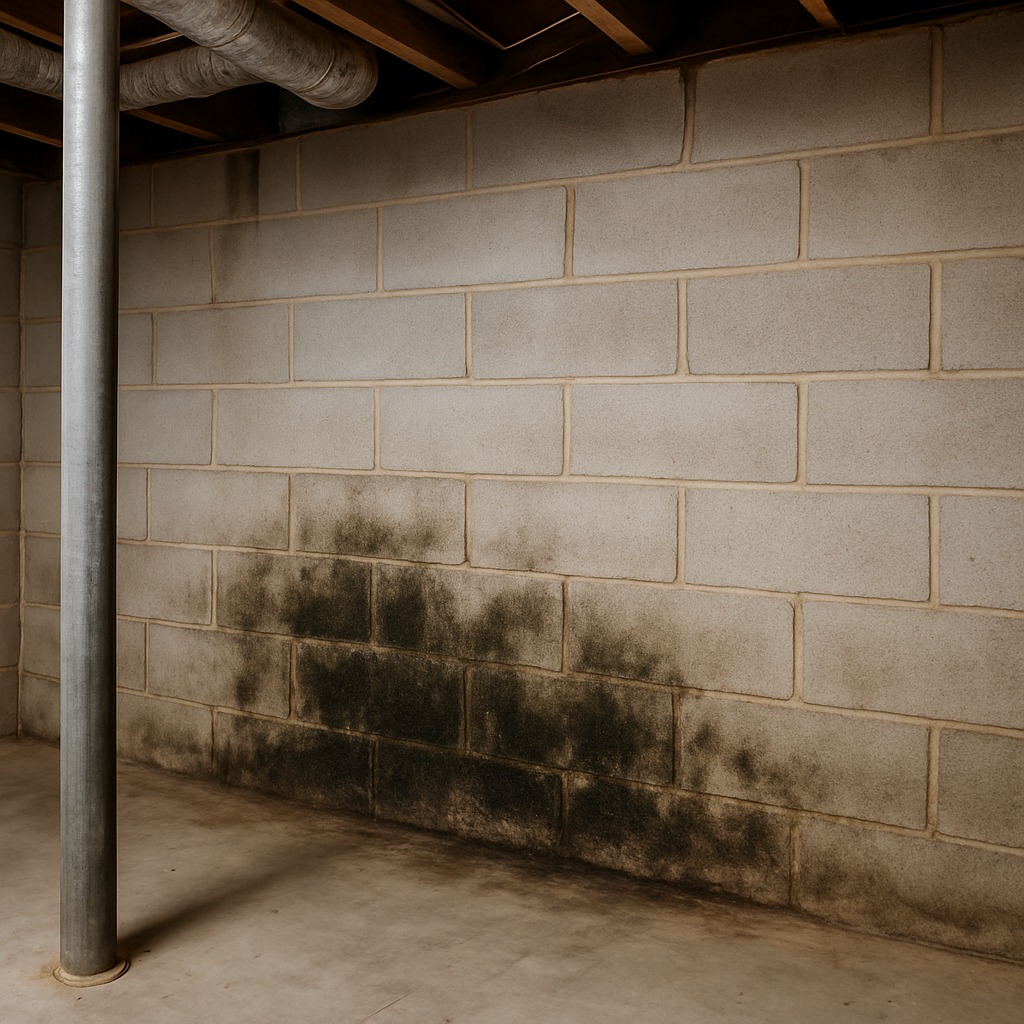
- Visible white or gray fuzzy mold patches: You spot irregular patches of white, gray, or greenish-black growth on floor joists, drywall, cardboard boxes, or the bottom edge of wood paneling. These colonies feel powdery or slightly fuzzy to the touch. They tend to cluster in corners, behind stored items, and along the wall-floor joint where humidity is highest and airflow is lowest.
- Condensation on pipes, walls, or windows: Cold-water supply pipes sweat visibly, dripping onto the slab or into joist bays. Basement windows fog on the interior side even when the outdoor temperature is above 60°F. You can feel the dampness by running your hand along the foundation wall — it may feel cool and slick. This condensation feeds mold and keeps relative humidity above the critical 60% threshold.
- Efflorescence or white mineral deposits on concrete: A chalky, crystalline white residue appears on poured-concrete or block foundation walls. When you scrape it with a putty knife, it crumbles into a fine powder. This is dissolved mineral salt carried through the concrete by moisture migration and deposited as water evaporates on the interior surface — a reliable indicator of active water intrusion through the masonry.
- Musty smell migrating to upper floors: Family members notice a stale odor drifting into the first-floor living space, especially near HVAC return vents, stairwells, or interior doors left open. The stack effect in a typical two-story home pulls roughly 50% of first-floor air from the basement. This means mold spores and volatile organic compounds generated below are redistributed throughout the house continuously.
What's Actually Causing This
- Poor or absent foundation waterproofing: In homes built before the mid-1980s, exterior foundation waterproofing was often just a single coat of asphalt damp-proofing — or nothing at all. Over 20–30 years that coating degrades, allowing bulk water and water vapor to pass through poured concrete or CMU block walls. Industry data from the American Society of Home Inspectors shows that roughly 60% of U.S. basements have some form of moisture problem. Without a continuous waterproof barrier, hydrostatic pressure pushes groundwater through cracks, cold joints, and porous concrete every time the water table rises after rain or snowmelt.
- Inadequate grading and gutter discharge: Soil around the foundation should slope away at a minimum of 6 inches of fall over the first 10 feet, per IRC Section R401.3. When grading flattens over time from landscaping, mulching, or soil settlement, surface water pools against the foundation. Downspouts that terminate at the footing or splash onto a flat patio direct hundreds of gallons per storm directly into the backfill zone. A single 1,000-square-foot roof section produces about 600 gallons of runoff from one inch of rainfall — that water has to go somewhere, and without proper grading it goes into your basement.
- High indoor relative humidity with no dehumidification: Basements are naturally cooler than upper floors, often sitting at 58–65°F year-round. When warm humid summer air enters through windows, doors, or ductwork, it meets those cool surfaces and the relative humidity spikes above 60–70%. Mold needs sustained relative humidity above 60% and an organic food source — drywall paper, wood, cardboard — to colonize. Without a properly sized dehumidifier or conditioned air supply, a 1,000-square-foot basement can generate mold within 48–72 hours of sustained elevated humidity, according to EPA guidelines.
- Clogged or failed perimeter drain tile: Interior or exterior footing drains installed during construction can clog with silt, iron ochre bacteria, or root intrusion within 15–25 years. When the drain tile fails, hydrostatic pressure builds against the footing, pushing water up through the wall-floor joint or cove joint. This is the single most common source of bulk water entry in basements with finished walls, and it is almost impossible to diagnose visually without removing a section of finished wall or running a camera scope through the drain system.
Here's something most homeowners miss: that musty smell often isn't coming from the basement floor — it's coming from the rim joist, the wood framing that sits directly on top of your foundation wall. Warm interior air hits that cold concrete-to-wood junction, condensation forms, and you get hidden mold colonies that never dry out. A 20-year waterproofing contractor will immediately inspect this area with a moisture meter. The fix is surprisingly affordable: spray-foam insulating the rim joist cavity ($1.50–$3.00 per linear foot, around $350–$700 for a typical basement perimeter) seals and insulates simultaneously, eliminating the condensation cycle permanently. This single repair resolves the odor source in roughly 25% of musty basement cases we see.
Step-by-Step Diagnosis
Work through these steps before calling a contractor. Each step tells you what to look for and what it means.
Measure basement relative humidity levels
🔧 Digital hygrometerPurchase a digital hygrometer — a reliable unit costs $15–$30 at any home improvement store. Place it at the center of the basement, roughly 3 feet off the floor, away from HVAC vents. Record readings morning and evening for 3 consecutive days. Your target is relative humidity consistently below 50%. If readings hover between 55–70%, you have a moisture problem that is feeding mold and generating the musty smell. If readings exceed 70%, you likely have active water intrusion beyond simple humidity, and you should inspect for leaks before proceeding. Write down the numbers — you will need them to size a dehumidifier correctly.
Inspect and correct exterior grading and gutters
🔧 4-foot level, hand tamper, downspout extensionsWalk the full perimeter of the foundation with a 4-foot level. Set one end against the foundation wall at grade level and check slope. You need at least 6 inches of drop over 10 feet of horizontal distance. If the soil is flat or slopes toward the house, add clean fill dirt — not topsoil or mulch — and compact it with a hand tamper to reestablish proper grade. Next, check every downspout: attach rigid or flexible extensions that discharge water at least 6 feet from the foundation. Clean all gutters and confirm they are not overflowing during rain. This single correction eliminates the moisture source in roughly 30–40% of musty basement cases, according to waterproofing contractors I have worked alongside for years.
Deploy a properly sized dehumidifier
🔧 Dehumidifier (50–70 pint capacity), condensate pumpFor a 1,000-square-foot basement with humidity readings between 55–70%, you need a dehumidifier rated at 50–70 pints per day. For spaces over 1,500 square feet or readings above 70%, step up to a commercial-grade unit rated at 90+ pints per day — expect to pay $250–$400. Set the unit to maintain 45–50% relative humidity. Route the drain hose to a floor drain or condensate pump so the unit runs continuously without manual emptying. Place the dehumidifier centrally, not in a corner, to maximize airflow. Within 48–72 hours, you should notice the musty smell diminishing measurably. If it does not, the moisture source is bulk water, not just vapor, and dehumidification alone will not solve it.
Clean existing mold with proper safety gear
🔧 N95 respirator, nitrile gloves, safety goggles, stiff-bristle brushPut on an N95 respirator, nitrile gloves, and safety goggles before disturbing any mold. Mix a cleaning solution of one cup household detergent per gallon of water — bleach is not necessary on porous surfaces and does not kill mold roots embedded in wood. Scrub affected areas with a stiff-bristle brush, then wipe with clean rags. For hard surfaces like concrete, a solution of one part white vinegar to one part water works well. Bag all rags and debris in 6-mil contractor trash bags and seal them before carrying them through the house. After cleaning, allow the area to dry completely with a fan running for 24 hours, then recheck with your hygrometer. If mold covers more than 10 square feet total — the EPA threshold — stop and call a mold remediation professional.
Seal visible cracks and penetrations in concrete
🔧 Polyurethane crack injection kit, hydraulic cement, masonry waterproofing paintInspect the foundation walls, floor slab, and wall-floor joint for visible cracks, gaps around pipe penetrations, and deteriorated mortar joints in block walls. For hairline to 1/4-inch cracks in poured concrete, use a polyurethane or epoxy crack injection kit — these run $30–$60 per crack and cure to a flexible waterproof seal. For gaps around pipes, use hydraulic cement, which sets in 3–5 minutes even in active water. For block walls, apply a masonry waterproofing coating such as Drylok or Xypex to the interior face after wire-brushing the surface clean. Note: these are vapor-management steps, not structural repairs. If a crack is wider than 1/4 inch, if it is horizontal, or if it is actively leaking more than a trickle, you need a structural evaluation before sealing anything.
When to Stop DIY and Call a Pro
Stop the DIY approach and call a licensed general contractor or waterproofing specialist when you observe any of the following: horizontal cracks in foundation walls (a sign of lateral soil pressure that can lead to structural failure), mold covering more than 10 square feet of surface area (the EPA-recommended threshold for professional remediation), water actively flowing through the wall-floor joint or floor cracks during or after rain, persistent humidity above 65% even after running a dehumidifier for a week with grading corrected, or any signs of structural movement such as sticking doors, stair-step cracks in block walls, or a bowing wall. From a cost perspective, if you are spending more than $500 on repeated DIY treatments — new dehumidifiers, sealants, mold cleaning products — without lasting results, professional waterproofing at $3,000–$15,000 is the more cost-effective path. Interior French drain systems with a sump pump typically cost $3,000–$7,000 for a standard basement. Exterior excavation and membrane waterproofing runs $8,000–$15,000 or more. A professional can diagnose whether the source is hydrostatic pressure, vapor diffusion, or bulk water — each requires a different fix — and a misdiagnosis will cost you more in the long run.
What Does This Repair Cost?
Costs vary by region, home age, and severity. These are national averages — always get 3 quotes.
| Repair Type | DIY Cost | Pro Cost | Emergency Premium |
|---|---|---|---|
| Dehumidifier + humidity monitoring | $230–$370 | $350–$600 (installed, commercial-grade) | N/A |
| Foundation crack sealing (per crack) | $8–$25 | $250–$600 | $400–$900 |
| Mold remediation (under 100 sq ft) | $50–$150 | $1,500–$6,000 | $2,500–$8,000 |
| Interior French drain + sump pump | Not recommended | $3,500–$8,500 | $5,000–$12,000 |
| Exterior waterproofing membrane | Not recommended | $5,000–$15,000 | $8,000–$18,000 |
| Emergency diagnostic visit | N/A | $150–$350 | $250–$500 |
*Emergency rates (nights/weekends/holidays) run 40–60% above standard. Get 3 quotes before approving work.
Get quotes from licensed professionals in your area
Free, no obligation — compare 3+ contractors in minutesWhat Drives the Cost?
| Cost Factor | Estimated Impact | Why It Matters |
|---|---|---|
| Basement square footage | Adds $500–$4,000 | Larger basements require more linear feet of drain tile, additional sump capacity, and longer remediation time — costs scale roughly $20–$40 per linear foot for French drain installation. |
| Mold species identified | Adds $1,000–$5,000 | Stachybotrys (black mold) requires full containment, HEPA air scrubbing, and licensed disposal — standard mildew cleanup is a fraction of the cost but requires lab testing ($250–$400) to confirm species. |
| Exterior access and landscaping | Adds $1,500–$6,000 | Exterior waterproofing requires excavation to footer depth; mature landscaping, decks, porches, or driveways blocking access dramatically increase labor and restoration costs. |
| Regional water table height | Adds $800–$3,000 | High water table regions (coastal areas, river valleys) often require battery backup sump pumps ($300–$800) and more aggressive drainage systems to keep basements dry year-round. |
In the Northeast and upper Midwest, musty basement smells spike every spring during the freeze-thaw cycle when snowmelt saturates soil against foundation walls. Veteran contractors in these regions will tell you that regrading the first 4–6 feet of soil away from your foundation at a slope of 1 inch per foot is the single most cost-effective exterior fix — typically $500–$1,200 for a professional landscaper versus $8,000+ for a full exterior waterproofing membrane. Another red flag seasoned pros watch for: if the musty smell intensifies only when your HVAC runs, your ductwork is likely running through a damp crawlspace or pulling air from the basement via return leaks. Sealing those duct joints with mastic ($15 in materials) can eliminate the smell from living spaces within hours, buying you time before addressing the root moisture source.
⚠️ Stop DIY — Call a Pro If You See These
- Horizontal crack in poured or block foundation wall — Indicates lateral soil or hydrostatic pressure exceeding the wall's design load. Left unaddressed for 1–3 years, the wall can bow inward 1–2 inches or more, requiring steel beam reinforcement ($5,000–$15,000) or full wall replacement ($20,000+).
- Standing water or damp carpet after every rain event — Signals failed drain tile or active groundwater intrusion. Within 24–48 hours of sustained saturation, mold colonizes carpet pad and tack strips. Delayed action turns a $3,000–$7,000 drain tile repair into a $10,000+ mold remediation plus waterproofing project.
- Respiratory symptoms worsening when spending time in basement — Elevated mold spore counts — often Aspergillus, Penicillium, or Stachybotrys — trigger allergic reactions, asthma attacks, and chronic sinus inflammation. Prolonged exposure over months can cause hypersensitivity pneumonitis. Air quality testing ($300–$600) is warranted immediately.
- Soft or spongy wood on floor joists, sill plate, or rim joist — Wood that yields to a screwdriver probe has moisture content above 28% and active decay (wood rot). Structural joists with rot lose load capacity rapidly. Sistering or replacing joists costs $200–$500 per joist; a failed joist that sags a floor above could cause $10,000–$25,000 in structural damage.
Frequently Asked Questions
How much does it cost to fix Basement Musty Smell?
The national average ranges from $500 to $12,000 depending on the root cause. On the low end, correcting grading, adding downspout extensions, and buying a quality dehumidifier runs $200–$500 in materials if you do the labor yourself. Mid-range, an interior perimeter drain system with sump pump installation costs $3,000–$7,000 for a typical 1,000-square-foot basement. On the high end, exterior excavation, membrane waterproofing, and drain tile replacement runs $8,000–$15,000 or more. The two biggest cost drivers are the severity of water intrusion and whether finished walls, flooring, or insulation need to be removed and replaced to access the foundation or remediate mold.
Can I fix Basement Musty Smell myself?
Yes, in many cases — if the root cause is humidity and poor drainage, not structural failure or large-scale mold. Start by correcting grading, extending downspouts, and running a dehumidifier. Clean small mold patches under 10 square feet with detergent and water while wearing an N95 mask. Seal minor cracks with injection kits. These steps resolve roughly 40–50% of musty basement complaints. However, if you have active water flowing in, mold exceeding 10 square feet, horizontal foundation cracks, or a failed drain tile system, you need a licensed contractor. Misdiagnosed moisture sources lead to wasted money and recurring problems.
How urgent is Basement Musty Smell?
A musty smell is not an emergency in terms of hours, but it should not wait weeks or months. Mold can double its colony size in 24–48 hours under ideal conditions (humidity above 60%, temperature above 60°F, organic food source present). Every week you delay, the remediation scope grows. What starts as a $200 dehumidifier fix can escalate to a $5,000 mold remediation within a single season. Additionally, mold spores circulating through HVAC systems can affect occupant health — particularly children, elderly adults, and immunocompromised individuals — within days to weeks of sustained exposure. Address it within 1–2 weeks of first noticing the smell.
What causes Basement Musty Smell?
The three most common causes are: first, high relative humidity (above 60%) caused by warm moist air contacting cool basement surfaces, creating condensation that feeds mold growth on organic materials like drywall paper, wood framing, and stored cardboard. Second, poor exterior drainage — flat or negative grading and missing or short downspout extensions direct thousands of gallons of rainwater against the foundation per year. Third, failed or clogged perimeter drain tile, which allows hydrostatic pressure to push groundwater through the wall-floor joint. Less common causes include sewer gas from dried-out floor drain traps and buried organic debris in backfill decomposing against the foundation wall.
Will homeowners insurance cover Basement Musty Smell?
In most cases, no. Standard homeowners insurance policies exclude damage from groundwater seepage, gradual moisture intrusion, mold resulting from deferred maintenance, and foundation waterproofing failures. Insurance typically covers sudden and accidental water damage — for example, a burst pipe that floods the basement. If that sudden event causes mold, the resulting mold remediation may be covered, but usually capped at $5,000–$10,000 depending on the policy. Flood insurance through FEMA's NFIP covers rising water but not mold remediation. Review your policy's mold exclusion endorsement. Some carriers offer a separate mold rider for an additional premium of $500–$1,500 per year.
How do I find a licensed general contractor for this?
Follow a four-step process. First, verify the contractor's license through your state's licensing board website — search by name or license number, and confirm the license is active and in good standing. Second, confirm they carry both general liability insurance (minimum $1 million) and workers' compensation insurance; ask for a certificate of insurance and call the carrier to verify it is current. Third, get a detailed written estimate — not a verbal ballpark — that specifies the scope of work, materials, timeline, warranty, and payment schedule. Never pay more than 10–15% upfront. Fourth, check at least three recent references for similar basement waterproofing or mold remediation work, and look at online reviews on Google and the Better Business Bureau. Prefer contractors who specialize in waterproofing over general handymen.
A musty basement smell comes down to three decisions: identify whether you are dealing with humidity, surface water, or groundwater intrusion; determine if the mold and moisture are within DIY scope (under 10 square feet of mold, no structural cracks, no active water flow); and choose the right fix — grading and dehumidification for vapor issues, interior or exterior drainage systems for bulk water. Getting the diagnosis right the first time saves thousands of dollars and prevents the problem from migrating into your living space and HVAC system.
Your recommended next step is straightforward: buy a digital hygrometer today, measure your basement humidity for three days, and walk the exterior perimeter checking grading and downspouts. If humidity is above 60% but you see no active water, correct the grading and deploy a properly sized dehumidifier. If you find standing water, horizontal cracks, mold over 10 square feet, or spongy wood on structural framing, call a licensed waterproofing contractor for an on-site evaluation — most offer free inspections. Acting within the first two weeks of noticing the smell keeps the repair scope small, the cost manageable, and your family's air quality safe.
Ready to Solve This for Good?
Get matched with pre-screened, licensed general contractors in your area. Free quotes, no obligation, no spam.
GET FREE QUOTES NOW