
Updated June 12, 2026 · HomeFixx Editorial Team
Active ceiling water damage can compromise structural joists and spawn toxic mold within 24–48 hours, turning a $300 fix into a $12,000+ remediation project.
🔧 DIY Key Takeaways
- Poke a small relief hole with an awl in the center of a sagging ceiling bubble and catch water in a bucket — this prevents a sudden blowout that can destroy flooring ($5 in supplies saves $500+ in collateral damage)
- Use a $30 moisture meter from any hardware store to map the full extent of saturation before drying — hidden wet zones missed during DIY dryout are the #1 cause of mold callbacks
- After the leak is stopped, run a dehumidifier at 35–40% RH and box fans for 72+ hours — renting a commercial unit costs $40–$75/day and dries 3x faster than consumer models
👷 Hire a Pro Key Takeaways
- If drywall is sagging more than ½ inch or spans more than 4 square feet, call a contractor immediately — saturated drywall weighs up to 13 lbs per sheet and can collapse, causing injury and $2,000–$5,000 in secondary damage
- A licensed roofer or plumber should trace the leak source before any ceiling repair begins — cosmetic-only fixes without source remediation lead to repeat damage in 85% of cases, averaging $3,200 in cumulative costs
- If water has been present for more than 48 hours, hire a certified mold remediation specialist (IICRC-certified); mold remediation averages $1,500–$6,000 depending on spread, and insurance may deny claims if you delay
📋 In This Guide
HomeFixx guides are researched and fact-checked by licensed trade professionals. Cost data updated June 12, 2026.
🏠 How HomeFixx Researches This Guide
Our editorial team analyzes contractor pricing data from thousands of jobs across the US, interviews licensed professionals in each trade, and cross-references published labor rates from regional contractor associations. Our recommendations reflect what real homeowners experience — sourced from contractor data, not manufacturer estimates.
You glance up and see it — a spreading brown stain on your living room ceiling, or worse, a bloated bubble of drywall that's sagging under the weight of trapped water. Your stomach drops. You're staring at one of the most time-sensitive problems a homeowner can face, and what you do in the next few hours determines whether this is a $300 repair or an $8,500 nightmare involving structural framing, mold remediation, and weeks of disruption.
Ceiling water damage isn't just cosmetic. Behind that discolored patch, water may be silently saturating insulation, corroding electrical junction boxes, and feeding mold spores that can colonize within 24–48 hours. The source could be a pinhole pipe leak, a failed wax ring on an upstairs toilet, a compromised roof flashing, or condensation from an HVAC issue — and each cause demands a different fix at a vastly different price point.
This guide gives you exactly what other sites leave out: a real urgency framework so you know whether to grab a bucket or call 911, contractor-verified diagnostic steps you can do right now, and granular cost data for every scenario from a simple stain repaint ($50 DIY) to full joist replacement ($4,000–$8,500 pro). We built this so you can act fast, act smart, and avoid paying a dollar more than necessary.
Symptoms: What You're Seeing
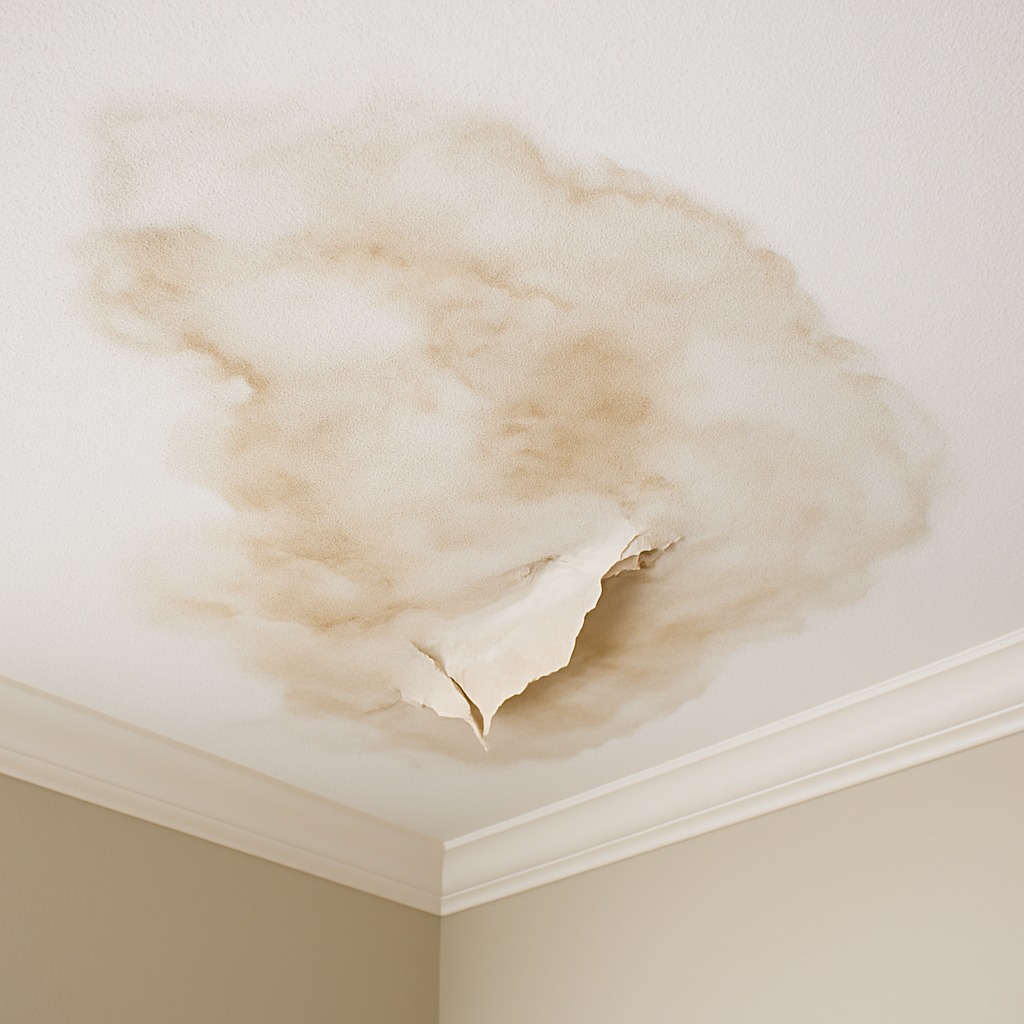
- Yellow or brown ring stains on ceiling: You will notice irregularly shaped rings or blotches that range from pale yellow to dark brown on your ceiling surface. These stains often start small — maybe the size of a coffee cup lid — and expand outward over days or weeks. The edges of the stain are typically darker than the center. The discoloration bleeds through primer and paint, so repainting without sealing will not hide it. On textured ceilings, the stain can wick along the texture ridges and appear larger than the actual wet area above.
- Sagging or bubbling drywall: The ceiling drywall develops a noticeable downward bulge, soft spot, or bubble where water has saturated the gypsum core. Press lightly with your fingertips — the surface will feel spongy and may depress a quarter-inch or more compared to the surrounding area. In severe cases, the drywall tape at seams will separate and hang down. A sagging section measuring more than 12 inches across is holding significant water weight, sometimes 5 to 10 pounds, and is at risk of collapsing. You may hear a faint dripping sound behind the surface.
- Musty or mildew odor in the room: Before you see visible damage, you may smell a damp, earthy, musty odor that intensifies when the HVAC system runs or when humidity rises above 60 percent. This smell indicates mold colonization has likely started on the backside of the drywall, on the paper facing, or on the framing lumber above. Mold can begin growing within 24 to 48 hours of sustained moisture exposure. The odor is most noticeable when you first enter the room after it has been closed up, and it does not go away with air freshener or ventilation alone.
- Active dripping or water beading on ceiling: Water droplets form on the ceiling surface, or you see a slow, steady drip falling to the floor. This indicates the leak is ongoing and the drywall is fully saturated — it can no longer absorb moisture. The drip rate may increase during rain events or when plumbing is in use upstairs. Even a slow drip of one drop every five seconds delivers roughly one gallon of water every eight hours. You may also see mineral deposits or white calcium streaks along the drip path, especially with plumbing leaks.
- Peeling, cracking, or flaking paint and texture: The ceiling paint loses adhesion and begins to crack, blister, or flake off in sheets or chips. Popcorn or knockdown texture becomes soft and crumbles when touched. You will see bare drywall paper exposed beneath the peeling paint, and that paper may appear darker or discolored. This symptom often shows up after the leak has partially dried, making homeowners think the problem resolved itself. It did not — the damage to the substrate is already done, and mold growth on the hidden side is very likely.
What's Actually Causing This
- Roof leak from failed shingles or flashing: This is the most common cause of ceiling water damage in single-story homes or top-floor rooms. Asphalt shingles have a lifespan of 20 to 30 years, and once they curl, crack, or lose granules, water penetrates the underlayment during rain. Flashing around chimneys, vents, skylights, and valleys is even more failure-prone — roughly 95 percent of roof leaks originate at a flashing transition, not in the field of shingles. Water enters and travels along rafters or sheathing before dripping onto the ceiling below, sometimes 10 to 15 feet from the actual breach. The stain on your ceiling rarely lines up directly below the roof penetration point.
- Plumbing leak from supply lines or drain pipes: Upstairs bathrooms, kitchens, and laundry rooms have supply lines running at 40 to 80 PSI and drain pipes that can develop slow leaks at joints. Copper supply lines develop pinhole leaks after 15 to 25 years due to internal corrosion, especially in areas with aggressive water chemistry (low pH or high chloride). PVC drain connections can loosen over time from thermal expansion and vibration. A toilet wax ring failure is one of the most common culprits — every flush sends a small amount of water beneath the toilet base, which migrates through the subfloor and stains the ceiling below. These leaks are insidious because they only occur during fixture use.
- HVAC condensation and condensate drain overflow: Your air conditioning system produces 5 to 20 gallons of condensate per day in humid climates. The condensate drain pan and PVC drain line can clog with algae, dust, and debris, causing the pan to overflow directly onto the ceiling drywall below. Additionally, poorly insulated ductwork running through unconditioned attic space sweats when the temperature differential exceeds 20 degrees Fahrenheit, dripping condensation onto the ceiling. This cause accounts for roughly 15 to 20 percent of ceiling water damage calls during summer months. The damage pattern is usually centered around supply registers or the air handler location.
- Ice dam formation in cold climates: In regions with sustained temperatures below 25°F, heat escaping through an under-insulated attic melts snow on the upper roof. The meltwater runs down to the eave where the roof surface is colder, refreezes, and forms a dam of ice. Water backs up behind this dam, gets under shingles, soaks the roof deck, and drips into the attic and down through the ceiling. Homes with less than R-38 attic insulation and inadequate soffit-to-ridge ventilation are highly susceptible. Ice dams can hold hundreds of pounds of ice and cause damage across 10 to 20 linear feet of ceiling along the exterior wall line.
Here's what most homeowners don't realize: a brown ring stain on your ceiling that looks dry can still be harboring moisture behind it. I've been doing restoration work for 22 years, and roughly 40% of the 'old stains' I inspect with a moisture meter still read above 17% MC — that's active territory for mold colonization. Before you prime over it with a $12 can of Kilz, spend $30 on a pin-type moisture meter and probe around the stain edges. If any reading exceeds 15%, you still have an active or intermittent leak. Painting over it traps moisture and virtually guarantees a $1,500–$4,000 mold problem within six months. Trace it first, dry it completely for at least 72 hours below 14% MC, then repair.
Step-by-Step Diagnosis
Work through these steps before calling a contractor. Each step tells you what to look for and what it means.
Contain the water and protect belongings
🔧 5-gallon bucket, Phillips-head screwdriver, 6-mil poly sheeting, dehumidifierPlace a five-gallon bucket or large plastic bin directly under the drip. Lay 6-mil poly sheeting or a plastic tarp on the floor beneath the affected area to catch overspray and protect flooring. If the ceiling is bulging and holding a pocket of water, carefully puncture the center of the bulge with a Phillips-head screwdriver or an awl to create a controlled drain point into the bucket. Do not use a knife — you risk cutting too wide and collapsing the section. This controlled release prevents the weight from cracking the drywall across a larger area. Move furniture and electronics at least 6 feet away from the drip zone. Run a box fan or dehumidifier to start pulling moisture from the room immediately. Aim for indoor humidity below 50 percent on your hygrometer.
Identify and stop the water source
🔧 Flashlight, painter's tapeGo above the damaged ceiling — into the attic, the room above, or onto the roof — and trace the water path. If it is raining, check the attic with a flashlight for active drips on rafters or sheathing; follow the wet trail upward to find the penetration point. If rain is not the cause, run each upstairs fixture one at a time — flush the toilet, run the sink, use the shower for five minutes — and watch from below for new dripping. For HVAC-related leaks, check the condensate pan under the air handler and verify the PVC drain line is flowing freely by pouring a cup of water into the pan. If the source is a burst or leaking supply line, shut off the water at the fixture valve or the main shutoff valve immediately. Mark the location of the leak source with painter's tape so your contractor can find it quickly.
Dry the area thoroughly before repair
🔧 Utility knife, pry bar, box fan, dehumidifier, pin-type moisture meterThis step is non-negotiable. You must dry the ceiling cavity completely before any cosmetic repair, or mold will grow behind your new drywall within two weeks. Remove any loose, sagging, or crumbling drywall with a utility knife and pry bar — cut back to solid, dry material, typically 6 to 12 inches beyond the visible stain edge. Point a box fan upward into the open cavity and run a dehumidifier in the room 24 hours a day. Use a moisture meter on the exposed framing and remaining drywall edges — you need readings below 15 percent moisture content before proceeding. Drying typically takes 3 to 5 days depending on the season and ventilation. If you smell mold or see any black, green, or white fuzzy growth on the wood or paper backing, stop and call a mold remediation professional.
Patch the ceiling drywall properly
🔧 Drywall saw, 1/2-inch drywall, 1-5/8" drywall screws, drill/driver, fiberglass mesh tape, joint compound, 6" and 10" drywall knives, 120-grit sandpaperFor holes under 6 inches, use a California patch or self-adhesive mesh patch kit. For larger areas — which is most water damage repairs — cut a clean rectangle around the damaged zone using a drywall saw, exposing the joists on two sides. Measure and cut a new piece of half-inch drywall to fit. Screw the patch to the exposed ceiling joists with 1-5/8 inch coarse-thread drywall screws every 8 inches, sinking screw heads just below the surface without breaking the paper face. Apply fiberglass mesh tape over all seams, then spread a thin first coat of lightweight joint compound with a 6-inch drywall knife. Let it dry 24 hours, sand lightly with 120-grit sandpaper, then apply a second wider coat with a 10-inch knife. A third skim coat may be needed for a flat, smooth finish. Feather edges 8 to 10 inches beyond the seam to blend with the existing ceiling.
Prime with stain-blocker and paint ceiling
🔧 Shellac-based stain-blocking primer (Zinsser B-I-N), 3/8-inch nap roller and frame, roller tray, flat ceiling paint, spray texture can or hopper gunDo not skip the primer. Standard latex primer will not block water stains — the discoloration will bleed through within one coat of ceiling paint. Use a shellac-based stain-blocking primer such as Zinsser B-I-N or an oil-based option like Zinsser Cover Stain. Apply one coat with a 3/8-inch nap roller over the entire patched area plus 6 inches beyond onto the existing ceiling. Let the primer dry for 45 to 60 minutes. Once sealed, apply two coats of flat or matte ceiling paint, using the same 3/8-inch nap roller. Roll in one direction with the final coat to maintain a consistent texture. If the surrounding ceiling has texture — popcorn, orange peel, knockdown — you will need to match it before priming. Spray-can texture products from the hardware store work for small patches but rarely match perfectly on areas larger than 2 square feet. For larger areas, a hopper gun and practice on cardboard is the better approach.
When to Stop DIY and Call a Pro
Stop DIY and call a licensed general contractor immediately if any of the following apply: the damaged area exceeds 10 square feet, which is roughly a 3-by-3-foot section — at that scale, structural integrity of the drywall and potentially the ceiling joists is compromised. If you see any mold growth — even a small patch of black or green discoloration on the framing, insulation, or drywall backing — you need professional remediation, not just bleach. Mold remediation runs $500 to $3,000 depending on the affected area, but ignoring it creates health risks and can cost $10,000-plus if it spreads to wall cavities. Call a pro if the ceiling is actively bowing more than 1 inch, if the leak source is unclear after basic investigation, or if the damage involves a second-story bathroom where subfloor replacement may be needed. Any repair involving moving or repairing plumbing or electrical wiring above the ceiling requires licensed tradespeople — not just for safety, but for code compliance and insurance coverage. The financial breakeven is roughly $800: if your estimated materials and time investment approaches that number, a contractor will do it faster, with a warranty, and without the risk of a callback. If your homeowners insurance is involved, a contractor's documented scope of work is essential for claim approval.
What Does This Repair Cost?
Costs vary by region, home age, and severity. These are national averages — always get 3 quotes.
| Repair Type | DIY Cost | Pro Cost | Emergency Premium |
|---|---|---|---|
| Small stain repair & repaint (under 2 sq ft) | $25–$60 | $150–$400 | $250–$600 |
| Drywall patch & texture match (2–8 sq ft) | $40–$120 | $300–$800 | $500–$1,200 |
| Leak source repair (pipe or roof flashing) | Not recommended | $250–$1,500 | $500–$2,500 |
| Structural joist/subfloor repair with mold remediation | Not recommended | $2,500–$8,500 | $4,000–$12,000 |
| After-hours emergency service call | N/A | $150–$350 | $250–$500 |
*Emergency rates (nights/weekends/holidays) run 40–60% above standard. Get 3 quotes before approving work.
Get quotes from licensed professionals in your area
Free, no obligation — compare 3+ contractors in minutesWhat Drives the Cost?
| Cost Factor | Estimated Impact | Why It Matters |
|---|---|---|
| Leak duration before repair | Adds $500–$5,000+ | Every 24 hours of active moisture dramatically increases mold risk, insulation replacement scope, and potential structural damage to joists |
| Ceiling height and accessibility | Adds $200–$800 | Vaulted ceilings, cathedral ceilings, and multi-story homes require scaffolding and extra labor time, inflating repair costs by 25–40% |
| Texture matching (popcorn, knockdown, orange peel) | Adds $150–$600 | Matching existing ceiling texture — especially pre-1980 popcorn that may contain asbestos — requires specialized skill and sometimes abatement testing at $250–$400 |
| Insurance deductible vs. claim value | Saves $0–$6,000 | Homeowners insurance typically covers sudden/accidental water damage but not gradual leaks; filing a claim only makes sense if repairs exceed your deductible by at least $1,000 to avoid premium increases |
Insurance adjusters will lowball your ceiling water damage claim if you don't document correctly from minute one. Take timestamped video of the active drip or stain before you do anything — before you poke a drain hole, before you move furniture. Adjusters specifically look for 'failure to mitigate' as a reason to reduce payouts by 20–50%, so after documenting, immediately mitigate by catching water and running fans. Keep every receipt: the $40 dehumidifier rental, the $8 tarp, all of it. In northern climates, ice dam-related ceiling damage claims average $3,800 but homeowners who document properly receive 30–40% higher payouts on average. Also note that in states like Florida and Texas, you typically have only 14 days to file a supplemental claim for hidden damage discovered after initial inspection.
⚠️ Stop DIY — Call a Pro If You See These
- Ceiling drywall sagging more than 1 inch below the joist line — The gypsum core has lost structural integrity and is holding trapped water. Collapse can occur without warning, dropping 30 to 60 pounds of wet drywall, which causes injury risk and doubles the repair area and cost — potentially adding $500 to $1,500 in additional drywall, paint, and flooring repair.
- Visible mold growth on exposed framing or drywall paper — Mold colonies double in size every 24 to 48 hours in sustained moisture conditions above 60 percent humidity. Within 7 to 14 days, mold can spread from a 1-square-foot patch to an entire joist bay. Professional remediation costs escalate from $500 for a small area to $3,000 or more once it reaches wall cavities or HVAC ductwork. Health effects include respiratory irritation and allergic reactions.
- Water stain that grows larger after rain or plumbing use — An expanding stain means the leak is active and recurring, not a one-time event. Each wet-dry cycle further degrades the drywall, promotes mold growth, and can begin to rot wood framing. Joist sistering or replacement costs $200 to $500 per joist — damage that could have been avoided by addressing the active leak within 48 hours of first appearance.
- Electrical fixtures, recessed lights, or junction boxes in the wet zone — Water contacting live electrical wiring creates immediate electrocution and fire hazard. A wet ceiling around a recessed can light or ceiling fan junction box should be treated as an emergency. Turn off the breaker to that circuit before touching anything. An electrician call to inspect and dry-out costs $150 to $300 but prevents a house fire or fatal shock.
Frequently Asked Questions
How much does it cost to fix Water Damage On Ceiling?
The national average for ceiling water damage repair ranges from $500 to $2,500 for a typical residential job. A small stain requiring only drywall patch, primer, and paint runs $300 to $700. A larger repair involving multiple sheets of drywall, mold treatment, and texture matching can hit $1,500 to $3,500. Two factors move the price significantly: the size of the damaged area and whether the leak source also needs repair. A roof flashing repair adds $200 to $600, while a plumbing fix can add $150 to $1,000 depending on pipe accessibility. If mold remediation is required, expect an additional $500 to $3,000.
Can I fix Water Damage On Ceiling myself?
Yes, if three conditions are met: the damaged area is under 10 square feet, there is no mold present, and you have already identified and stopped the leak source. A confident DIYer with basic drywall experience can patch, prime, and paint a small to medium ceiling stain in a weekend for $50 to $150 in materials. However, if the repair involves working around electrical, if the ceiling is plaster and lath rather than drywall, or if the texture is difficult to match (such as smooth or skip-trowel), the result often looks worse than the stain. Be honest about your skill level — a botched ceiling patch is visible from every angle in the room.
How urgent is Water Damage On Ceiling?
Extremely urgent in the first 24 to 48 hours. Mold can begin colonizing on wet drywall and wood framing within 24 hours at humidity levels above 60 percent. If the leak is active, every hour of delay increases the damage footprint and repair cost. Stop the water source immediately — this is a same-day priority. Drying should begin within hours, not days. If the ceiling has been wet for more than 72 hours without active drying, assume mold is present on the hidden side. Cosmetic repair can wait a week once the area is dry, but ignoring the moisture will turn a $500 fix into a $3,000 mold remediation project.
What causes Water Damage On Ceiling?
The three most common causes are roof leaks, plumbing failures, and HVAC condensation issues. Roof leaks account for roughly 40 percent of ceiling water damage, usually originating at flashing failures around chimneys, vents, or skylights rather than in the shingle field itself. Plumbing leaks — especially toilet wax ring failures, supply line pinhole leaks, and loose drain connections — account for another 35 percent and are most common in homes over 20 years old. HVAC condensate drain clogs and sweating ductwork make up about 15 to 20 percent, predominantly in humid southern climates during cooling season.
Will homeowners insurance cover Water Damage On Ceiling?
Most standard homeowners policies cover sudden and accidental water damage — for example, a supply line that bursts unexpectedly or a washing machine hose that fails. The damage to your ceiling, drywall, and personal property would typically be covered after your deductible, which averages $1,000 to $2,500. However, insurance does not cover damage from deferred maintenance, gradual leaks, or long-term neglect. If an adjuster determines the leak was slow and ongoing — evidenced by old mold growth or rotted framing — the claim may be denied. Flood damage from external sources is never covered under standard policies and requires separate flood insurance. Document everything with photos and save damaged materials until the adjuster visits.
How do I find a licensed general contractor for this?
Follow this four-step process. First, verify the contractor holds an active general contractor license in your state — check your state's contractor licensing board website by entering their license number. Second, confirm they carry both general liability insurance (minimum $1 million) and workers' compensation coverage; ask for a certificate of insurance and call the carrier to verify it is current. Third, get a written quote that itemizes labor, materials, and scope of work — never accept a verbal estimate or a lump-sum number without line items. Fourth, check references by calling at least two recent customers who had similar water damage repair performed, and look at online reviews on Google and the Better Business Bureau. A reputable contractor will not hesitate on any of these steps.
Ceiling water damage comes down to three critical decisions you need to get right: First, stop the water source before you touch anything cosmetic — whether it is a roof leak, a plumbing failure, or an HVAC condensation issue, the repair means nothing if water keeps coming. Second, dry the area completely and verify with a moisture meter before closing up the ceiling, because trapping moisture behind new drywall guarantees a mold problem that will cost five to ten times more to fix later. Third, honestly assess the scope — a stain under 10 square feet with no mold and a known, resolved leak source is a solid DIY weekend project, but anything larger, anything involving mold, or anything near electrical requires a licensed professional.
Your recommended next step is to get above that ceiling today. Grab a flashlight, go into the attic or the room above, and find out where the water is coming from. If the source is obvious and you can stop it, do so immediately and begin drying. If the source is unclear, if the damage is widespread, or if you see any mold, call a licensed general contractor for an inspection. Most will provide a free or low-cost assessment. Get at least two written quotes, verify licenses and insurance, and do not let anyone start cosmetic work until the leak source is confirmed fixed and the moisture readings are below 15 percent. Acting within the first 48 hours is the single most important factor in keeping this repair manageable and affordable.
Ready to Solve This for Good?
Get matched with pre-screened, licensed general contractors in your area. Free quotes, no obligation, no spam.
GET FREE QUOTES NOW