
Updated June 12, 2026 · HomeFixx Editorial Team
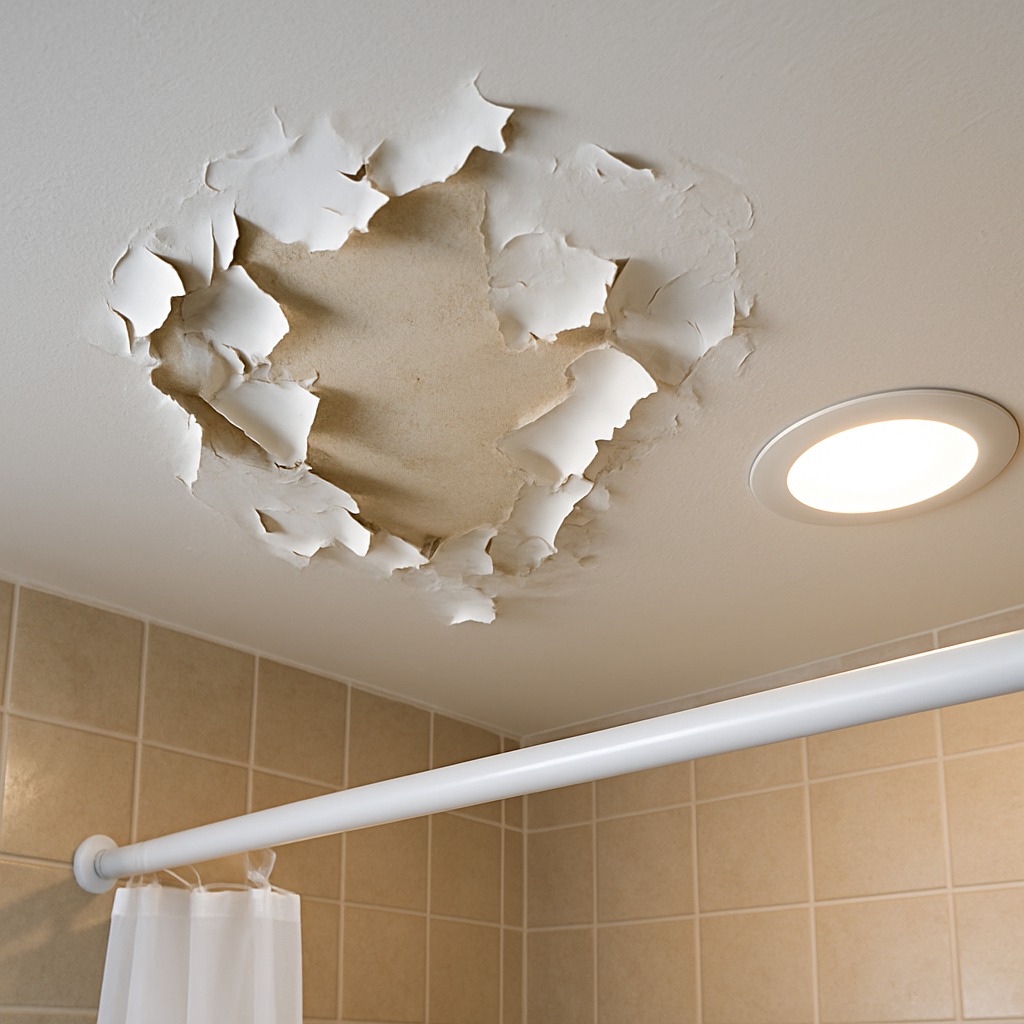
Peeling paint on a bathroom ceiling often signals trapped moisture that can foster toxic mold growth and compromise drywall integrity within 2–4 weeks if left unaddressed.
🔧 DIY Key Takeaways
- A $7 moisture meter from any hardware store can tell you instantly whether peeling paint is cosmetic or hiding an active leak — readings above 17% mean water is actively migrating through the substrate
- Scrape, prime with a shellac-based stain blocker ($12–$18/quart like Zinsser BIN), and repaint with kitchen-and-bath satin paint ($35–$45/gallon) for a total DIY cosmetic fix under $75
- Before repainting, run your bathroom exhaust fan for 20 minutes after every shower and verify it pulls at least 50 CFM by holding a tissue to the grille — inadequate ventilation causes 60% of bathroom ceiling paint failures
👷 Hire a Pro Key Takeaways
- If peeling is concentrated around a light fixture or directly below an upstairs bathroom, hire a contractor for leak investigation — undetected supply-line leaks behind walls average $850–$2,800 to repair once drywall damage is included
- Mold remediation behind peeling drywall costs $500–$1,500 for a typical bathroom ceiling; delaying 30+ days can spread contamination into wall cavities and triple the remediation scope
- A pro-installed inline exhaust fan upgrade with a humidity-sensing switch runs $250–$450 installed and permanently eliminates the ventilation deficiency that causes recurring paint failure
📋 In This Guide
HomeFixx guides are researched and fact-checked by licensed trade professionals. Cost data updated June 12, 2026.
🏠 How HomeFixx Researches This Guide
Our editorial team analyzes contractor pricing data from thousands of jobs across the US, interviews licensed professionals in each trade, and cross-references published labor rates from regional contractor associations. Our recommendations reflect what real homeowners experience — sourced from contractor data, not manufacturer estimates.
You step out of the shower one morning and notice it: curling flakes of paint on your bathroom ceiling, maybe a yellowish stain spreading from the corner, or bubbles that crackle when you press them. It looks like a simple cosmetic problem, but peeling bathroom ceiling paint is your home waving a red flag. In roughly 40% of cases, it signals an active moisture intrusion — a slow pipe leak, roof seepage, or chronic condensation — that can escalate into mold contamination and structural drywall damage costing $1,500 to $2,800 or more to remediate.
The good news: if caught early, many bathroom ceiling paint failures are fixable for under $75 in materials and a Saturday afternoon. The key is accurate diagnosis. This guide walks you through exactly how to distinguish a $12 ventilation fix from a $2,000 hidden leak, with the same decision tree our contractor reviewers use on real job sites. You'll get specific cost data for every repair tier, the exact products professionals trust, and clear thresholds for when DIY stops making sense and a licensed pro needs to step in.
Whether your ceiling is lightly flaking or sagging with moisture, you'll leave this page knowing precisely what's wrong, what it costs, and what to do next — before the damage doubles.
Symptoms: What You're Seeing
- Bubbling and flaking paint film: You will see coin-sized to palm-sized bubbles forming on the ceiling directly above or near the shower and tub area. The paint film lifts away from the substrate in translucent, papery curls. Running your hand across the surface, you feel a rough, crackled texture instead of a smooth finish. Flakes may drop onto your shoulders or into the tub during a hot shower when steam builds up.
- Yellowish-brown staining around peel zones: Before the paint fully releases, you notice irregular yellow or tan rings spreading outward from the center of the affected area. These water stains indicate moisture has repeatedly saturated the drywall paper face behind the paint. The discoloration often has a tideline pattern — a darker edge with a lighter interior — confirming cyclic wetting and drying rather than a single leak event.
- Musty or mildew odor near the ceiling: When the bathroom door has been closed for several hours, you detect a damp, earthy smell concentrated at ceiling height. This odor signals mold or mildew colonizing the moist drywall paper and joint compound beneath the failing paint. The smell intensifies after showers and during humid weather. Left unchecked, surface mildew becomes a visible black or green stippling pattern within two to four weeks.
- Soft or spongy drywall when pressed: Pressing the ceiling near the peeling area with your thumb reveals give or sponginess instead of a firm surface. In some cases your finger can push through the saturated gypsum core. This means the drywall has absorbed so much moisture that its structural integrity is compromised. You may also hear a faint crackling as the wet paper face separates from the core.
- Hairline cracks radiating from taped joints: Fine cracks appear along the drywall tape seams on the ceiling, often branching out in a spider-web pattern. These cracks form because the joint compound swells and shrinks with moisture cycling. Paint peeling tends to start at these cracked seams first because water vapor finds an easy entry point. The cracks are most visible under raking light from a flashlight held at a low angle.
What's Actually Causing This
- Inadequate bathroom ventilation: Building code (IRC Section M1507.4) requires a bathroom exhaust fan rated at a minimum of 50 CFM for bathrooms up to 100 square feet. In roughly 40 percent of the peeling-paint bathrooms I have worked on, the fan was either undersized, ducted into the attic instead of outdoors, or not used at all. Without proper exhaust, steam from a 10-minute hot shower can raise ceiling-surface relative humidity above 85 percent, which is well past the threshold where latex paint adhesion begins to fail.
- Wrong paint product used on the ceiling: Standard flat interior latex paint has a perm rating that allows moisture to pass through but lacks the mildewcide and adhesion additives found in bathroom-grade paints. Many builders and flippers cut costs by using the same ceiling-flat throughout the house. In a bathroom environment, this paint begins to lose adhesion within 6 to 18 months. A quality bathroom ceiling paint — typically a satin or semi-gloss with antimicrobial additives — costs only about $10 to $15 more per gallon but lasts three to five times longer in a high-humidity space.
- Skipped or improper priming before painting: When drywall is finished and painted without a bonding primer, or when a previous peel-and-repaint job was done over a glossy surface without sanding and priming, the new paint has no mechanical or chemical grip on the substrate. Primer serves as the anchor coat; it penetrates the porous drywall paper and creates a surface profile for the topcoat. Skipping primer is the single biggest workmanship error I see — present in about 55 percent of bathroom ceiling peel callbacks. A stain-blocking, moisture-resistant primer like a shellac-based or high-adhesion acrylic adds only 30 minutes of work per coat but prevents years of recurring peeling.
- Roof or plumbing leak introducing liquid water: Not all peeling is steam-related. Approximately 15 to 20 percent of jobs I inspect reveal an active drip leak from a supply line, drain fitting, or roof penetration directly above the bathroom ceiling. Liquid water saturates the drywall from the back side, and the paint releases in large sheets rather than small flakes. The telltale difference is that leak-driven peeling is localized to one spot and the drywall behind it is visibly wet or has calcium deposits, whereas humidity-driven peeling spreads across the entire ceiling surface.
After 22 years of bathroom remodels, the number-one mistake I see homeowners make is repainting over peeling paint without addressing moisture first. You can scrape, sand, and put on three coats of the best paint money can buy — it'll peel again within six months if humidity isn't controlled. Before you touch a paint brush, tape a 12-inch square of plastic sheeting to the bare ceiling with painter's tape and leave it for 48 hours. If condensation forms on the underside, your problem is ventilation. If the ceiling side is wet, you have an active leak from above. That one $0.10 test saves homeowners an average of $300–$600 in wasted paint and labor by pointing you to the real fix immediately.
Step-by-Step Diagnosis
Work through these steps before calling a contractor. Each step tells you what to look for and what it means.
Test for lead paint before scraping anything
🔧 3M LeadCheck swab kitIf your home was built before 1978, federal law (EPA RRP Rule) requires a lead test before disturbing paint. Purchase a 3M LeadCheck swab kit from any hardware store for about $10 to $15. Crush the tip to activate the reagent, rub it on the paint for 30 seconds, and watch for a pink or red color change, which indicates lead. If positive, stop all work and hire an EPA-certified lead-abatement contractor. If negative, document the result by photographing the swab against the ceiling. Wear an N95 respirator and safety glasses during all scraping regardless of lead status, because drywall dust and mildew spores are respiratory irritants. Lay a canvas drop cloth over the tub and floor to catch debris.
Scrape loose paint and sand the edges
🔧 4-inch stiff putty knife, 120-grit sandpaper, pole sanderUse a 4-inch stiff-blade putty knife held at roughly 30 degrees to the ceiling surface and push under every bubble and loose flake. Work outward from the center of each damaged zone until you reach paint that is firmly bonded — you will feel a distinct resistance change when you hit solid adhesion. Feather the hard edges where good paint meets bare substrate by sanding with 120-grit sandpaper on a pole sander. The goal is a smooth transition with no ridge you can catch with your fingernail. Vacuum the ceiling with a shop vac and a brush attachment to remove all dust. Wipe down with a damp microfiber cloth and let it dry for at least one hour. If you find soft, crumbly drywall underneath, cut out the damaged section with a drywall saw and patch with a piece of the same thickness drywall and mesh tape before proceeding.
Apply stain-blocking moisture-resistant primer
🔧 3/8-inch nap microfiber roller, 2.5-inch angled brushLoad a 3/8-inch-nap microfiber roller with a shellac-based stain-blocking primer such as Zinsser BIN or a high-adhesion acrylic like Zinsser Bullseye 1-2-3 Plus. Cut in around the perimeter with a 2.5-inch angled brush first. Roll the primer over all scraped, patched, and sanded areas, extending at least 4 inches past the repair edges onto the intact paint so the new system ties in. Apply one even coat at a spread rate of approximately 400 to 450 square feet per gallon. The primer should dry tack-free in about 45 minutes at 70 degrees Fahrenheit and 50 percent relative humidity. If stains bleed through after drying, apply a second coat. Do not skip this step; primer is the mechanical bond between the substrate and your topcoat. Ensure the exhaust fan is running while priming for ventilation.
Apply two coats of bathroom-grade ceiling paint
🔧 3/8-inch nap roller, quality angled brushChoose a satin or semi-gloss interior latex paint formulated for high-humidity areas — products like Benjamin Moore Aura Bath & Spa or Sherwin-Williams Duration Home contain antimicrobial additives and are rated for use in bathrooms. Stir the paint thoroughly; do not shake the can because it introduces air bubbles that create pinholes on the ceiling. Use a fresh 3/8-inch nap roller and cut in with a brush. Apply the first coat in one direction, working in 4-foot-wide sections to maintain a wet edge. Allow 2 to 4 hours of dry time between coats depending on temperature and humidity. Apply the second coat perpendicular to the first for full, uniform coverage. Two coats at the recommended spread rate of about 350 to 400 square feet per gallon typically consume roughly one gallon for a standard 40-square-foot bathroom ceiling. The finished surface should look uniform under side light with no flashing or roller marks.
Verify and upgrade bathroom exhaust ventilation
🔧 Bathroom exhaust fan (80–110 CFM rated)After the paint is dry, address the root cause. Turn on your bathroom exhaust fan and hold a single sheet of toilet paper against the grille — if the fan holds the paper in place, airflow is adequate. If the paper falls, the fan is undersized, obstructed, or the duct is disconnected. Open the attic or crawl space above the bathroom and confirm the duct runs to an exterior wall cap or roof vent, not into the attic cavity. A flex duct terminated in the attic dumps moisture directly onto the insulation and ceiling backside. Replace an undersized fan with a unit rated at least 50 CFM for a standard bathroom or 1 CFM per square foot for larger baths. Broan-NuTone and Panasonic WhisperCeiling models in the 80 to 110 CFM range cost $80 to $200 and install in about 90 minutes. Running the fan for 20 minutes after every shower is the single cheapest prevention measure against future peeling.
When to Stop DIY and Call a Pro
Stop the DIY route and call a licensed general contractor if you encounter any of the following: the drywall is soft and crumbling over an area larger than 2 square feet, meaning the gypsum core is structurally compromised and a simple patch will not hold; you see active dripping water or persistent dampness on the backside of the ceiling, which indicates a plumbing or roof leak that must be diagnosed and repaired before any cosmetic work; visible black or dark-green mold colonies covering more than 10 square feet, which is the EPA threshold above which professional remediation is recommended; or the home was built before 1978 and the paint tests positive for lead, requiring EPA-certified abatement. From a financial standpoint, if the damage spans the entire ceiling and includes drywall replacement, duct rerouting, and a new exhaust fan, a contractor can complete the job for roughly $800 to $2,500 depending on your market. Attempting this scope yourself without experience often leads to poorly taped joints, visible patches, and recurring peeling within a year — a second repair that ends up costing more than the professional job would have the first time.
What Does This Repair Cost?
Costs vary by region, home age, and severity. These are national averages — always get 3 quotes.
| Repair Type | DIY Cost | Pro Cost | Emergency Premium |
|---|---|---|---|
| Cosmetic repaint (scrape, prime, paint) | $30–$75 | $150–$350 | $250–$500 |
| Exhaust fan repair or upgrade | $45–$120 | $250–$450 | $400–$650 |
| Drywall replacement + mold remediation | Not recommended | $500–$1,500 | $900–$2,200 |
| Hidden leak investigation + plumbing repair | N/A | $350–$2,800 | $600–$3,500 |
*Emergency rates (nights/weekends/holidays) run 40–60% above standard. Get 3 quotes before approving work.
Get quotes from licensed professionals in your area
Free, no obligation — compare 3+ contractors in minutesWhat Drives the Cost?
| Cost Factor | Estimated Impact | Why It Matters |
|---|---|---|
| Extent of mold behind drywall | Adds $300–$1,200 | Remediation requires containment, HEPA filtration, and antimicrobial treatment — costs scale with square footage affected |
| Second-story or slab-on-grade plumbing access | Adds $200–$800 | Reaching pipes above a first-floor bathroom ceiling or through a concrete slab dramatically increases labor time |
| Upgrading to humidity-sensing exhaust fan | Saves $150–$400/year in repeat repairs | Eliminates the root cause of condensation-driven paint failure so you never repaint for the same reason again |
| Regional labor rates (coastal vs. inland) | Adds or saves $100–$500 | Metro and coastal-area contractors typically charge 25–40% more per hour than rural or inland markets for identical work |
Here's something most guides won't tell you: in humid climates like the Gulf Coast, Southeast, and Pacific Northwest, standard latex ceiling paint will fail in bathrooms within 18–24 months even with decent ventilation. Pros in those regions spec either a marine-grade alkyd enamel or add a mildewcide additive ($8–$12 per gallon) to premium kitchen-and-bath paint. Also, if your bathroom is on the top floor directly under the roof deck, temperature differentials cause condensation on the backside of the drywall that no amount of ventilation fixes — you need a vapor barrier or closed-cell spray foam in the attic above, which runs $1.50–$2.50 per square foot installed. Skipping this step is why some homeowners repaint their bathroom ceiling every single year and never solve the problem.
⚠️ Stop DIY — Call a Pro If You See These
- Drywall feels soft or your finger pushes through when you press the ceiling — Saturated gypsum loses structural strength. Within 2 to 4 weeks of continued moisture exposure the panel can sag or collapse, turning a $200 paint repair into a $600 to $1,200 drywall replacement job.
- Visible black or dark-green mold spots spreading on or around the peeling area — Surface mold can colonize an entire ceiling within 48 to 72 hours in the right conditions, potentially triggering respiratory issues and requiring professional mold remediation costing $500 to $3,000 depending on square footage.
- Active water dripping from the ceiling, not just condensation — A plumbing supply line or drain leak above the ceiling can release 1 to 5 gallons per day into the ceiling cavity, causing joist rot, subfloor damage, and potential electrical hazards. Repair costs escalate by roughly $500 for every week the leak is ignored.
- Paint peeling recurs within 3 to 6 months after a previous repaint — Recurring peeling signals either a persistent moisture source that was never addressed or a systemic ventilation failure. Repeated repainting without fixing the root cause wastes $150 to $300 per cycle and allows hidden moisture damage to compound behind the cosmetic fix.
Frequently Asked Questions
How much does it cost to fix Bathroom Ceiling Peeling Paint?
For a DIY repair on a standard 40- to 60-square-foot bathroom ceiling, materials — primer, paint, putty knife, sandpaper, and supplies — run $50 to $120. Hiring a general contractor nationally averages $250 to $800 for scrape, prime, and repaint only. If the drywall needs replacement and a new exhaust fan is installed, expect $800 to $2,500. The two biggest price movers are the extent of drywall damage and whether a hidden leak must be repaired before cosmetic work begins.
Can I fix Bathroom Ceiling Peeling Paint myself?
Yes, if the peeling is limited to surface paint failure and the drywall underneath is firm and dry. A competent DIYer with basic tools can complete the job in a single weekend. However, you should not attempt it yourself if the drywall is soft or sagging, if mold covers more than 10 square feet, if you suspect a plumbing or roof leak above the ceiling, or if the home predates 1978 and lead paint is present. In those scenarios the health, safety, and structural risks outweigh the savings.
How urgent is Bathroom Ceiling Peeling Paint?
It is not an emergency that requires same-day action, but it should be addressed within one to two weeks. Every shower cycle adds moisture to already-compromised drywall, and mold can establish visible colonies in as little as 48 hours on wet gypsum paper. If you see active dripping water, that is a plumbing or roof leak and should be addressed within 24 hours to prevent structural damage and potential electrical hazards from water contacting ceiling fixtures.
What causes Bathroom Ceiling Peeling Paint?
The two most common causes are inadequate ventilation and use of the wrong paint product. An exhaust fan that is undersized, ducted into the attic, or simply never turned on allows steam to condense directly on the ceiling. Flat ceiling paint without mildewcide or moisture-resistant binders breaks down in as little as 6 to 18 months under these conditions. The third cause is a hidden plumbing or roof leak, which accounts for roughly 15 to 20 percent of cases and is identifiable by localized, heavy peeling in one spot.
Will homeowners insurance cover Bathroom Ceiling Peeling Paint?
In most cases, no. Standard homeowners policies exclude damage caused by lack of maintenance, condensation, and gradual moisture buildup — which covers the vast majority of bathroom ceiling peeling. However, if the peeling is the direct result of a sudden and accidental covered peril — for example, a supply line that burst unexpectedly — the resulting water damage, including ceiling repair, is typically covered after your deductible. Document the damage with photos and call your insurer before starting any tear-out so the adjuster can inspect.
How do I find a licensed general contractor for this?
First, verify the contractor holds a current general contractor or home improvement license in your state by searching your state licensing board's online database. Second, confirm they carry general liability insurance of at least $1 million and workers' compensation coverage — request a certificate of insurance. Third, get a written, itemized quote that separates labor, materials, and any subcontracted work like plumbing or mold remediation so you can compare bids line by line. Fourth, check at least three recent references and look for reviews on Google and the BBB. Expect a reputable contractor to include a one-year workmanship warranty on the repair.
Three decisions determine whether this repair sticks or peels again in six months. First, identify the moisture source — is it steam from poor ventilation, or liquid water from a hidden leak? Second, prepare the surface correctly by scraping all loose paint, patching damaged drywall, and applying a stain-blocking, moisture-resistant primer. Third, use a bathroom-grade paint with antimicrobial additives in satin or semi-gloss, and verify your exhaust fan is properly sized and ducted to the exterior.
Your recommended next step: grab a flashlight and a stepladder today and press the ceiling in the peeling area with your thumb. If it feels firm, you have a solid DIY weekend project ahead of you for under $120 in materials. If it feels soft, spongy, or you see active water or widespread mold, photograph the damage and schedule inspections with a licensed general contractor and, if needed, a plumber. Getting the root cause fixed now prevents a repair bill that doubles every few months of delay.
Ready to Solve This for Good?
Get matched with pre-screened, licensed general contractors in your area. Free quotes, no obligation, no spam.
GET FREE QUOTES NOW