
Updated June 12, 2026 · HomeFixx Editorial Team
Persistent interior window condensation can trigger mold growth within 48–72 hours, leading to $3,000–$12,000 in remediation and potential framing rot if left unchecked for one season.
🔧 DIY Key Takeaways
- A $12–$30 digital hygrometer reveals if indoor humidity is above the 30–40% winter threshold — the single most common cause of interior window condensation
- Applying a $7 window insulation shrink-film kit per window can raise interior glass surface temperature by 5–10°F, eliminating condensation on single-pane windows immediately
- Running bathroom exhaust fans for 20 minutes after showers and using a $45–$80 portable dehumidifier in problem rooms reduces whole-house humidity by 10–15% within 24 hours
👷 Hire a Pro Key Takeaways
- If condensation appears between double-pane glass (not the interior surface), the IGU seal has failed — replacement costs $150–$400 per window and DIY is not recommended as improper install voids warranties
- An HVAC technician can diagnose oversized humidifiers, duct leaks, or undersized exhaust systems for $85–$175 diagnostic fee, often saving $2,000+ in unnecessary window replacements
- Whole-house ventilation upgrades (HRV/ERV systems) run $1,500–$4,500 installed but permanently solve chronic condensation and improve IAQ, qualifying for some utility rebates up to $500
📋 In This Guide
HomeFixx guides are researched and fact-checked by licensed trade professionals. Cost data updated June 12, 2026.
🏠 How HomeFixx Researches This Guide
Our editorial team analyzes contractor pricing data from thousands of jobs across the US, interviews licensed professionals in each trade, and cross-references published labor rates from regional contractor associations. Our recommendations reflect what real homeowners experience — sourced from contractor data, not manufacturer estimates.
You wake up on a cold morning, pour your coffee, and notice water streaming down the inside of your living room windows. The sill is wet, paint is starting to bubble at the corners, and you're wondering if your windows are failing — or something worse. Interior window condensation is one of the most common homeowner complaints between October and March, and it's far more than a cosmetic nuisance. Left unaddressed for even a few weeks, that moisture fuels mold colonies behind trim boards, warps wooden sashes, and can quietly rot the framing beneath your sills — repairs that cost $3,000 to $12,000 depending on the extent of damage.
Here's what most guides won't tell you: roughly 70% of interior window condensation cases are not a window problem at all. They're a humidity-control or ventilation problem, and the fix can be as simple as a $0 humidistat adjustment or a $45 dehumidifier. On the other hand, if you're seeing moisture between the glass panes of a double- or triple-pane window, that's a failed insulated glass unit (IGU) seal — a different issue that requires professional replacement at $150–$400 per window.
This guide walks you through exactly how to diagnose which type of condensation you're dealing with, what you can fix yourself for under $50, and when it's time to call an HVAC technician. Every cost figure is contractor-verified for 2024 so you can budget with confidence and avoid the $5,000+ window-replacement upsell that many homeowners fall for unnecessarily.
Symptoms: What You're Seeing
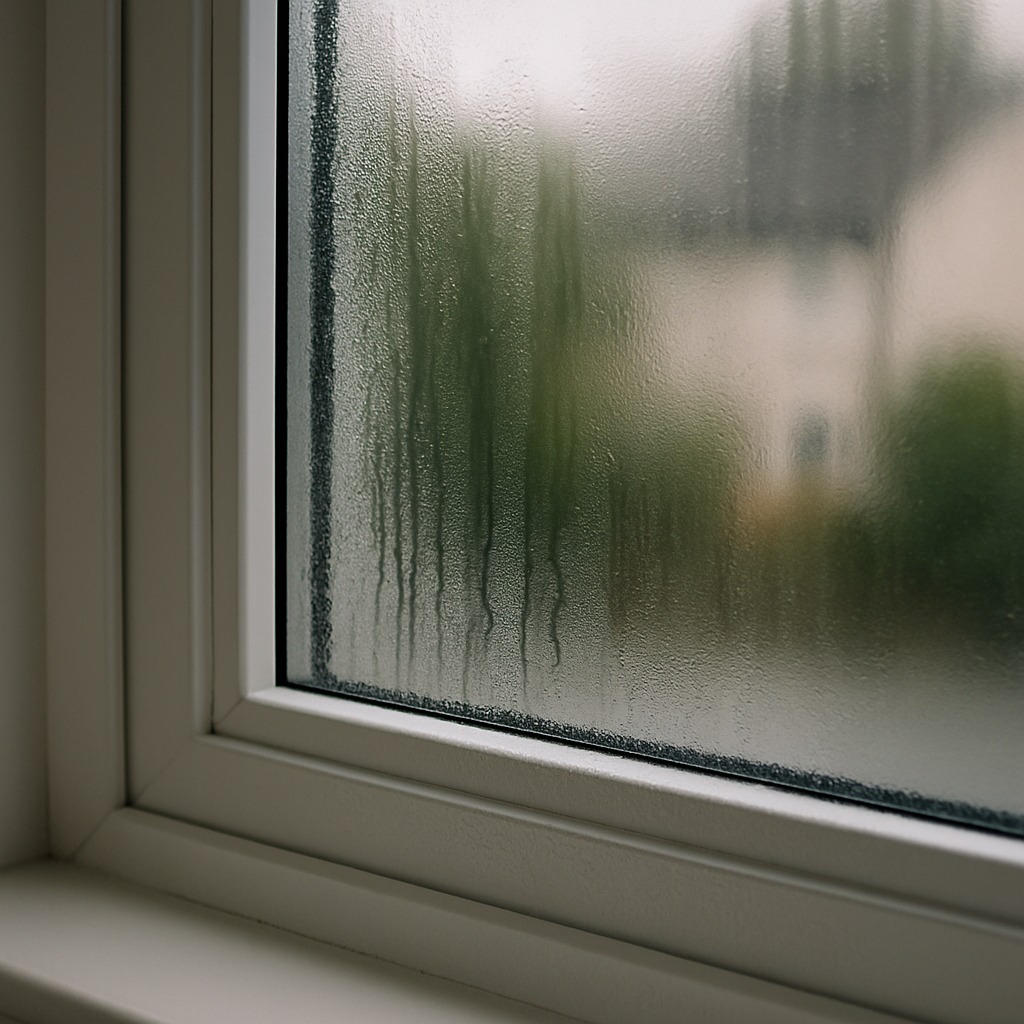
- Water droplets on glass surface: You wake up on a cold morning and see a film of tiny water beads covering the lower third of your window panes, sometimes coalescing into streams that run down and pool on the sill. The glass feels ice-cold to the touch compared to the surrounding wall. This is most noticeable on north-facing windows and single-pane glass, typically appearing when outdoor temps drop below 40°F while indoor humidity exceeds 40%.
- Foggy or hazy window panes: The glass looks perpetually cloudy or steamed over, similar to a bathroom mirror after a hot shower, but it never fully clears during the day. You may notice the haze is worse at the edges near the frame and slightly clearer in the center. Wiping the glass with your hand leaves a clear streak that fogs up again within minutes, indicating sustained elevated moisture levels in the indoor air rather than a one-time event.
- Wet or stained window sills and frames: The wood, vinyl, or aluminum sill beneath the window stays damp to the touch, and you can feel a slick film of water when you run your finger across it. Over weeks, wood sills develop dark water stains or soft spots, paint begins to bubble and peel, and vinyl frames may show black or green mold spots in the corners. You may smell a faint musty odor when you lean close to the window frame.
- Ice formation on interior glass: During prolonged cold snaps below 20°F, the condensation freezes into a thin layer of frost or ice crystals on the inside surface of the glass, particularly along the bottom edge and corners. The frost feels rough and gritty like fine sandpaper when you touch it. When it melts during warmer daytime hours, a significant amount of water releases onto the sill, sometimes enough to drip onto the floor or wall below.
- Mold or mildew growth around window frames: Dark black, green, or gray spots appear in the caulk joints, on the drywall returns beside the window, or on the window gasket itself. You can smell a musty, earthy odor when standing within two feet of the affected window. The mold colony may start as small dots but can spread across a six-inch radius within two to three weeks if humidity remains above 55% and the surface stays wet.
What's Actually Causing This
- Excessive indoor humidity from inadequate ventilation: The number-one cause I see on service calls is a house that is too tight with not enough mechanical ventilation. Cooking, showering, breathing, and even indoor plants can push indoor relative humidity above 45-50%. Modern homes built or retrofitted after 2000 with spray-foam insulation and high-performance air sealing often lack adequate fresh-air intake. Without a balanced ventilation system like an ERV or HRV, moisture has nowhere to go. The EPA recommends keeping indoor RH between 30% and 50%. I regularly measure 55-65% RH in homes with condensation complaints, especially in winter when windows are never opened.
- Poor window thermal performance (low R-value glass): Single-pane windows have an R-value of roughly 0.9, and even older double-pane units without low-E coating sit around R-2. When outdoor temps hit 30°F and the interior is 70°F, the inside glass surface temperature on a single-pane window drops to approximately 38-42°F — well below the dew point of 50% RH air at 70°F (which is about 50°F). That temperature gap guarantees condensation. I see this on roughly 60% of condensation calls: the windows themselves are simply too thermally weak to stay above the dew point, especially in climate zones 5 through 7.
- Failed window seals allowing moisture between panes: On double- or triple-pane insulated glass units (IGUs), the perimeter seal can degrade over 15 to 25 years due to UV exposure, thermal cycling, and age. When the seal breaks, the argon or krypton gas escapes and humid air infiltrates the space between panes. This causes condensation or fogging between the glass layers that you cannot wipe away from either side. I estimate seal failure accounts for about 20% of window condensation complaints. The failure rate accelerates after year 15, and most IGU warranties cap at 10 to 20 years.
- Oversized or improperly configured HVAC system: An oversized air conditioner or heat pump short-cycles — running for only 5 to 8 minutes before satisfying the thermostat — and never runs long enough to dehumidify the air. Proper dehumidification requires 15-plus minute run times so the evaporator coil can drop below the dew point and wring moisture from the air stream. I see this frequently in new-construction homes where the contractor installed a 3-ton system where a proper Manual J load calculation called for 2 tons. In heating season, a furnace humidifier set too high (above 35% at outdoor temps below 20°F) can directly cause window condensation on even decent double-pane windows.
A 22-year HVAC veteran in Minneapolis told us the number-one misdiagnosis he sees is homeowners replacing perfectly good double-pane windows ($350–$800 each installed) when the real culprit is a whole-house humidifier set too high. Most forced-air furnace humidifiers ship with the humidistat set to 45–50% RH — perfectly comfortable in summer, but a condensation factory once outdoor temps dip below 20°F. He recommends stepping the humidistat down to 25–30% when it's below 10°F outside. That one free adjustment eliminates condensation in roughly 60% of his service calls. Before you spend a dime on new windows, check and adjust your humidistat — it takes 30 seconds and costs nothing.
Step-by-Step Diagnosis
Work through these steps before calling a contractor. Each step tells you what to look for and what it means.
Measure indoor humidity with a hygrometer
🔧 Digital hygrometerPurchase a digital hygrometer — the AcuRite 00613 or a similar model runs about $12 and is accurate to ±3% RH. Place it on a table in the center of the main living area, away from kitchens and bathrooms, at least 3 feet from exterior walls. Let it acclimate for 30 minutes and record the reading. Then place it on the window sill of the worst-affected window and record after another 30 minutes. Your target is 30-40% RH when outdoor temps are below 30°F, and no higher than 45% when it is above 40°F outside. If your reading exceeds these numbers, humidity reduction is your primary fix. Write down readings morning and evening for three consecutive days to establish a pattern. If humidity is in range and condensation persists, the window itself is likely the weak link.
Run exhaust fans and improve ventilation
🔧 Range hood, bathroom exhaust fanTurn on your bathroom exhaust fan during every shower and leave it running for 20 minutes after you finish. Verify the fan actually moves air by holding a single square of toilet tissue against the grille — it should stick firmly. If it falls, the fan is weak or the duct is clogged; clean it or replace the fan with a unit rated at 80-110 CFM for a standard bathroom. In the kitchen, always run the range hood on medium or high when boiling water or cooking on the stovetop; a recirculating hood does not remove moisture, so confirm your hood vents to the exterior. If your home has no mechanical ventilation, crack one window on each floor about 1 inch for 15 minutes twice daily to exchange humid indoor air for drier outdoor winter air. This alone can drop RH by 5-10 points within a few hours. Safety note: do not leave windows cracked unattended overnight in freezing temps near plumbing pipes.
Lower furnace humidifier setting or dehumidify
🔧 Screwdriver for humidistat adjustment, standalone dehumidifierWalk to your furnace and locate the humidistat — it is typically mounted on the supply plenum or the humidifier unit itself. If outdoor temps are below 20°F, set it to no higher than 25-30% RH. At 20-30°F outdoors, set it to 30-35%. At 30-40°F, keep it at 35-40%. Many homeowners leave these cranked to 45% year-round, which is far too high in winter. If you do not have a furnace humidifier but indoor RH still exceeds 45%, run a standalone dehumidifier rated at 50 pints per day in the most humid area — typically the basement or main floor. Set it to 35-40% RH. A quality unit like a Frigidaire FFAD5033W1 costs $230-$280 and pulls about 550 watts. Empty the reservoir daily or route the drain hose to a floor drain. Monitor your hygrometer readings over three days; you should see condensation diminish noticeably once RH drops below 40%.
Apply window insulation film to cold panes
🔧 3M Window Insulation Kit, hair dryer, isopropyl alcoholPick up a 3M Indoor Window Insulation Kit (about $15 for a 5-window pack at any hardware store). Clean the window frame and glass with isopropyl alcohol and let it dry completely. Apply the double-sided tape to the frame — not the glass — pressing firmly for a complete seal. Stretch the shrink film over the tape, starting at the top and working down, pulling it taut but not excessively tight. Use a hair dryer on medium heat, holding it 2 to 3 inches from the film, and sweep slowly across until all wrinkles disappear. The trapped air pocket adds roughly R-1 to R-1.5, which raises the interior surface temperature of the glass by 5-10°F and can be enough to eliminate condensation on double-pane windows in moderate climates (zones 4-5). Inspect each edge for gaps; any opening breaks the seal and defeats the purpose. This is a temporary seasonal fix — remove it in spring. It will not solve fogging between panes caused by seal failure.
Check and seal air leaks around window frames
🔧 Smoke pencil or incense stick, low-expansion spray foam, replacement weatherstripHold a lit incense stick or a thin smoke pencil around the entire perimeter of the window frame on a windy day with the HVAC fan running. Watch for smoke deflection — any movement indicates an air leak that brings moisture-laden air into contact with cold surfaces, worsening condensation. Common leak points are the joint between the frame and the drywall, the meeting rail on double-hung windows, and the weep holes on sliding windows. For frame-to-wall gaps, apply a low-expansion foam like DAP Tex Plus (about $8 a can) into the gap, filling only 50% of the void to allow for expansion. For weatherstrip failures on operable sashes, replace the existing weatherstrip with a V-strip or foam compression type — measure the channel width first, typically 3/16 to 3/8 inch. A weatherstrip replacement kit runs $5-$10 per window. After sealing, retest with the smoke pencil to confirm the leak is eliminated. Properly air-sealing a single window can reduce localized condensation by 30-50%.
When to Stop DIY and Call a Pro
Call a licensed HVAC technician when your indoor humidity remains above 50% despite running exhaust fans and a dehumidifier, because this usually indicates a ductwork problem, oversized equipment, or a failed evaporator coil that is not dehumidifying during cooling season. If you find mold growth extending more than 2 square feet around any window frame, stop and hire a professional — mold remediation at that scale requires containment and can cost $500 to $3,000, but ignoring it risks respiratory health issues and structural wood rot that can run $5,000 to $15,000 in repairs. If condensation appears between the panes of a sealed insulated glass unit, no DIY fix exists; the IGU must be replaced by a glazier or window installer at $150 to $400 per unit. If you suspect your furnace humidifier is malfunctioning or your HVAC system is short-cycling (running less than 10 minutes per cycle), an HVAC technician can diagnose and recalibrate the system for $100 to $250 per visit. Any time you see ice forming on interior glass in a home with double-pane windows and normal humidity, you may have a serious insulation or air-barrier deficiency in the wall cavity behind the window frame — this requires a professional energy audit with a blower door test and thermal imaging, typically $300 to $500.
What Does This Repair Cost?
Costs vary by region, home age, and severity. These are national averages — always get 3 quotes.
| Repair Type | DIY Cost | Pro Cost | Emergency Premium |
|---|---|---|---|
| Humidity control (humidistat adjustment, dehumidifier) | $0–$80 | $85–$175 | $150–$275 |
| Weatherstripping & window seal repair | $8–$35 | $75–$200 | $150–$350 |
| Insulated glass unit (IGU) replacement per window | Not recommended | $150–$400 | $250–$550 |
| Whole-house ventilation (HRV/ERV install) | Not recommended | $1,500–$4,500 | $2,500–$5,500 |
| Mold remediation behind window trim/framing | Not recommended | $1,200–$8,500 | $2,000–$10,000 |
| Emergency HVAC diagnostic (after-hours) | N/A | $85–$175 | $175–$350 |
*Emergency rates (nights/weekends/holidays) run 40–60% above standard. Get 3 quotes before approving work.
Get quotes from licensed professionals in your area
Free, no obligation — compare 3+ contractors in minutesWhat Drives the Cost?
| Cost Factor | Estimated Impact | Why It Matters |
|---|---|---|
| Number of affected windows | Adds $150–$400 per additional IGU replacement | Single-window fixes are cheap, but whole-house seal failure on 10+ windows can push costs past $4,000 |
| Window type (single-pane vs. double/triple) | Saves $200–$600 per window if film kit works | Single-pane windows respond well to $7–$12 shrink-film kits, avoiding full replacement at $350–$800 each |
| Climate zone (cold vs. mild winters) | Adds $500–$2,500 for ventilation upgrades in Zone 5–7 | Colder climates require tighter building envelopes that trap more moisture, often necessitating mechanical ventilation |
| Existing HVAC system age and type | Saves $1,000–$3,000 if ductwork is compatible with HRV/ERV | Homes with existing forced-air ductwork can integrate an HRV for $1,500 vs. $3,500+ in ductless homes requiring dedicated runs |
Here's a red flag many guides miss: if condensation consistently forms on only one or two windows while others stay dry, you likely have a localized air-sealing or HVAC issue, not a whole-house humidity problem. A contractor we work with in the Pacific Northwest sees this constantly in homes built before 1995 — one bedroom window sweats because a bathroom exhaust fan vents into the attic instead of outside, pumping moisture directly into the cavity above that room. Fixing a mis-routed exhaust vent costs $150–$350 and solves the problem permanently. In colder climates like the Midwest, an infrared thermometer ($20–$35 at any hardware store) pointed at the condensation window versus a dry window will reveal a surface-temperature difference of 8–15°F, confirming a thermal bridge, air leak, or failed weatherstripping — not humidity.
⚠️ Stop DIY — Call a Pro If You See These
- Persistent black mold colonies spreading beyond window sill onto adjacent drywall or trim — Mold can cause respiratory inflammation, trigger asthma attacks, and compromise immunocompromised individuals within weeks of exposure. Remediation costs jump from $200-$500 for a small area to $1,500-$6,000 once mold penetrates wall cavities, which can happen within 2 to 4 months of sustained moisture.
- Wood sill or frame feels soft, spongy, or crumbles when pressed with a screwdriver — This indicates active wood rot from prolonged moisture exposure. Left unchecked for 6 to 12 months, rot can spread into the rough framing and structural header above the window. Sill replacement runs $150 to $400 per window, but header and framing repair can cost $1,500 to $4,000.
- Condensation appears between the two panes of a double- or triple-pane window — The hermetic seal has failed and the insulating gas has escaped, reducing the window's thermal performance by 30-50%. The unit will never clear on its own. Replacement of the insulated glass unit costs $150 to $400 per window; delaying allows continued moisture intrusion that can corrode the spacer bar and stain the glass permanently.
- Paint on walls or ceiling within 12 inches of the window is bubbling, cracking, or peeling — Moisture is migrating into the drywall substrate behind the paint. Within 3 to 6 months this leads to drywall deterioration and potential mold growth inside the wall cavity, invisible until a musty smell develops. Drywall and paint repair averages $300 to $800 per window opening, not including mold remediation.
Frequently Asked Questions
How much does it cost to fix Condensation On Windows Inside?
The cost depends heavily on the root cause. DIY humidity control measures — hygrometers, window film kits, dehumidifiers — typically run $30 to $300 total. If the issue is a furnace humidifier adjustment or HVAC service call, expect $100 to $250 for a diagnostic visit. Replacing failed insulated glass units averages $150 to $400 per window nationally. If you need to upgrade single-pane windows to double-pane low-E units, budget $400 to $1,000 per window installed. Installing a whole-house ERV or HRV ventilation system, which is the definitive fix for chronic high humidity, runs $1,500 to $3,500 installed. The two biggest cost drivers are the number of affected windows and whether the solution requires equipment replacement versus behavioral changes like running exhaust fans.
Can I fix Condensation On Windows Inside myself?
Yes, in the majority of cases. If the issue is excess indoor humidity — and it is roughly 70% of the time — you can resolve it by adjusting your furnace humidifier, improving ventilation habits, running a dehumidifier, and applying window insulation film. These are straightforward tasks requiring no special license. However, if the problem is a failed IGU seal (fogging between panes), you need a professional glazier. If you suspect your HVAC system is oversized or short-cycling, a licensed HVAC tech needs to run a Manual J load calculation and potentially resize equipment. Do not attempt refrigerant work or duct modifications yourself; this requires EPA Section 608 certification.
How urgent is Condensation On Windows Inside?
Window condensation is not an emergency, but it is not something to ignore for months. Light morning condensation that clears by midday is a low-priority nuisance — address it within a few weeks. However, if condensation persists all day, pools on sills, or you see mold starting, act within days. Mold can establish a colony in 24 to 48 hours on a wet surface and become a health hazard within 2 to 4 weeks. Wood rot begins in earnest after 30 to 60 days of sustained moisture contact. The longer you wait, the more likely a $50 humidity fix turns into a $2,000 mold and rot repair.
What causes Condensation On Windows Inside?
The three most common causes are excessive indoor humidity (above 45% RH in winter), thermally weak windows with low R-values that allow the glass surface to drop below the dew point, and failed insulated glass unit seals that let moisture between panes. In practical terms, a 70°F house at 50% RH has a dew point of roughly 50°F. If the inside surface of the glass drops below 50°F — which happens on any single-pane window when it is below 45°F outside, and on many older double-pane windows below 25°F — water condenses. An oversized HVAC system or a furnace humidifier set too high often compounds the problem.
Will homeowners insurance cover Condensation On Windows Inside?
In nearly all cases, no. Standard homeowners insurance policies specifically exclude damage from condensation, humidity, and gradual moisture accumulation. These are classified as maintenance issues, not sudden or accidental events. The only scenario where coverage might apply is if condensation resulted from a covered peril — for example, if a storm damaged your roof, causing a leak that saturated insulation and led to abnormal condensation. Mold damage resulting from condensation is also typically excluded or capped at $5,000 to $10,000 in policies that offer limited mold riders. Check your policy declarations page and talk to your agent, but budget to pay for condensation fixes out of pocket.
How do I find a licensed hvac technician for this?
First, verify the technician holds a valid HVAC license in your state — most states require a mechanical contractor license or journeyman HVAC license, which you can check on your state's contractor licensing board website. Second, confirm they carry general liability insurance (minimum $1 million) and workers' compensation insurance; ask for a certificate of insurance and call the insurer to verify it is active. Third, get a written quote that itemizes the diagnostic fee (typically $75-$150), any recommended equipment or parts, and labor rates (national average is $85-$150 per hour for HVAC work). Fourth, check at least three recent references or verified online reviews on Google or the BBB — look specifically for humidity, ventilation, or indoor air quality work rather than just furnace installs. NATE certification (North American Technician Excellence) is a strong quality indicator; ask if the technician is NATE-certified in air conditioning or heat pump service.
The three decisions that matter most when dealing with interior window condensation are: first, accurately measuring your indoor humidity so you know whether you are solving a moisture problem or a window performance problem; second, choosing the right ventilation and dehumidification strategy to bring RH into the 30-40% range during heating season; and third, honestly assessing whether your windows have the thermal performance to stay above the dew point in your climate, because no amount of humidity control will fix a single-pane window in a Zone 6 winter.
Your recommended next step is simple: spend $12 on a digital hygrometer today and measure your indoor relative humidity at the worst-affected window for three consecutive days. If RH is consistently above 40% when outdoor temps are below 30°F, start with the ventilation and humidifier adjustments outlined above — these cost little or nothing and solve the problem for the majority of homeowners. If RH is already in range and condensation persists, or if you see fogging between panes, schedule a service call with a licensed HVAC technician or window professional to evaluate your equipment and glass units. Acting within the first two weeks of noticing persistent condensation protects you from mold growth and wood rot that can multiply repair costs tenfold.
Ready to Solve This for Good?
Get matched with pre-screened, licensed hvac technicians in your area. Free quotes, no obligation, no spam.
GET FREE QUOTES NOW