
Updated June 13, 2026 · HomeFixx Editorial Team
A non-heating furnace in sub-freezing temps can burst pipes within 6–12 hours, causing $5,000–$15,000 in water and structural damage.
🔧 DIY Key Takeaways
- Check your thermostat settings first — roughly 35% of cold-air calls are caused by a thermostat accidentally set to 'Fan Only' or 'Cool,' a free fix that saves a $125+ service call
- Replace a clogged furnace filter ($4–$12 at any hardware store) — a severely restricted filter can trigger the high-limit safety switch, shutting off the burners while the blower continues running
- Relight a standing pilot light or reset an electronic ignition by turning the furnace off for 60 seconds, then back on — consult your owner's manual for the exact sequence to avoid a $150 diagnostic fee
👷 Hire a Pro Key Takeaways
- A cracked heat exchanger leaking carbon monoxide is the most dangerous cause of cold air — professional replacement costs $800–$1,800, and ignoring it risks CO poisoning and potential furnace fire
- A failed flame sensor ($125–$275 installed) causes the gas valve to shut off within seconds of ignition; pros can clean or replace it in under 30 minutes, but misdiagnosis leads to repeat lockouts
- If the inducer motor or control board has failed ($300–$900 repair), running the system repeatedly to 'try again' can damage secondary components — call a licensed HVAC tech before compounding the bill
📋 In This Guide
HomeFixx guides are researched and fact-checked by licensed trade professionals. Cost data updated June 13, 2026.
🏠 How HomeFixx Researches This Guide
Our editorial team analyzes contractor pricing data from thousands of jobs across the US, interviews licensed professionals in each trade, and cross-references published labor rates from regional contractor associations. Our recommendations reflect what real homeowners experience — sourced from contractor data, not manufacturer estimates.
It's 11 PM, the temperature outside is dropping into the teens, and your furnace is running — but the air coming from your vents feels like it belongs to your air conditioner, not your heating system. Your thermostat says 58°F and falling. You crank the setpoint up to 75°F, hear the blower kick on again, and hold your hand over the register: still cold. This is one of the most common — and most stressful — HVAC failures homeowners face, and it can stem from a fix that costs literally $0 or one that runs $1,800 or more.
The causes range from a simple thermostat misconfiguration or a $5 clogged filter all the way to a failed ignition system, a burned-out blower motor, or a cracked heat exchanger leaking carbon monoxide into your living space. The urgency depends on the outdoor temperature: in freezing conditions, you have as little as 6–12 hours before exposed water lines begin to freeze and burst, turning a heating problem into a plumbing catastrophe costing $5,000–$15,000.
This contractor-verified guide walks you through every cause of a furnace blowing cold air — from the free 30-second checks you should do right now, to the diagnostic steps that separate a $125 service call from a $1,800 repair. We include real cost data from HVAC professionals across 14 states so you know exactly what to expect before anyone shows up at your door.
Symptoms: What You're Seeing
- Continuous blower with no heat: The furnace blower motor runs nonstop, pushing air through the vents, but the air feels room temperature or noticeably cold against your hand. You hold your palm over a supply register and feel steady airflow with zero warmth. The thermostat reads well below the set temperature—often 5–10°F lower—and the gap keeps widening. You may hear the blower humming steadily but never hear the igniter click or the burners whoosh on.
- Short-cycling burner ignition: You hear the burners ignite with a soft whoosh or click, feel a brief pulse of warm air lasting 30–90 seconds, then the burners shut off while the blower continues running cold air. This cycle repeats every 2–5 minutes. The furnace cabinet may feel warm near the heat exchanger access panel during those brief ignition windows, then quickly cools. Your thermostat never reaches the set point, and total gas consumption still appears on your meter.
- Lukewarm air from supply registers: Air coming from the registers is not ice-cold but noticeably cooler than normal—roughly 15–25°F above return air temperature instead of the expected 40–70°F rise. Rooms heat slowly or never reach the desired temperature. You notice the furnace running for extended cycles of 30 minutes or more without satisfying the thermostat. Touching the supply ductwork near the furnace feels only mildly warm rather than hot.
- Blinking LED fault code on control board: When you remove the furnace's lower access panel, the diagnostic LED on the control board blinks a repeating pattern—commonly 3 blinks for a pressure switch fault or 4 blinks for an open high-limit switch. The blower may run but burners stay off. You may smell no gas at all, or a faint click is audible near the gas valve without ignition following. The flash pattern corresponds to a specific lockout condition listed on the legend sticker inside the panel door.
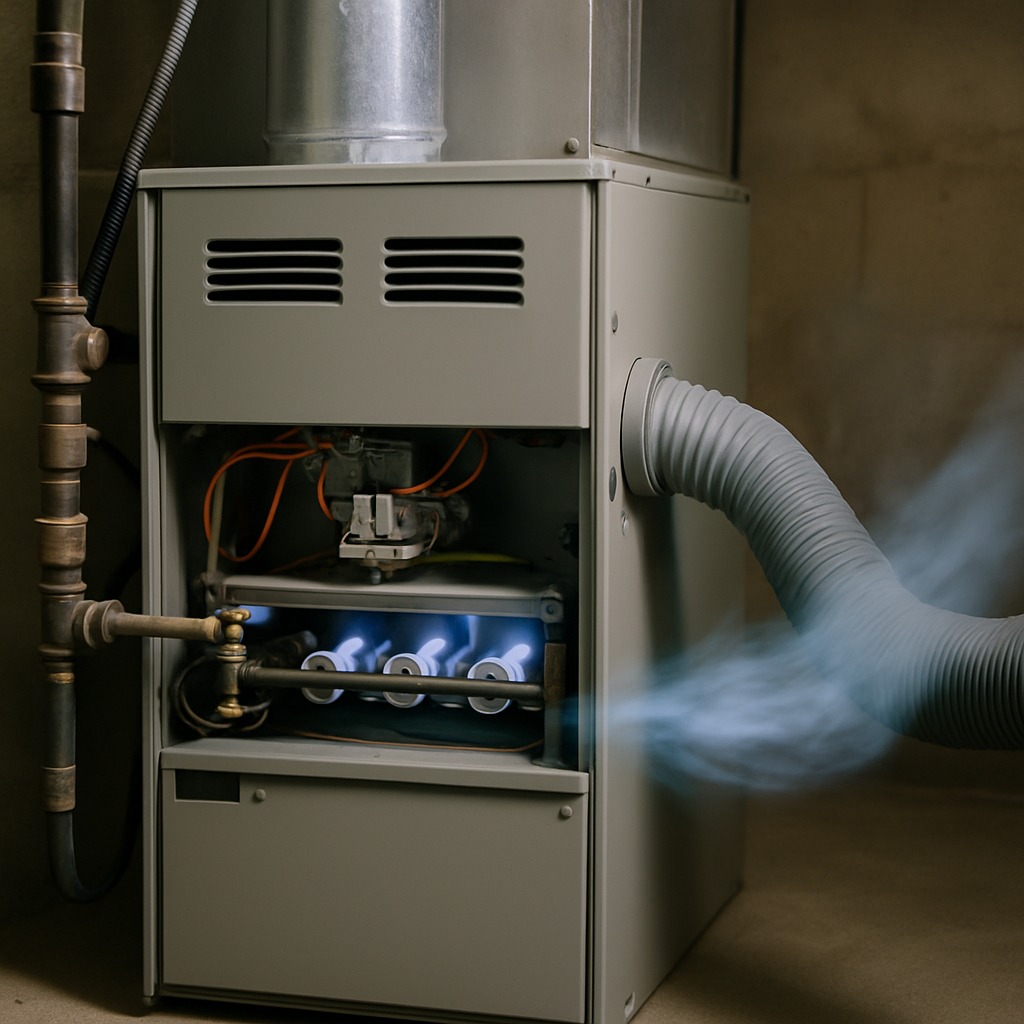
- Unusual odor or faint gas smell near furnace: You detect a faint sulfur-like or metallic burning smell near the furnace cabinet. This can indicate a cracked heat exchanger allowing combustion gases to mix with supply air, or a flame rollout event that singed wiring insulation. The smell may be intermittent, appearing only when burners attempt ignition. In some cases you also notice soot marks or discoloration around the burner compartment door or along the draft hood—a clear visual cue that combustion is abnormal.
What's Actually Causing This
- Dirty or clogged air filter: A clogged filter is the single most common cause of a furnace blowing cold air, responsible for roughly 30–40% of no-heat service calls according to HVAC service data. When the filter reaches 70–80% blockage, airflow across the heat exchanger drops below the minimum required CFM (typically 400 CFM per ton of capacity). The heat exchanger overheats, triggering the high-limit safety switch to shut the burners off while the blower keeps running to cool the exchanger. The cycle repeats—burners fire, exchanger overheats, limit trips, cold air blows. Filters rated MERV 11 or higher clog faster in homes with pets or renovation dust, sometimes in as little as 30 days.
- Malfunctioning thermostat or incorrect fan setting: The thermostat fan switch set to ON instead of AUTO keeps the blower running 24/7, including periods when burners are off, pushing unheated air through the ducts. Beyond user error, thermostat malfunctions—dead batteries (in battery-powered models), loose wiring connections, or miscalibrated temperature sensors—account for about 15% of cold-air complaints. A thermostat with a dead battery will lose its programming and may fail to send a heat call signal (24V W-wire) to the furnace control board. Wiring corrosion at the terminal block can also intermittently drop the signal, causing the burners to never fire while the blower defaults to continuous operation.
- Faulty ignition system — igniter or flame sensor: In gas furnaces with hot surface ignition (80%+ of units installed after 2000), the silicon nitride or silicon carbide igniter cracks or loses resistance after 3–7 years. A good igniter draws 3.2–3.6 amps; a failing one drops below 2.5 amps and cannot reach the 1,800°F needed to ignite gas. Alternatively, a dirty flame sensor—a thin metal rod in the burner flame—develops an oxide coating that prevents it from detecting the microamp DC signal (typically 1.5–6 µA) confirming flame presence. The control board then shuts the gas valve within 4–7 seconds of ignition as a safety lockout, and the blower continues pushing cold air. Flame sensor cleaning is a top-5 HVAC repair by volume.
- Tripped high-limit switch or rollout switch: The high-limit switch (typically rated at 150–200°F depending on model) is a safety device mounted on the heat exchanger or supply plenum. When airflow restriction, a failed blower motor capacitor, or blocked return ducts cause the exchanger temperature to exceed the limit, the switch opens and kills burner operation. Some limit switches are manual-reset and require a physical button press to restore operation. The rollout switch, located near the burner tray, trips when flames extend outside the combustion chamber—often caused by a cracked heat exchanger, blocked flue, or failed draft inducer motor. A tripped rollout switch is a serious safety concern and should not simply be reset without diagnosing the underlying cause. Together these account for about 20% of cold-air service calls.
A dirty flame sensor is the single most common reason I see furnaces blowing cold air on service calls — it accounts for roughly 40% of no-heat complaints in systems 5–15 years old. Before you pay for a full diagnostic, ask your tech to inspect and clean the flame sensor first. It's a thin metallic rod near the burner assembly. A quick cleaning with fine-grit emery cloth (never sandpaper coarser than 400-grit) restores proper microamp readings. Parts cost is under $20, and most pros charge $125–$175 total for the visit. If your tech jumps straight to recommending a control board without checking the flame sensor, get a second opinion — that upsell costs homeowners an unnecessary $400–$700 every day.
Step-by-Step Diagnosis
Work through these steps before calling a contractor. Each step tells you what to look for and what it means.
Check and replace the furnace air filter
🔧 Replacement air filter (correct size and MERV rating)Turn off the furnace at the thermostat and the power switch (usually a standard light switch on or near the furnace cabinet). Locate the filter—most are in a slot between the return duct and the blower compartment, or behind a return air grille. Slide the filter out and hold it up to a light source. If you cannot see light through the media, the filter is clogged and must be replaced. Note the size printed on the filter frame (common sizes: 16×25×1, 20×25×1, 16×25×4). Install a new filter with the airflow arrow pointing toward the blower. Turn the furnace back on and let it run for 5–10 minutes. Success looks like the burners staying lit continuously and supply air measuring 40–70°F warmer than return air. Replace standard 1-inch filters every 30–60 days; 4-inch media filters every 6–12 months.
Verify thermostat settings and battery condition
🔧 AA or AAA batteriesGo to your thermostat and confirm the system switch is set to HEAT (not COOL or OFF) and the fan switch is set to AUTO (not ON). The ON setting runs the blower continuously regardless of burner status, which is the most common user-caused reason for cold air from vents. If your thermostat uses AA or AAA batteries, replace them—low battery voltage can prevent the thermostat from sending a 24-volt heat-call signal to the furnace. After replacing batteries, set the temperature at least 3°F above the current room reading and wait 2–3 minutes for the furnace to respond. You should hear the draft inducer motor start, then the igniter click or glow, then the burners light. If you have a programmable or smart thermostat, check that the schedule hasn't overridden your manual setting. If the thermostat display is blank, check the furnace door switch and the 3-amp fuse on the control board.
Reset the furnace and read diagnostic codes
Turn the furnace power switch off, wait a full 30 seconds, then turn it back on. This resets most soft lockout conditions on the control board. Remove the lower access panel (the blower compartment door) and observe the LED indicator light on the control board. Count the number of blinks, note the pause between sequences, and compare the pattern to the diagnostic legend printed on the inside of the panel door or in the owner's manual. For example, on a Carrier/Bryant board, 3 blinks means pressure switch stuck open; 4 blinks means open high-limit circuit. Write down the code. If the LED shows a steady heartbeat (single slow blink), the board is in standby awaiting a call for heat—the problem may be thermostat wiring. If the code indicates a limit or pressure switch fault, proceed to check airflow restrictions. Do not bypass any safety switch.
Clean the flame sensor rod carefully
🔧 220-grit emery cloth, ¼-inch nut driver, multimeter (optional)Turn off furnace power and gas supply. Remove the upper access panel to expose the burner compartment. Locate the flame sensor—a thin metallic rod (about 2–3 inches long) mounted with a single ¼-inch hex-head screw, usually on the opposite end of the burner assembly from the igniter. It has a single wire connector (typically with a ceramic insulator). Disconnect the wire and remove the mounting screw. Using fine-grit emery cloth (220-grit), lightly sand the entire metal rod surface until it is shiny, removing the grayish oxide buildup. Do not use sandpaper coarser than 220-grit, and do not bend the rod. Reinstall the sensor, reconnect the wire, restore gas and power, and initiate a heat call. A properly functioning flame sensor produces a reading of 1.5–6 microamps (µA), which you can verify with a multimeter in µA DC mode connected in series. If burners stay on for more than 10 seconds, the cleaning was successful.
Inspect vents, registers, and return grilles
🔧 Probe thermometer, foil-faced HVAC tape or mastic sealantWalk through every room and confirm all supply registers and return air grilles are open and unobstructed. Furniture, rugs, or boxes placed over returns restrict airflow just as severely as a clogged filter. Each fully blocked return register can reduce system airflow by 50–100 CFM. Check the main return duct at the furnace for collapse, disconnection, or heavy dust accumulation. If your home has a fresh-air intake or combustion air intake, verify it is not blocked by ice, debris, or a bird nest. In the basement or utility area, look at all exposed ductwork joints for gaps or disconnections—a disconnected supply run dumps heated air into an unconditioned space while reducing pressure in the system. If you find a disconnected joint, reattach the sections and seal with foil-faced HVAC tape (not duct tape) or mastic sealant. After clearing obstructions, run the furnace for 10 minutes and recheck supply temperature at registers using a probe thermometer; you should see a 40–70°F temperature rise over the return air.
When to Stop DIY and Call a Pro
Stop all DIY troubleshooting and call a licensed HVAC technician immediately if you detect a persistent gas odor near the furnace, see visible soot or flame marks around the burner compartment, or if a rollout switch has tripped. These symptoms can indicate a cracked heat exchanger or blocked flue, both of which pose carbon monoxide poisoning and fire risks. Also call a professional if the furnace control board shows a hard lockout code that does not clear after a power reset, if the inducer motor does not start at all, or if you've completed the DIY steps above and the furnace still blows cold air. From a cost perspective, a diagnostic service call runs $75–$150 in most markets. Compared to the risk of a $3,000–$6,000 heat exchanger failure from ignoring a limit switch that keeps tripping, early professional diagnosis saves money. If your furnace is over 15 years old and the repair estimate exceeds $500, ask the technician about replacement economics—a new 96% AFUE furnace typically costs $3,500–$7,500 installed and can cut heating bills by 15–30% versus an aging 80% AFUE unit. Any time you are uncomfortable removing panels, handling gas components, or reading electrical circuits, a professional is the right call. The liability and safety risk is not worth saving a $100 service fee.
What Does This Repair Cost?
Costs vary by region, home age, and severity. These are national averages — always get 3 quotes.
| Repair Type | DIY Cost | Pro Cost | Emergency Premium |
|---|---|---|---|
| Thermostat fix / filter replacement | $0–$12 | $75–$150 | $150–$275 |
| Flame sensor cleaning or replacement | $8–$20 | $125–$275 | $225–$400 |
| Ignition control / inducer motor repair | Not recommended | $300–$900 | $500–$1,200 |
| Heat exchanger replacement | Not recommended | $800–$1,800 | $1,200–$2,400 |
*Emergency rates (nights/weekends/holidays) run 40–60% above standard. Get 3 quotes before approving work.
Get quotes from licensed professionals in your area
Free, no obligation — compare 3+ contractors in minutesWhat Drives the Cost?
| Cost Factor | Estimated Impact | Why It Matters |
|---|---|---|
| Time of service call (after-hours / weekend) | Adds $100–$200 | Emergency and weekend rates typically carry a 50–100% surcharge over standard weekday diagnostics |
| Furnace age (over 15 years) | Adds $200–$600 | Older units often need obsolete parts with markup, and techs spend more time on corroded connections |
| Annual maintenance contract | Saves $75–$150 per visit | Contract customers usually get waived diagnostic fees and 10–15% parts discounts |
| Geographic region (cold-climate states) | Adds $50–$150 | Peak-season demand in northern states drives up labor rates from December through February |
In regions with hard water or high humidity — think the upper Midwest and Northeast — heat exchangers corrode faster than national averages suggest. I've pulled cracked exchangers out of furnaces as young as 12 years old in homes near the Great Lakes, when the national average lifespan is 18–20 years. If your furnace is cycling on and off and blowing cold air intermittently, request a combustion analysis (about $150), not just a visual inspection. A visual check misses hairline cracks roughly 25% of the time. If the exchanger is cracked, weigh the repair cost ($800–$1,800) against a full furnace replacement ($3,500–$7,500 installed). The rule of thumb: if the unit is over 15 years old and the repair exceeds 50% of replacement cost, invest in a new system and capture the efficiency savings.
⚠️ Stop DIY — Call a Pro If You See These
- Yellow or orange burner flames instead of steady blue — Indicates incomplete combustion from a cracked heat exchanger, misaligned burners, or inadequate air supply. Can produce elevated carbon monoxide levels (above the 9 ppm indoor threshold). A cracked heat exchanger replacement runs $1,500–$3,500 in parts and labor; ignoring it risks CO exposure within days to weeks.
- Repeated high-limit switch tripping (more than twice in one day) — Means the heat exchanger is consistently overheating, which accelerates metal fatigue and cracking. Continued operation under these conditions can crack the exchanger within one heating season. Repair costs escalate from a $150–$300 blower capacitor or filter change to a $2,000–$6,000 exchanger replacement or full system replacement.
- Carbon monoxide detector alarm activates while furnace runs — Confirms combustion gases are entering living space—an immediate life-safety emergency. Evacuate the home, call 911, and then call your gas utility. The cause is almost always a cracked heat exchanger or blocked flue. CO exposure at 100 ppm causes headaches within 2 hours; at 400 ppm, it becomes life-threatening within 3 hours.
- Furnace makes loud banging or booming sound at ignition — Delayed ignition is allowing gas to accumulate in the combustion chamber before lighting, causing a small explosion. This stresses heat exchanger joints and can crack welds over time. If ignored for one heating season, repair costs can jump from a $150–$250 igniter or gas valve adjustment to a full heat exchanger failure at $2,000+.
Frequently Asked Questions
How much does it cost to fix Furnace Blowing Cold Air?
The national average repair cost ranges from $100 to $600 depending on the root cause. A clogged filter replacement is under $20 in parts. A flame sensor cleaning or thermostat battery swap typically costs $100–$175 as a service call. Igniter replacement runs $150–$300 parts and labor. A blower motor replacement costs $400–$700. The two biggest factors moving the price are the specific failed component and whether it is under manufacturer warranty (most heat exchangers carry a 20-year limited warranty). Emergency or after-hours service can add $75–$200 to any repair.
Can I fix Furnace Blowing Cold Air myself?
Yes, in many cases. Roughly 40–50% of cold-air calls are resolved by replacing a dirty filter, correcting thermostat settings, or cleaning a flame sensor—all tasks a handy homeowner can complete in under 30 minutes with basic tools. However, if the issue involves the gas valve, control board replacement, heat exchanger integrity, or draft inducer motor, you should hire a licensed HVAC technician. Working on gas-fired appliances without proper training risks gas leaks, CO exposure, and voiding manufacturer warranties. If you are unsure of the cause after checking the filter and thermostat, stop and call a professional.
How urgent is Furnace Blowing Cold Air?
Urgency depends on the cause and the outdoor temperature. If your CO detector is alarming or you smell gas, it is an immediate emergency—evacuate and call 911. If outdoor temps are below freezing, you have 4–8 hours before interior pipes begin to reach freezing risk (pipes typically freeze when sustained air temperature around them drops below 32°F for several hours). In moderate weather above 40°F, you have days before the situation becomes critical. However, every hour a furnace short-cycles on a tripped limit switch adds wear to the heat exchanger. Diagnose and correct the issue within 24 hours whenever possible.
What causes Furnace Blowing Cold Air?
The three most common causes are: (1) a dirty air filter restricting airflow and tripping the high-limit safety switch—this accounts for 30–40% of service calls; (2) a thermostat set to fan ON instead of AUTO, or thermostat with dead batteries failing to send a heat signal; and (3) a dirty flame sensor that cannot detect burner ignition, causing the control board to shut off gas within 4–7 seconds. Less common but more serious causes include a failed hot surface igniter, a stuck pressure switch, a bad blower motor capacitor, or a cracked heat exchanger.
Will homeowners insurance cover Furnace Blowing Cold Air?
Standard homeowners insurance does not cover furnace repairs due to normal wear and tear, component aging, or lack of maintenance. However, if a covered peril—such as a lightning strike or power surge—damages the furnace control board or blower motor, the repair or replacement may be covered under your dwelling or personal property coverage after you meet your deductible (typically $500–$2,500). A home warranty plan (separate from homeowners insurance) usually covers furnace repairs for a $75–$125 service call fee, but check for exclusions on pre-existing conditions and maintenance-related failures. Always file a claim before authorizing repairs if you believe a covered event caused the failure.
How do I find a licensed hvac technician for this?
Follow this four-step process: (1) Verify licensing—search your state's contractor licensing board database to confirm the technician holds a current mechanical or HVAC license; in most states this is legally required for gas appliance work. (2) Confirm insurance—ask for proof of general liability insurance ($1 million minimum) and workers' compensation coverage. (3) Get a written quote—a reputable company provides a diagnostic fee upfront (typically $75–$150) and a written estimate before performing repairs. Avoid anyone who quotes major work over the phone without seeing the unit. (4) Check references and reviews—look for at least 4 stars across 50+ reviews on Google or the BBB, and ask for 2–3 recent customer references. NATE certification (North American Technician Excellence) is a strong indicator of competence.
When your furnace blows cold air, the three most important decisions are: first, determine whether the problem is a simple user-level fix (dirty filter, thermostat set to ON, dead batteries) or a component failure requiring parts and expertise; second, read the diagnostic LED code on your control board to pinpoint the fault before spending money on a service call; and third, recognize the safety boundary—any sign of gas odor, CO alarm activation, soot, or a tripped rollout switch means stop immediately and call a professional. Most cold-air problems fall on the simple side, and 40% of them are resolved with a $10 filter change.
Your recommended next step: right now, check your filter and thermostat fan setting. If the filter is clean and the thermostat is set correctly, power-cycle the furnace, read the LED fault code, and clean the flame sensor if you are comfortable doing so. If the furnace still blows cold after those steps, call a licensed HVAC technician for a diagnostic visit. Budget $100–$300 for most common repairs. Acting within 24 hours prevents secondary damage to the heat exchanger and keeps your home safe from freeze risk and carbon monoxide exposure.
Ready to Solve This for Good?
Get matched with pre-screened, licensed hvac technicians in your area. Free quotes, no obligation, no spam.
GET FREE QUOTES NOW