
Updated June 12, 2026 · HomeFixx Editorial Team
Delayed ignition banging can crack a heat exchanger within days, risking carbon monoxide exposure and a $1,500–$3,500 replacement.
🔧 DIY Key Takeaways
- Replace a dirty furnace filter ($4–$25) — a clogged filter restricts airflow and causes ductwork to pop loudly as pressure builds and releases
- Open all supply and return vents fully and check for duct disconnections in the basement or attic; closed vents cause thermal expansion banging that mimics mechanical failure
- Listen for timing: banging only at startup points to delayed ignition (call a pro immediately), while banging during run cycles often indicates loose duct joints you can resecure with $8 foil tape and sheet-metal screws
👷 Hire a Pro Key Takeaways
- Delayed gas ignition — the most dangerous cause — requires a licensed HVAC tech to clean or replace burners and the flame sensor; typical cost is $150–$450 and ignoring it risks heat exchanger cracks costing $1,500–$3,500
- A failing blower motor bearing creates a repetitive banging that worsens over weeks; motor replacement runs $350–$900 installed, but waiting can burn out the control board adding $250–$600 more
- If banging occurs with visible flame rollout or a sulfur smell, shut the furnace off at the switch and call for emergency service ($175–$350 after-hours); this scenario indicates possible gas valve or heat exchanger failure
📋 In This Guide
HomeFixx guides are researched and fact-checked by licensed trade professionals. Cost data updated June 12, 2026.
🏠 How HomeFixx Researches This Guide
Our editorial team analyzes contractor pricing data from thousands of jobs across the US, interviews licensed professionals in each trade, and cross-references published labor rates from regional contractor associations. Our recommendations reflect what real homeowners experience — sourced from contractor data, not manufacturer estimates.
It's 2 a.m., the house is 28°F outside, and your furnace just fired up with a bang loud enough to rattle framed photos off the hallway wall. You're standing at the basement door wondering whether the whole system is about to blow — or whether it's something you can fix before breakfast. You're not alone: furnace banging is one of the top five HVAC complaints every heating season, and the cause ranges from a $4 air filter to a $3,500 heat exchanger replacement.
The critical difference is timing. A bang at startup often signals delayed gas ignition — a genuinely dangerous condition that can crack internal components and introduce carbon monoxide into your living space. Banging during the run cycle typically points to expanding ductwork or a failing blower motor, which is urgent but not immediately hazardous. Knowing which one you're dealing with can save you hundreds in emergency service fees.
This contractor-verified guide breaks down every banging scenario by sound, timing, and risk level. We include real 2024 repair costs from licensed HVAC technicians across the U.S., specific DIY checks you can safely perform in under 10 minutes, and the exact red flags that mean you should shut the system down and call for emergency service tonight — not tomorrow.
Symptoms: What You're Seeing
- Delayed ignition boom at startup: When you turn on your furnace, you hear a loud, single bang or boom roughly 3–10 seconds after the thermostat calls for heat. This happens because gas accumulates in the combustion chamber before the igniter or pilot finally lights it. The sound is sharp and concussive — similar to a small firecracker inside the unit. You may feel a slight vibration through nearby walls or floors. Some homeowners report the bang is strong enough to rattle ductwork registers throughout the house.
- Repetitive metallic banging from ductwork: You hear a rhythmic popping or banging that starts 30–90 seconds after the blower kicks on and repeats when the system shuts off. This is sheet-metal ductwork expanding under heat and contracting as it cools. The sound originates at trunk lines or takeoff fittings, often in the basement ceiling or between floor joists. It sounds like someone tapping on a tin can with a wrench, and it follows a predictable pattern tied to blower cycling.
- Loud knocking from the blower compartment: A consistent knock, clunk, or rattling sound while the blower is running points to a failing blower motor bearing, a cracked fan blade, or a loose blower wheel setscrew. The noise is mechanical, not pressure-related. You can usually hear it get louder as the blower reaches full speed. Place your hand on the blower access panel and you will feel the vibration. The sound may pause briefly, then resume with a metallic scraping quality.
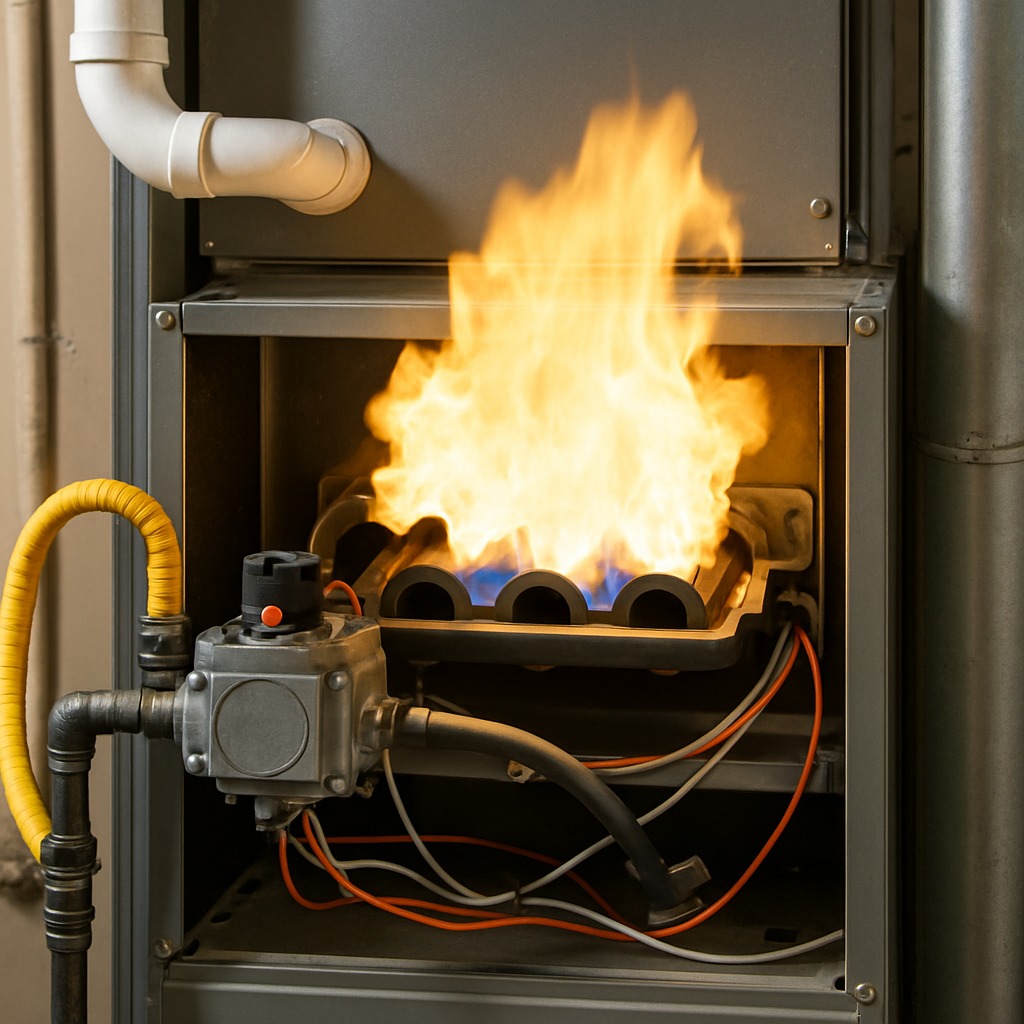
- Intermittent banging during combustion cycle: Mid-cycle banging that occurs while the furnace is actively heating — not just at startup or shutdown — can indicate a cracked heat exchanger or burner misalignment. You may also notice an unusual smell, something faintly metallic or acrid, near the supply registers. The banging is irregular, not rhythmic, and may be accompanied by a yellow or flickering burner flame visible through the sight glass on the furnace door.
- Single loud thud when blower shuts off: A heavy thud or clunk right when the blower motor cycles off suggests a loose or broken motor mount, a disconnected flex connector, or a failing blower motor capacitor causing the motor to stop abruptly rather than coasting down. You may notice the furnace cabinet shakes momentarily. This symptom typically worsens over weeks as the mount hardware loosens further or the capacitor degrades.
What's Actually Causing This
- Delayed ignition due to dirty burners or weak igniter: This is the most dangerous cause and accounts for roughly 30–40% of banging-noise service calls. When burner orifices are clogged with dust, rust, or carbon deposits, gas doesn't ignite immediately when the hot surface igniter or pilot flame fires. Gas pools in the combustion chamber for several seconds, then ignites all at once, producing a small explosion. A weak or cracking hot surface igniter (typical lifespan is 3–5 years) compounds the problem because it takes longer to reach the 1,800°F threshold needed to light natural gas. Ignoring delayed ignition risks cracking the heat exchanger, which turns a $150 repair into a $1,500–$3,500 replacement.
- Expanding and contracting sheet-metal ductwork: Undersized or improperly braced rectangular ductwork is the number-one cause of non-dangerous banging noises. Sheet metal expands when heated air (typically 120–140°F) pushes through, then contracts when the blower shuts off and temperatures drop. Ducts smaller than 20-gauge without cross-breaks or stiffening beads are most susceptible. Trunk lines longer than 8 feet and takeoffs with sharp 90-degree angles are the worst offenders. This issue is cosmetic — it poses no safety risk — but it is extremely common in homes built between 1970 and 1995 when lightweight ductwork was standard.
- Failing blower motor or loose blower wheel: Blower motors typically last 15–20 years, but sealed bearings can fail sooner if the motor overheats due to a dirty filter or restricted airflow. When bearings wear, the motor shaft develops play, causing the blower wheel (squirrel cage) to wobble and contact the housing. A loose setscrew on the blower wheel hub produces a distinct banging at startup and shutdown as the wheel shifts on the shaft. This accounts for about 20% of banging-noise calls and costs $300–$700 to repair depending on whether the motor or just the wheel needs replacement.
- Cracked heat exchanger causing expansion noise: A cracked heat exchanger can produce irregular banging or popping as the two sides of the crack expand and separate under combustion heat, then close as the metal cools. This is the most serious cause. A cracked heat exchanger can leak carbon monoxide into your living space. Heat exchangers crack most commonly in furnaces 15–25 years old, especially in units that have been oversized for the home, causing frequent short-cycling. Replacement costs range from $1,500 to $3,500 for the exchanger alone, but at that age most contractors recommend full furnace replacement at $3,000–$7,000 installed.
Twenty-year HVAC veteran tip: When you hear a single loud bang at startup followed by a normal burn cycle, you almost certainly have delayed ignition — gas is pooling in the combustion chamber before the igniter catches it. This is not a noise you troubleshoot yourself. Before calling a tech, pull your furnace filter and shine a flashlight into the burner assembly through the sight glass. If you see soot buildup or orange-tipped flames instead of clean blue, mention that on the call. It helps the tech arrive with the right parts — typically a $12 flame sensor and $45 igniter — and can save you a $95 follow-up visit. Delayed ignition repairs average $150–$400 when caught early but can escalate past $2,000 once a heat exchanger warps.
Step-by-Step Diagnosis
Work through these steps before calling a contractor. Each step tells you what to look for and what it means.
Kill power and inspect the air filter
🔧 Replacement air filter (correct size)Turn off the furnace at the dedicated switch (usually a standard light switch mounted on or near the unit) and at the breaker panel. Open the blower compartment door and slide out the air filter. Hold it up to a light source: if you cannot see light through the filter media, it is too dirty and is restricting airflow, which causes the blower motor to overwork and can contribute to overheating, duct pressure issues, and banging. Replace with the exact same size filter — check the dimensions printed on the frame (e.g., 16x25x1 or 20x20x4). Use a MERV 8–11 pleated filter for most residential systems. A clogged filter is the single most common aggravating factor in furnace noise complaints. Reinstall the filter with the airflow arrow pointing toward the blower. This takes about 5 minutes and costs $5–$20.
Visually inspect burners for debris or rust
🔧 Flashlight, shop vacuum with crevice attachmentWith power still off and the gas valve turned to the off position, remove the furnace's lower access panel to expose the burner assembly. Use a flashlight to look at each burner tube. You are looking for visible rust flakes, dust buildup, or spider webs inside the burner ports — spiders are attracted to the mercaptan odorant in natural gas and commonly nest in burner tubes during summer months, causing blockages. If you see light debris, carefully vacuum the exterior of the burners using a shop vacuum with a narrow crevice attachment. Do not insert anything into the gas orifices. If burner tubes are heavily rusted, corroded, or visibly cracked, stop here and call a licensed HVAC technician. Cleaning accessible dust and debris takes about 15 minutes. This step alone resolves delayed ignition banging in roughly 25% of cases.
Check blower wheel for looseness and damage
🔧 5/16-inch or 3/8-inch nut driver, flashlightWith power off, open the blower compartment and manually spin the blower wheel (squirrel cage). It should spin freely and smoothly without wobble or scraping. Grab the wheel and try to move it side-to-side and forward-and-back on the motor shaft. Any play means the setscrew that locks the wheel to the shaft has loosened. Locate the setscrew on the wheel hub — it is typically a 3/8-inch or 5/16-inch hex head. Tighten it snugly with the appropriate wrench or nut driver until the wheel is firmly seated with no lateral movement. While you are there, inspect the blower wheel fins for cracks, chips, or accumulated dirt. A heavily soiled blower wheel causes imbalance and vibration. If you find cracked or broken fins, the wheel must be replaced — this is a $60–$150 part. Reassemble the compartment.
Stiffen noisy ductwork to stop oil-canning
🔧 Sheet-metal screws, screw gun, duct stiffener or 1-inch angle ironIf the banging is clearly coming from sheet-metal ductwork (not the furnace itself), locate the offending section by running the system and listening. The noise is usually in a long, flat section of rectangular trunk duct. Turn off the system. Place a screw-on duct stiffener — sometimes called a cross-break bead or duct brace — across the widest flat face of the duct. You can also use a piece of 1-inch angle iron screwed to the duct face with #8 sheet-metal screws every 6 inches. The goal is to prevent the flat panel from flexing. Another option: apply a bead of foil-faced duct mastic tape along the center of the panel for minor cases. For ducts inside finished walls or ceilings, you will need professional access. This fix costs $5–$30 in materials and takes about 20 minutes per section.
Test the system and monitor for recurrence
Restore power and gas supply. Set the thermostat 5 degrees above room temperature to trigger a full heating cycle. Stand near the furnace with the lower access panel removed (most furnaces are designed to run briefly with the panel off for diagnostic purposes — check your model). Watch the burner ignition through the sight glass or open panel. The burners should light within 3–5 seconds of the igniter glowing, with a clean blue flame and no audible boom. Listen through the entire cycle — startup, steady run, and shutdown. If the banging is gone, you have solved it. If a delayed-ignition boom persists, or if you see a yellow, lazy, or uneven flame, turn the system off immediately and schedule a professional inspection. Run the system through 3–4 full cycles over the next 24 hours and note any changes. Replace the access panel securely when finished — the door safety switch will prevent operation if the panel is not seated.
When to Stop DIY and Call a Pro
Stop all DIY work and call a licensed HVAC technician immediately if you experience any of the following: a loud boom or explosion sound at ignition that repeats after cleaning the burners; a yellow, orange, or rolling flame instead of a steady blue flame; any smell of rotten eggs (gas leak) near the furnace; visible cracks, rust holes, or separation in the heat exchanger; carbon monoxide detector alarms or symptoms such as headaches, dizziness, or nausea among household members; or a blower motor that is hot to the touch, smells like burning insulation, or trips the breaker. Financially, if the diagnostic and repair estimate exceeds $500 on a furnace that is already 18–20+ years old, replacement usually makes more sense than repair — a mid-efficiency 80,000 BTU gas furnace runs $3,000–$5,500 installed in most markets. Any work involving gas line connections, heat exchanger inspection, or combustion analysis requires a licensed technician with combustion analyzer equipment (Testo, Bacharach, or equivalent). This is not about skill level — it is about having the instrumentation to verify safe operation. A standard diagnostic service call runs $75–$150 and is money well spent if the noise has not resolved after basic filter and blower-wheel checks.
What Does This Repair Cost?
Costs vary by region, home age, and severity. These are national averages — always get 3 quotes.
| Repair Type | DIY Cost | Pro Cost | Emergency Premium |
|---|---|---|---|
| Dirty filter replacement | $4–$25 | $85–$150 | $150–$250 |
| Flame sensor / igniter cleaning or replacement | $12–$45 | $150–$400 | $275–$550 |
| Blower motor replacement | Not recommended | $350–$900 | $550–$1,200 |
| Heat exchanger replacement | Not recommended | $1,500–$3,500 | $2,000–$4,200 |
| Ductwork repair (oil-canning fix) | $8–$30 | $85–$200 | $150–$300 |
| After-hours emergency diagnostic call | N/A | $95–$175 | $175–$350 |
*Emergency rates (nights/weekends/holidays) run 40–60% above standard. Get 3 quotes before approving work.
Get quotes from licensed professionals in your area
Free, no obligation — compare 3+ contractors in minutesWhat Drives the Cost?
| Cost Factor | Estimated Impact | Why It Matters |
|---|---|---|
| Time of service call (nights/weekends) | Adds $75–$200 | After-hours and weekend rates are typically 1.5x–2x standard diagnostic fees; scheduling a weekday morning call saves significantly |
| Furnace age (15+ years) | Adds $200–$1,500 | Older units often need obsolete parts sourced from specialty suppliers, and techs may recommend full replacement over repair once a unit passes 18 years |
| Annual maintenance contract | Saves $100–$350/year | Prepaid service plans typically include one or two tune-ups plus discounted parts and priority scheduling, catching delayed ignition issues before they cause banging |
| Geographic region (cold-climate states) | Adds $50–$300 | Peak-season demand in northern states from December–February drives up labor rates and wait times; booking in early fall avoids both premiums |
Cost-saving insight most homeowners miss: ductwork banging — technically called oil-canning — is the most common source of furnace-related banging noises and is often misdiagnosed by less experienced techs as a mechanical furnace problem. The sheet metal in your supply plenum flexes inward under negative pressure and snaps back loudly. A seasoned tech will check this first before quoting burner or blower work. The fix is a simple cross-break or stiffener bead hammered into the duct panel, costing $85–$150 for a service call. In northern states with forced-air systems running 18+ hours daily in winter, this accounts for roughly 40% of 'furnace banging' calls. Ask your tech specifically whether the noise originates from the ductwork or the unit itself before approving any repair over $200.
⚠️ Stop DIY — Call a Pro If You See These
- Boom or explosion sound at every startup cycle — Repeated delayed ignition stresses the heat exchanger with each mini-explosion. Within 1–3 heating seasons, this can crack the exchanger, turning a $150 burner cleaning into a $1,500–$3,500 heat exchanger replacement or full system replacement. A cracked exchanger also creates a carbon monoxide poisoning risk.
- Visible yellow or flickering burner flame — A yellow flame indicates incomplete combustion, meaning the furnace is producing elevated carbon monoxide levels. CO concentrations above 35 ppm in ambient air are dangerous. Without a combustion analysis, you cannot know the CO output. This can escalate to a life-safety emergency within hours if the heat exchanger is also compromised.
- Banging accompanied by burning smell from vents — A hot or electrical burning smell combined with banging points to a failing blower motor drawing excessive amperage. Motors pulling more than rated amps overheat winding insulation, which can fail completely within days to weeks, leaving you without heat. In worst cases, an overheating motor can cause a fire — HVAC-related fires account for roughly 15% of residential heating fires according to NFPA data.
- Furnace short-cycling with banging at each restart — If the furnace runs for only 2–5 minutes, bangs, shuts off, then restarts and repeats, the high-limit safety switch is likely tripping due to overheating. This pattern accelerates wear on the igniter, gas valve, and control board. Each component costs $100–$400 to replace, and cumulative damage from short-cycling can total $800–$1,200 within a single season if left unaddressed.
Frequently Asked Questions
How much does it cost to fix Furnace Making Banging Noise?
The national average repair cost ranges from $150 to $600 depending on the root cause. A simple burner cleaning and igniter replacement runs $150–$250 in most markets. A blower motor replacement costs $300–$700 including labor. Ductwork modifications to stop oil-canning typically cost $100–$300. The two biggest factors that move the price are the specific failed component (igniter vs. motor vs. heat exchanger) and whether your system uses a standard or variable-speed blower motor. Heat exchanger replacement — the worst-case scenario — runs $1,500–$3,500, at which point full furnace replacement at $3,000–$7,000 is usually the better investment.
Can I fix Furnace Making Banging Noise myself?
Yes, in specific limited cases. You can safely replace a dirty air filter, tighten a loose blower wheel setscrew, and stiffen noisy ductwork — these are straightforward mechanical tasks requiring basic hand tools. However, any repair that involves the gas supply, burner assembly adjustments, igniter replacement, or heat exchanger inspection should be handled by a licensed HVAC technician. Working on gas-fired equipment without proper training and combustion analysis tools creates carbon monoxide and fire risks. If the banging is caused by delayed ignition and persists after a filter change and visual burner inspection, stop and call a pro.
How urgent is Furnace Making Banging Noise?
It depends on the type of banging. Ductwork popping and oil-canning is cosmetic — you can address it at your convenience over days or weeks with no safety risk. A loose blower wheel should be fixed within a few days before it causes motor bearing damage. A delayed-ignition boom is urgent: address it within 24–48 hours because every ignition cycle stresses the heat exchanger and increases the risk of a crack and carbon monoxide leak. If you smell gas or your CO detector alarms, shut the furnace off immediately, leave the house, and call your gas utility's emergency line — that is a same-hour emergency.
What causes Furnace Making Banging Noise?
The three most common causes are: (1) Delayed ignition — dirty burners or a failing hot surface igniter allow gas to pool in the combustion chamber before it lights, creating a mini-explosion. This accounts for 30–40% of banging calls. (2) Ductwork expansion and contraction — undersized or unbraced sheet-metal ducts pop and bang as they heat up and cool down, responsible for about 25–30% of noise complaints. (3) Blower motor or wheel issues — worn bearings, a loose setscrew, or a cracked squirrel-cage wheel cause mechanical banging during blower operation, making up roughly 20% of service calls.
Will homeowners insurance cover Furnace Making Banging Noise?
Standard homeowners insurance policies do not cover furnace repairs due to normal wear and tear, mechanical failure, or lack of maintenance — which covers nearly all banging-noise scenarios. Insurance may cover furnace damage resulting from a specific covered peril, such as a lightning strike that damages the control board or a house fire that affects the unit. A home warranty (not the same as homeowners insurance) typically covers furnace repairs with a $75–$125 service call fee if the furnace was functioning when the policy started. Check your warranty contract for exclusions related to pre-existing conditions or lack of maintenance documentation.
How do I find a licensed hvac technician for this?
Follow this four-step process: (1) Verify the contractor holds a current HVAC license in your state or municipality — check your state's contractor licensing board website. (2) Confirm they carry general liability insurance (minimum $1 million) and workers' compensation coverage; ask for a certificate of insurance. (3) Get a written quote that separates diagnostic fees from repair costs — a reputable company charges $75–$150 for diagnostics and applies it toward the repair if you proceed. (4) Check references and online reviews, prioritizing Google and BBB over anonymous review sites. NATE certification (North American Technician Excellence) is an additional credential that indicates the technician has passed industry-standard competency exams. Avoid any contractor who diagnoses over the phone without inspecting the unit.
A banging furnace demands your attention, but the right response depends entirely on accurately identifying the source. The three most important decisions you face are: (1) determining whether the noise originates from the combustion chamber, the blower compartment, or the ductwork — because each points to a completely different problem with different urgency levels; (2) knowing when to stop DIY troubleshooting — specifically, any delayed-ignition boom that persists after a filter change and visual burner inspection means you need professional combustion analysis; and (3) weighing repair cost against furnace age — if your unit is 18+ years old and facing a repair over $500, the math almost always favors replacement.
Your recommended next step: change the air filter, visually inspect the burners and blower wheel using the steps above, and listen through three full heating cycles. If the banging stops, schedule an annual maintenance visit to prevent recurrence. If it continues — especially a startup boom or any smell of gas — shut the system down, call a licensed HVAC technician for a combustion analysis and full inspection, and do not run the furnace until it has been cleared. A $100 service call is cheap insurance against a cracked heat exchanger or carbon monoxide exposure.
Ready to Solve This for Good?
Get matched with pre-screened, licensed hvac technicians in your area. Free quotes, no obligation, no spam.
GET FREE QUOTES NOW