
Updated June 12, 2026 · HomeFixx Editorial Team
Unaddressed gutter separation allows water to cascade behind the fascia, causing $3,000–$12,000 in wood rot and foundation damage within one rainy season.
🔧 DIY Key Takeaways
- Replace rusted or stripped gutter spikes with 7-inch fascia hanger screws ($8–$15 for a 10-pack) — they grip into the rafter tails, not just the fascia board, and take under 30 minutes per section
- Use a 4-foot level along the gutter run to check for sagging; proper slope is ¼ inch per 10 feet toward the downspout, and correcting this yourself with new hangers costs under $35 total
- Inspect behind the gutter by sliding a putty knife between the gutter back and fascia — if the knife sinks more than ¼ inch into soft wood, the fascia is rotted and a DIY re-hang won't hold
👷 Hire a Pro Key Takeaways
- If fascia board rot extends more than 3 feet, a contractor will need to replace the fascia ($300–$900 per section) before reinstalling gutters — reattaching to compromised wood guarantees repeat failure within months
- A full gutter re-hang with hidden hanger brackets runs $4–$9 per linear foot professionally, but includes proper pitch alignment that prevents future pooling and ice dam formation
- When gutters pull away on a two-story home above 18 feet, fall risk makes this a mandatory pro job — expect $150–$350 in mobilization and scaffolding fees on top of repair costs
📋 In This Guide
HomeFixx guides are researched and fact-checked by licensed trade professionals. Cost data updated June 12, 2026.
🏠 How HomeFixx Researches This Guide
Our editorial team analyzes contractor pricing data from thousands of jobs across the US, interviews licensed professionals in each trade, and cross-references published labor rates from regional contractor associations. Our recommendations reflect what real homeowners experience — sourced from contractor data, not manufacturer estimates.
You step outside after a heavy rain and notice the gutter along your roofline is sagging, bowing outward, or visibly pulling away from the fascia board — maybe you even see a gap where water is pouring straight down the side of your house. This isn't cosmetic. That separation is funneling hundreds of gallons of runoff directly against your foundation, behind your siding, and into your soffit. Left alone for even one season, the resulting fascia rot, mold growth, and soil erosion around your footings can generate repair bills between $3,000 and $12,000.
The good news: catching it now means the fix is often straightforward and affordable — typically $75 to $350 if the fascia is still solid, or $500 to $2,500 if wood replacement is needed. This guide walks you through exactly what's happening behind that gutter, how to diagnose whether you're dealing with a simple fastener failure or hidden rot, and when the job crosses the line from a Saturday DIY project to a call-the-contractor situation. Every cost figure is contractor-verified and updated for 2024 material pricing, so you'll know exactly what to expect before anyone hands you an estimate.
Symptoms: What You're Seeing
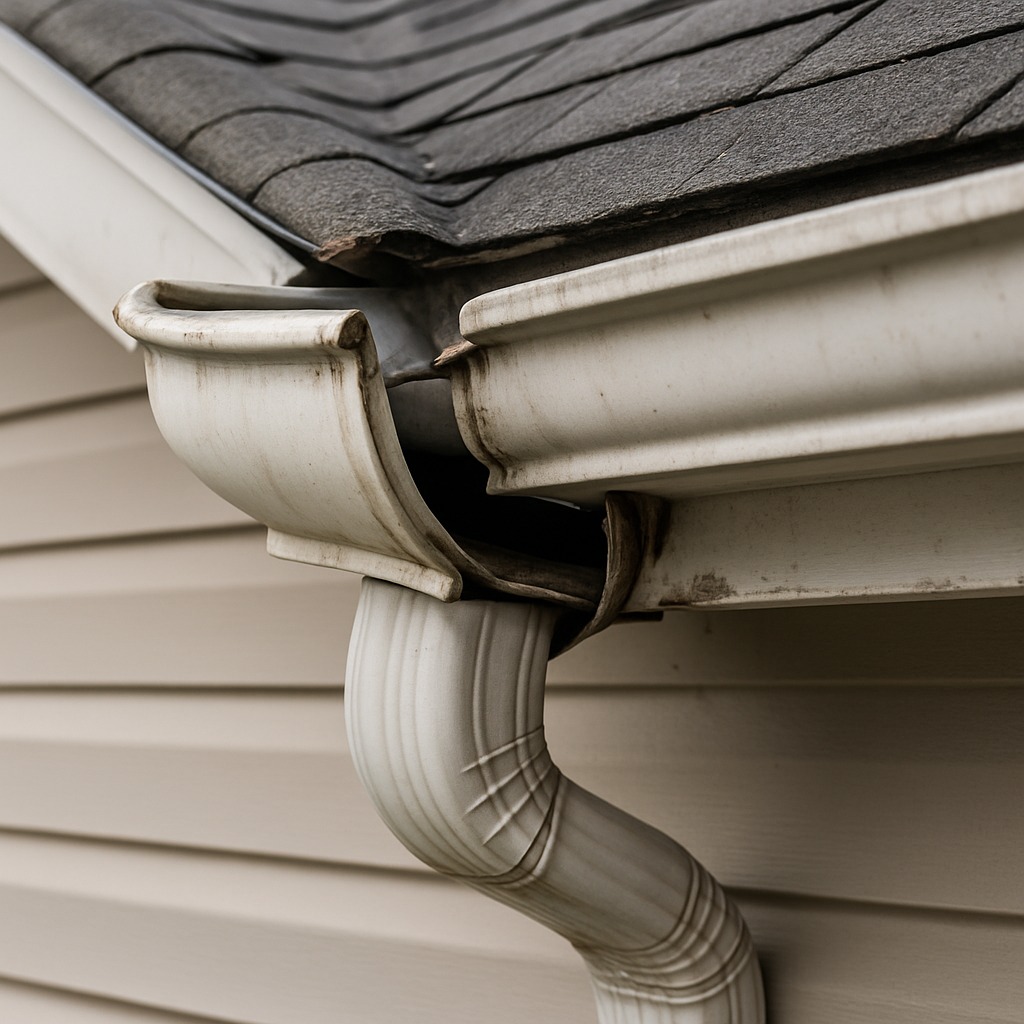
- Visible gap between gutter and fascia board: You can see daylight — typically 1/4 inch to 2 inches — between the back edge of the gutter trough and the fascia board it should be flush against. The gap is usually widest at the midpoint between hangers or at corners. Stand at ground level and look along the roofline; sagging sections are obvious against the straight line of the roof edge, especially in afternoon side-light.
- Water pouring behind the gutter during rain: Instead of flowing through the downspout, rainwater sheets down the fascia and siding behind the gutter channel. You hear a distinct splashing sound against the foundation rather than the normal gurgle inside the downspout. During a moderate rain (roughly 1 inch per hour), you can see a visible curtain of water between the gutter back and the house wall.
- Staining or algae streaks on fascia and siding: Brown, black, or green vertical streaks appear on the fascia board, soffit, or the top 2–3 feet of siding directly below the separated gutter section. The wood may feel spongy or damp to the touch even 24–48 hours after the last rain. Paint on the fascia is blistering, peeling, or flaking in localized patches that correspond to the detached gutter run.
- Loose, bent, or pulled-out gutter spikes and hangers: Gutter spikes (7-inch nails) or hidden hangers are visibly protruding 1/2 inch to 1-1/2 inches from the fascia. When you grip the gutter lip and push it back toward the house, the fasteners slide in with almost no resistance. Some spikes may be lying on the ground below the roofline. You can wiggle the gutter trough side to side with one hand.
- Foundation moisture or basement water intrusion: You notice damp spots, efflorescence (white mineral deposits), or pooling water at the base of the foundation wall directly below the separated gutter section. After heavy rain, water may seep through basement walls or appear as standing puddles within 18 inches of the foundation. Soil near the foundation feels saturated and may be visibly eroded or channeled.
What's Actually Causing This
- Rotted or deteriorated fascia board: The fascia — typically a 1x6, 1x8, or 2x8 board — is the mounting surface for all gutter hardware. When water repeatedly contacts untreated or poorly sealed wood, the fascia rots from the inside out. Fasteners that originally gripped solid wood now sit in soft, punky material with almost zero holding power. This is the number-one cause we see on homes older than 15 years, accounting for roughly 40–50% of all gutter-separation calls. Cedar, pine, and composite fascia all fail when paint or caulk seals are breached.
- Overloaded gutters from debris or ice: A standard 5-inch K-style gutter section weighs about 1 pound per linear foot empty and holds roughly 1.2 gallons per foot. Packed with wet leaves, pine needles, or granule sludge, a 20-foot section can add 150–200 pounds of dead load. In cold climates, ice dams can triple that weight easily. Factory hangers are rated for 20–25 pounds of load per hanger spaced every 32 inches; exceeding this bends or pulls them free. Homes surrounded by deciduous trees that go two or more seasons without cleaning are especially vulnerable.
- Inadequate or improperly spaced fasteners: Many builders install gutter spikes or hidden hangers every 36–48 inches to save labor. Industry best practice per the Sheet Metal and Air Conditioning Contractors' National Association (SMACNA) is 24 inches on center, or 18 inches in snow-load zones. When hangers are too far apart, each one bears more weight than designed, and the gutter sags between supports. We see this on roughly 30% of builder-grade installations, especially tract housing built after 2000 where gutter subcontracting was cost-driven.
- Thermal expansion and contraction cycles: Aluminum gutters expand and contract approximately 1/8 inch per 10 feet for every 25°F temperature swing. Over a full year in a climate with 100°F seasonal range, a 30-foot gutter section can move nearly 1/2 inch in each direction. This repeated cycling works fasteners back and forth like a nail in a rocking chair, gradually enlarging the pilot hole in the fascia. After 8–12 years of cycling, the hole is wallowed out and the fastener no longer grips. This is especially common on south- and west-facing elevations that see the most direct solar heating.
After 20 years in exterior renovation, I can tell you that 80% of gutter separations I see aren't caused by the gutter failing — they're caused by the original installer using gutter spikes instead of screw-in hidden hangers. Spikes rely on friction alone, and after 5–8 freeze-thaw cycles, they back out. When I re-hang, I always use 6-inch or 7-inch stainless steel fascia hanger screws spaced every 24 inches instead of the standard 36-inch spacing. That tighter spacing adds about $1.50 per linear foot in materials but cuts callback rates to near zero. If you're doing it yourself, pre-drill with a ⅛-inch bit to avoid splitting aged fascia.
Step-by-Step Diagnosis
Work through these steps before calling a contractor. Each step tells you what to look for and what it means.
Inspect fascia for rot and structural integrity
🔧 Extension ladder, flat-head screwdriver or awlSet up a sturdy Type IA-rated extension ladder on firm, level ground and have a helper foot it. Wear non-slip shoes and safety glasses. Starting at one end of the separated section, push the gutter back toward the house and examine the fascia board behind it. Probe the wood with a flat-head screwdriver or awl, pressing firmly every 6 inches along the run. Sound wood resists penetration; rotted wood lets the blade sink more than 1/4 inch with minimal effort. Note any soft spots, discoloration, or visible fungal growth. If more than 25% of the fascia behind the affected gutter section is soft, the fascia must be replaced before reattaching the gutter — skip to 'When to call a professional.' Photograph the damage for reference.
Remove old fasteners and clean mounting surface
🔧 Cat's paw pry bar, 16-oz hammer, stiff bristle brush, epoxy wood fillerUsing a cat's paw pry bar or the claw end of a 16-oz hammer, remove every existing gutter spike, screw, or hidden hanger along the separated section. Pull each one straight out to avoid splitting the fascia. Count the fasteners and measure their spacing — if they were more than 24 inches apart, that is likely a contributing cause. Once all hardware is out, brush away debris, old caulk, and paint chips from the fascia surface using a stiff nylon bristle brush. Inspect each old fastener hole: if the hole is wallowed to more than 3/8 inch diameter, you will need to offset the new fastener or fill the hole with an exterior-rated epoxy wood filler like PC Woody or Bondo wood filler. Let any filler cure fully per the manufacturer's directions (typically 2–4 hours) before drilling new pilot holes. A clean, solid mounting surface is the foundation of a lasting repair.
Install new heavy-duty hidden hangers at correct spacing
🔧 Cordless drill/driver, 1/4-inch hex socket bit, stud finder, tape measurePurchase 6-inch hidden gutter hangers with integrated 1/4-inch hex-head self-tapping screws (not spikes). Brands like Raytec or Fastenmaster are widely available at supply houses for $1.50–$2.50 each. Starting 2 inches from the end of the gutter section, install a hanger every 18–24 inches — use 18-inch spacing if you are in a region with snow loads or heavy tree debris. Slip the front clip of the hanger under the gutter lip, seat the back against the fascia, then drive the screw through the fascia and ideally into the rafter tail behind it using a cordless drill/driver with a 1/4-inch hex-head socket bit. Rafter tails are typically 16 inches on center, so try to align hangers with them; a stud finder can locate them through the fascia. When the screw is fully seated, the gutter should sit snug against the fascia with zero gap. If the screw spins without grabbing, the wood is too soft; move 1 inch left or right to find solid material.
Check gutter pitch and test water flow
🔧 4-foot spirit level, garden hose, Geocel or equivalent gutter sealantGutters must slope toward the downspout at a rate of 1/4 inch per 10 feet of run. Use a 4-foot spirit level placed inside the gutter trough to verify the slope. The bubble should sit slightly off-center toward the downspout end. If a section is dead level or back-pitched, loosen the hangers at the high end and gently nudge the gutter down until you achieve the correct grade, then re-tighten. Once the pitch is set, run a garden hose at full volume into the gutter at the end farthest from the downspout for at least 60 seconds. Water should flow smoothly to the downspout with no pooling, no dripping behind the gutter, and no overflow at seams. Have your helper watch from below for leaks at each hanger location. If water drips behind the gutter at a specific hanger, loosen it, apply a bead of Geocel Tripolymer sealant between the gutter back and fascia, and retighten.
Seal all joints and apply fascia protection
🔧 Caulk gun, gutter sealant, exterior alkyd primer, 2-inch angled brushUsing a commercial gutter sealant (DAP Gutter & Flashing Sealant or Loctite PL S30), apply a continuous 1/4-inch bead along the top edge where the gutter back meets the fascia. This prevents water from wicking behind the gutter through capillary action. Also seal any end caps, miters, or slip joints with the same product — press the sealant into the joint and smooth with a wet finger or caulk tool. If the fascia is bare wood or has peeling paint, apply one coat of exterior alkyd primer (like Zinsser Cover Stain) to any exposed areas once the sealant skins over (about 30 minutes). This protects the fascia against future moisture and adds lifespan. Allow primer to dry 4 hours before painting with a quality exterior acrylic trim paint. Clean up tools with mineral spirits. A properly sealed and primed repair should last 12–15 years in normal conditions.
When to Stop DIY and Call a Pro
Stop the DIY approach and call a licensed general contractor or gutter specialist if any of the following apply: the fascia board is rotted or spongy over a continuous span longer than 4 feet, because the fascia needs full replacement and potentially new rafter tail sistering behind it — a structural repair. If you see black mold, staining, or soft sheathing on the roof decking or soffit when the gutter is pulled back, water damage has extended beyond the fascia and may involve sheathing, underlayment, or framing repairs that can run $800–$3,000 per section. If the gutter separation spans an upper story (18+ feet off grade), ladder work becomes a serious fall-risk hazard — falls from ladders cause over 300 deaths and 165,000 emergency room visits annually in the U.S. A professional crew with scaffolding or boom lifts works this height safely. As a cost benchmark, most contractors charge $4–$12 per linear foot to resecure or replace gutters, and $8–$16 per linear foot for fascia replacement. If your repair estimate exceeds $500 in materials and you lack roofing or carpentry experience, a professional repair at $600–$1,500 typically delivers better long-term value than a botched DIY attempt that causes recurring damage.
What Does This Repair Cost?
Costs vary by region, home age, and severity. These are national averages — always get 3 quotes.
| Repair Type | DIY Cost | Pro Cost | Emergency Premium |
|---|---|---|---|
| Re-secure with fascia hanger screws (per 30 ft) | $10–$25 | $75–$200 | $150–$350 |
| Full gutter re-hang with hidden hangers (per 30 ft) | $30–$75 | $120–$350 | $250–$500 |
| Fascia board replacement + gutter re-hang (per section) | Not recommended | $500–$1,500 | $900–$2,500 |
| Emergency after-hours call (water intrusion active) | N/A | $200–$400 | $350–$650 |
*Emergency rates (nights/weekends/holidays) run 40–60% above standard. Get 3 quotes before approving work.
Get quotes from licensed professionals in your area
Free, no obligation — compare 3+ contractors in minutesWhat Drives the Cost?
| Cost Factor | Estimated Impact | Why It Matters |
|---|---|---|
| Story height (2nd floor or higher) | Adds $150–$350 | Scaffolding or extended ladder setups increase labor time and liability costs significantly |
| Fascia wood rot extent | Adds $200–$900 | Rotted fascia must be cut out and replaced with pressure-treated or composite boards before gutters can be re-mounted |
| Gutter material (aluminum vs. copper) | Adds $5–$25 per foot | Copper gutter re-hangs require soldering skills and specialty brackets that triple material costs over standard aluminum |
| Bundling with gutter cleaning or guard install | Saves $75–$200 | Most contractors discount add-on work when they already have ladders set up, reducing mobilization fees |
Here's the red flag most homeowners miss: if your gutter is pulling away at the corners or at seams near the downspout, that's almost always a weight problem, not a fastener problem. Clogged downspouts trap standing water, and a single 30-foot run of 5-inch K-style gutter can hold over 300 pounds of water and debris when blocked. Before you spend a dime on hangers, flush every downspout with a garden hose. In the Northeast and Pacific Northwest, I recommend installing $12–$18 gutter guards per 4-foot section to prevent future leaf buildup. That $150–$250 investment in guards saves you a $400–$800 emergency re-hang call down the road, especially in homes surrounded by mature hardwoods.
⚠️ Stop DIY — Call a Pro If You See These
- Fascia board soft or crumbling when probed with a screwdriver — Rot has compromised the gutter's mounting surface. Within 1–2 rain seasons, the gutter will detach completely, and replacement of the fascia board plus any damaged rafter tails can cost $600–$2,500 per section if delayed.
- Water stains or mold visible on soffit or attic-side of exterior wall — Water is migrating past the fascia into the roof structure or wall cavity. Unchecked, this leads to structural sheathing rot and potential mold remediation costing $2,000–$6,000, often within 12–18 months of first visible staining.
- Cracks or erosion in foundation within 2 feet of detached gutter — Concentrated roof runoff is undermining the foundation. Sustained saturation can cause differential settlement, basement leaks, and foundation wall cracks. Foundation crack repair ranges from $500–$5,000, and structural underpinning can exceed $10,000.
- Multiple gutter sections pulling away simultaneously on the same elevation — Indicates a systemic problem — either full-length fascia rot, undersized gutters, or structural movement. A full gutter and fascia overhaul on one elevation (40–60 feet) typically costs $1,200–$4,000 but prevents cascading water damage to siding, framing, and foundation.
Frequently Asked Questions
How much does it cost to fix Gutter Pulling Away From House?
For a straightforward reattachment with new hidden hangers on solid fascia, expect $150–$400 for a professional to fix a 20- to 40-foot run. If the fascia board needs replacement, costs rise to $500–$1,500 depending on length, material (pine vs. PVC-wrapped), and roof height. Two factors that move price the most are accessibility (second-story work adds 30–50% for equipment) and whether rafter tail repairs are needed. Nationally, the average homeowner pays $350–$800 for a complete gutter reattachment with minor fascia repair.
Can I fix Gutter Pulling Away From House myself?
Yes, if the gutter is on a single-story section (ladder height under 16 feet), the fascia behind it is structurally sound, and you are comfortable working on an extension ladder. The repair requires basic tools — a drill/driver, tape measure, level, and about $30–$75 in hidden hangers and sealant. However, if the fascia is rotted, the work is above 18 feet, or you see sheathing or framing damage, this moves into professional territory because it involves carpentry, potential re-roofing tie-ins, and fall-risk management.
How urgent is Gutter Pulling Away From House?
You have days, not months. Every rainstorm sends water behind the gutter and directly against the fascia, sheathing, and foundation. In active rain, a single detached 20-foot gutter section can dump 200+ gallons per hour against the foundation instead of routing it to the downspout. Within one to two rainy seasons, fascia rot, siding damage, and foundation erosion accelerate the repair cost by 3–5 times the original fix. Treat this as a same-week repair; if heavy rain is in the forecast, temporarily re-secure the gutter with gutter screws as a stopgap.
What causes Gutter Pulling Away From House?
The two most common causes are rotted fascia boards and clogged or overloaded gutters. Fascia rot weakens the wood that anchors every hanger and spike; once the wood is soft, fasteners pull free under normal gutter weight. Clogged gutters packed with wet leaves, shingle granules, or ice add 150–300 pounds of extra weight to a single 20-foot section, far exceeding the 20–25-pound-per-hanger design load. A third common cause is improper hanger spacing — anything wider than 24 inches on center leaves too much unsupported span, causing gradual sag and eventual separation.
Will homeowners insurance cover Gutter Pulling Away From House?
Standard homeowners policies cover gutter damage caused by sudden events — a fallen tree limb, wind damage from a named storm, or ice-storm collapse. In those cases, the gutter repair and related fascia or siding damage typically falls under dwelling coverage minus your deductible (commonly $500–$2,500). Insurance does not cover gradual wear, deferred maintenance, rot from lack of cleaning, or age-related deterioration — these are considered homeowner-responsibility maintenance items. If a storm caused the separation, document it with photos and file the claim within 48–72 hours for best results.
How do I find a licensed general contractor for this?
First, verify the contractor holds an active license in your state or municipality — check your state's contractor licensing board website. Second, confirm they carry general liability insurance (minimum $1 million) and workers' compensation; ask for a certificate of insurance and call the carrier to verify it is current. Third, get a written, itemized quote that specifies materials (hanger type, fascia material, linear footage), labor, and warranty terms — avoid anyone who only gives a verbal lump sum. Fourth, check at least three recent references or verified online reviews specifically for gutter or exterior carpentry work. A qualified contractor will also inspect the fascia, soffit, and roof edge before quoting, not just the gutter itself.
Three decisions determine whether this repair protects your home or becomes a recurring headache. First, assess the fascia — a solid mounting surface is non-negotiable, and no amount of new hardware will hold in rotted wood. Second, choose the right fasteners at the right spacing: heavy-duty hidden hangers with screws every 18–24 inches, not the builder-grade spikes spaced 36 inches apart that failed in the first place. Third, know when the job exceeds your skill set or safety comfort — rotted structural framing, multi-story heights, and widespread fascia replacement belong in a licensed contractor's hands.
Your recommended next step: get on a ladder today and probe the fascia with a screwdriver behind the separated gutter section. If the wood is solid, you can buy hidden hangers and sealant for under $75 and complete this repair in an afternoon. If the wood is soft, measure the damaged span, take photos, and get quotes from two to three licensed contractors this week — before the next rainstorm turns a $400 fix into a $2,500 problem.
Ready to Solve This for Good?
Get matched with pre-screened, licensed general contractors in your area. Free quotes, no obligation, no spam.
GET FREE QUOTES NOW