
Updated June 12, 2026 · HomeFixx Editorial Team
Continued operation with a frozen evaporator coil can burn out your compressor within 2–6 hours, turning a $150 fix into a $1,500–$3,200 compressor replacement.
🔧 DIY Key Takeaways
- Turn the system to FAN ONLY immediately — this thaws the coil safely in 1–3 hours and costs $0, preventing compressor damage that runs $1,500+
- Replace a clogged air filter ($4–$15 at any hardware store) — restricted airflow is the #1 cause of freeze-ups in 60%+ of service calls
- Inspect supply registers and return vents — closing more than 20% of registers starves airflow across the coil and triggers ice formation within hours
👷 Hire a Pro Key Takeaways
- Low refrigerant means a leak exists — a certified HVAC tech must find and repair the leak ($200–$650) before recharging ($150–$400 per pound of R-410A), otherwise it will freeze again within days
- A failing blower motor reduces airflow below the 400 CFM-per-ton threshold needed to prevent freezing — replacement runs $350–$900 installed, but delaying risks a $2,500+ compressor burnout
- If the TXV (thermostatic expansion valve) is stuck or failing, refrigerant floods the evaporator unevenly causing localized freezing — TXV replacement costs $350–$750 and requires EPA-certified recovery equipment
📋 In This Guide
HomeFixx guides are researched and fact-checked by licensed trade professionals. Cost data updated June 12, 2026.
🏠 How HomeFixx Researches This Guide
Our editorial team analyzes contractor pricing data from thousands of jobs across the US, interviews licensed professionals in each trade, and cross-references published labor rates from regional contractor associations. Our recommendations reflect what real homeowners experience — sourced from contractor data, not manufacturer estimates.
You walk over to a supply vent expecting cold air and get nothing — or worse, warm, humid air while your outdoor unit hums along. You open the air handler closet or pull back the access panel and find the evaporator coil encased in a solid block of ice. Your AC unit is freezing up, and every minute you keep it running in cooling mode risks catastrophic compressor damage that can cost $1,500 to $3,200 to repair.
This isn't a rare problem. HVAC technicians report that frozen evaporator coils account for roughly 1 in 5 summer service calls. The causes range from a $5 air filter swap to a $650 refrigerant leak repair — and knowing which one you're dealing with before you call a contractor can save you hundreds in diagnostic fees and prevent unnecessary upsells.
This guide walks you through exactly what's happening inside your system when ice forms, shows you every DIY step you can safely take right now, and gives you contractor-verified cost data so you know precisely what a fair price looks like when it's time to call a pro. We sourced pricing from licensed HVAC technicians across four U.S. climate zones to give you numbers that actually reflect 2024 market rates.
Symptoms: What You're Seeing
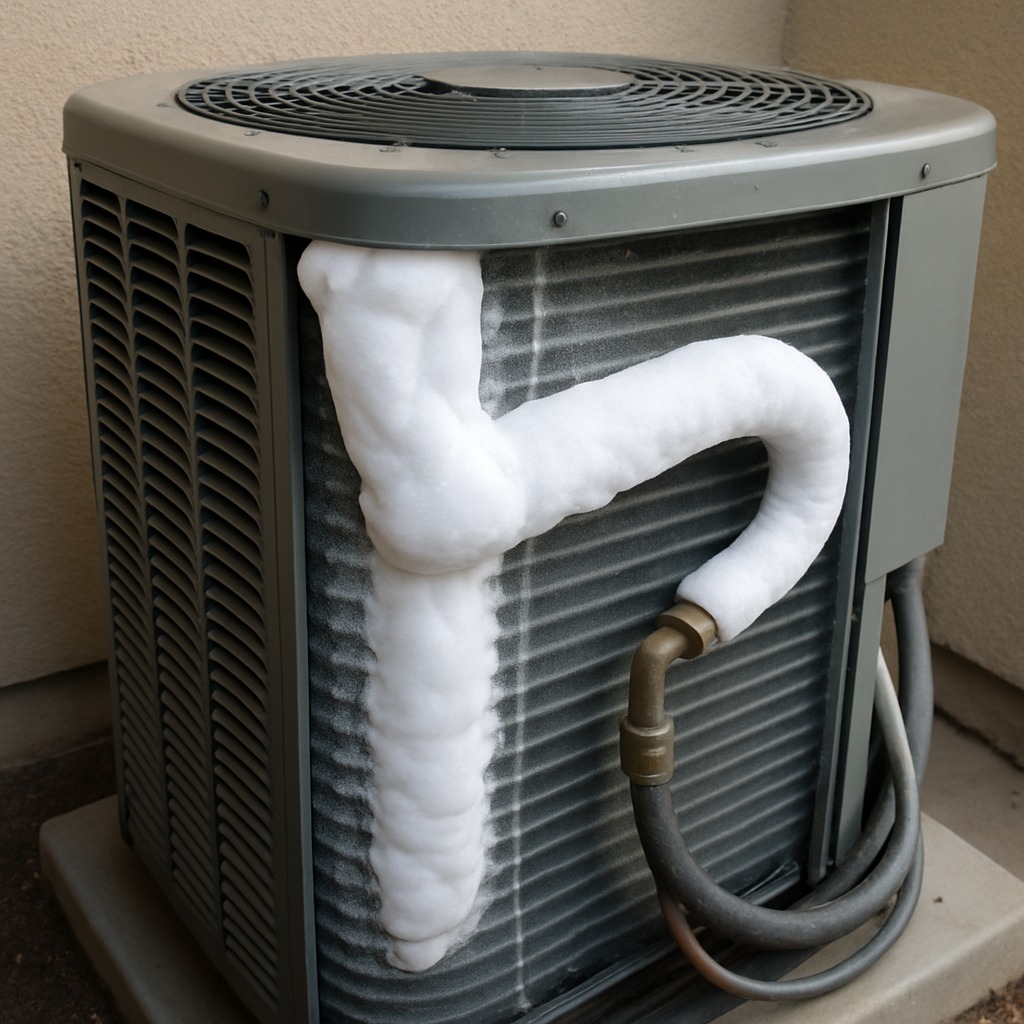
- Ice buildup on refrigerant lines: You will see a layer of white frost or solid ice coating the copper refrigerant lines running from the outdoor condenser to the indoor evaporator coil. The larger suction line — typically 3/4-inch to 7/8-inch diameter — freezes first. Touch it and your fingers stick slightly. In severe cases, ice extends from the indoor coil all the way back to the compressor at the outdoor unit, forming a thick crystalline sleeve you can actually hear cracking when the system cycles off.
- Reduced or warm airflow from supply registers: Place your hand at a supply vent and you will notice the air volume has dropped dramatically — sometimes to nearly nothing. What air does come through feels lukewarm or room temperature rather than the typical 15–20°F below the return air temperature. You may hear a faint whistling from registers as the frozen coil chokes the blower's output. The thermostat never reaches setpoint, and the system runs continuously without cycling off.
- Visible ice on the outdoor unit or evaporator coil: Open the access panel on your air handler or look through the coil window if your unit has one. You will see a thick sheet of ice encasing the aluminum fins of the evaporator coil, sometimes completely blocking all airflow. The ice can be an inch thick or more. The outdoor unit's suction line service valve may also be frosted over. You may notice water pooling beneath the air handler as partial melting occurs.
- Unusual hissing or bubbling sounds near the indoor unit: Stand near the air handler or furnace with the system running and listen for a faint hissing, gurgling, or bubbling noise coming from the area around the evaporator coil. This sound indicates refrigerant is not transitioning properly from liquid to gas — possibly because of a restriction, low charge, or a metering device malfunction. It is distinctly different from the normal whoosh of airflow and tends to be rhythmic or intermittent.
- Water damage or overflow from condensate drain pan: As the ice on the evaporator coil melts — either during defrost or when you shut the system off — the volume of water overwhelms the condensate drain pan. You may see water staining on drywall below the air handler, dripping from ceiling vents, or puddles on the floor near the furnace. A musty, mildew smell often accompanies the standing water, and in extreme cases, secondary drain pans overflow, triggering float switch shutoffs.
What's Actually Causing This
- Restricted airflow from dirty air filter or blocked return: This is the single most common cause, responsible for roughly 40–50% of freeze-up calls. When a 1-inch pleated filter goes unchanged beyond 30–60 days — or a 4-inch media filter beyond 6 months — the pressure drop across the filter exceeds 0.5 inches of water column. The evaporator coil starves for warm air, its surface temperature drops below 32°F, and moisture in the air freezes on contact. Closed supply registers, collapsed flex duct, or furniture blocking returns produce the same effect.
- Low refrigerant charge due to system leak: A properly charged R-410A residential system operates with suction pressure around 118–130 PSI at normal conditions. When a leak develops — commonly at flare fittings, the evaporator coil U-bends, or Schrader valve cores — the charge drops, suction pressure falls below 100 PSI, and the evaporator temperature plummets well below freezing. The coil ices over progressively. Leak rates vary; a pinhole in a copper line can lose 1–2 pounds of refrigerant per cooling season. This accounts for about 25–30% of freeze-up service calls.
- Dirty evaporator coil restricting heat transfer: Over 3–5 years, dust, pet dander, and microbial growth coat the evaporator coil fins even when filters are changed regularly. A coil caked with 1/16-inch of debris loses roughly 20–30% of its heat transfer efficiency. The refrigerant inside the coil cannot absorb enough heat, the coil surface drops below the dew point and then below freezing, and ice accumulates. This cause is especially prevalent in homes with pets, smokers, or poor ductwork sealing that pulls in attic insulation particles.
- Malfunctioning blower motor or fan speed issue: The blower motor must move a specific volume of air — typically 400 CFM per ton of cooling — across the evaporator coil. A failing capacitor can reduce motor speed by 20–40%, dropping a 3-ton system from 1,200 CFM down to 700–800 CFM. A worn blower wheel, a motor with failing bearings drawing excessive amps, or an incorrect fan speed setting on the control board all produce the same outcome: insufficient airflow, falling coil temperatures, and ice formation. Capacitor failures spike during the first heat wave of summer when electrical demand surges.
After 22 years in residential HVAC, here's what I tell every homeowner: never chip or scrape ice off a frozen evaporator coil. The aluminum fins are only 0.006 inches thick, and puncturing a refrigerant line means you're now looking at a $400–$900 brazing repair on top of the original problem. Instead, switch your thermostat to FAN ONLY — not OFF — so the blower circulates room-temperature air across the coil. Place towels under the air handler or a wet-dry vac nearby, because a heavily frozen coil can release 1–3 gallons of water as it thaws. Give it a full 2–3 hours before inspecting. If the coil refreezes within one cooling cycle after thawing, you almost certainly have a refrigerant leak or a mechanical issue that requires professional diagnosis with gauges.
Step-by-Step Diagnosis
Work through these steps before calling a contractor. Each step tells you what to look for and what it means.
Turn off cooling and run fan only
Go to your thermostat and switch the mode from COOL to OFF, then set the fan switch to ON instead of AUTO. This keeps the blower running without engaging the compressor, pushing warm indoor air across the frozen evaporator coil to accelerate thawing. Do NOT try to chip or scrape ice off the coil — you will puncture the thin aluminum fins or damage copper tubing, creating a refrigerant leak that costs $300–$1,200 to repair. Thawing typically takes 2–4 hours depending on the severity of ice buildup. Place towels or a shallow pan beneath the air handler to catch excess meltwater that may overflow the drain pan. You will know the coil is fully thawed when the suction line is no longer cold to the touch and water has stopped dripping from the unit. Do not restart cooling until thawing is complete.
Inspect and replace the air filter
🔧 Replacement air filter (correct size and MERV rating)Locate the air filter — it sits in the return air grille, at the air handler cabinet, or in a filter rack between the return duct and the blower compartment. Slide it out and hold it up to a light source. If you cannot see light passing through the media, the filter is clogged and must be replaced immediately. For 1-inch disposable filters, use a MERV 8–11 rating; anything above MERV 13 in a standard 1-inch frame creates excessive static pressure and can cause the same freeze-up you are trying to fix. For 4-inch media filters, replacement interval is every 6–12 months. Write the date on the filter frame with a permanent marker so you track its age. A replacement filter costs $3–$15 at any hardware store. Proper filter maintenance alone prevents nearly half of all AC freeze-ups.
Check all supply and return vents
🔧 Vacuum with brush attachmentWalk through every room in the house and verify that all supply registers and return air grilles are fully open and unobstructed. Furniture, rugs, drapes, and even closed doors in rooms with undersized door gaps can restrict airflow enough to cause a freeze-up. Each closed register increases static pressure in the duct system. As a rule, never close more than 20% of your supply registers — closing more than that on a fixed-speed system pushes static pressure above the 0.5-inch water column threshold and starves the coil. Open every register louver fully and move any objects within 12 inches of vents. Check return air grilles for dust buildup; vacuum the grille face with a brush attachment if it looks dirty. This step costs nothing and takes 10–15 minutes for an average 2,000-square-foot home.
Inspect the condensate drain for clogs
🔧 Wet/dry shop vacuum, distilled white vinegarLocate the PVC condensate drain line exiting your air handler — it is typically a 3/4-inch white PVC pipe that runs to a floor drain, exterior wall, or condensate pump. A clogged drain can cause water to back up into the drain pan, trigger the float safety switch, and create conditions that contribute to coil icing. Check the drain pan inside the air handler for standing water. If you find water, the line is likely clogged. Use a wet/dry shop vacuum on the outdoor drain termination point to suction out the clog — seal the connection with a rag around the hose for maximum suction. Alternatively, pour a cup of distilled white vinegar into the drain access point near the air handler to break up algae and biofilm. Flush with warm water and confirm flow at the drain termination. Repeat this cleaning every 90 days during cooling season.
Restart the system and monitor performance
🔧 Digital or infrared thermometerAfter the coil has fully thawed, the filter is fresh, all vents are open, and the drain is clear, switch the thermostat back to COOL and set it 3–5 degrees below room temperature. Allow the system to run for 15–20 minutes, then check the supply air temperature at the closest register to the air handler using a digital thermometer or an inexpensive infrared thermometer. The supply air should be 15–20°F cooler than the return air temperature. If the temperature split is less than 14°F or greater than 22°F, you likely have a refrigerant charge issue or a mechanical problem that requires a licensed technician. Also touch the larger copper suction line at the outdoor unit — it should feel cold and sweating with condensation, not frosted or iced. If ice returns within 30–60 minutes of restarting, shut the system down and call a professional.
When to Stop DIY and Call a Pro
Stop all DIY troubleshooting and call a licensed HVAC technician immediately if you observe any of the following: ice returns within one hour of restarting the system after a full thaw with a clean filter and open vents — this almost always indicates a refrigerant leak or metering device failure. If you hear the compressor making a loud knocking, clanking, or grinding noise, shut the system off at the disconnect or breaker to prevent catastrophic compressor damage — a compressor replacement runs $1,500–$3,000 installed. If the blower motor hums but does not spin, or spins weakly, the run capacitor or motor itself has failed and involves electrical components carrying 240 volts — not a safe DIY repair. Any refrigerant work — leak detection, brazing, evacuation, and recharging — requires EPA Section 608 certification and is illegal for unlicensed individuals to perform. If your system is more than 12 years old and requires a refrigerant recharge, the repair-versus-replace financial breakpoint is typically around $1,000–$1,500 in repair costs; beyond that threshold, investing in a new system with a 10-year warranty is the smarter financial decision. When in doubt, a diagnostic service call from a reputable HVAC contractor costs $75–$150 and gives you a definitive answer.
What Does This Repair Cost?
Costs vary by region, home age, and severity. These are national averages — always get 3 quotes.
| Repair Type | DIY Cost | Pro Cost | Emergency Premium |
|---|---|---|---|
| Air filter replacement | $4–$15 | $75–$150 | $125–$225 |
| Refrigerant leak detection & recharge | Not recommended | $200–$650 | $400–$950 |
| Blower motor replacement | Not recommended | $350–$900 | $550–$1,200 |
| Compressor replacement (if damaged) | Not recommended | $1,500–$3,200 | $2,200–$4,000 |
| TXV / expansion valve replacement | Not recommended | $350–$750 | $500–$1,000 |
| Emergency after-hours diagnostic call | N/A | $95–$175 | $175–$350 |
*Emergency rates (nights/weekends/holidays) run 40–60% above standard. Get 3 quotes before approving work.
Get quotes from licensed professionals in your area
Free, no obligation — compare 3+ contractors in minutesWhat Drives the Cost?
| Cost Factor | Estimated Impact | Why It Matters |
|---|---|---|
| Refrigerant type (R-22 vs R-410A) | Adds $75–$400 per pound | R-22 is phased out and now costs $75–$175/lb vs $50–$80/lb for R-410A; older systems pay a steep premium for recharges |
| After-hours or weekend service | Adds $100–$250 | Emergency and weekend rates typically carry a 50–100% surcharge over standard weekday pricing |
| System age (10+ years) | Adds $200–$1,500 | Older systems often have secondary failures discovered during diagnosis — corroded coils, degraded contactors — that increase the total repair bill |
| Attic vs. closet air handler location | Adds $50–$200 labor | Attic-mounted units require more time, safety precautions, and sometimes two technicians, increasing labor charges significantly |
One thing homeowners in humid Southern and Gulf Coast states need to understand: your AC is simultaneously a dehumidifier, and when the evaporator coil is undersized or the system is short-cycling, condensation accumulates faster than it drains, creating freeze conditions even when the filter is clean. I see this constantly in homes where a 3-ton system was installed in a space that needed a 2.5-ton — the system short-cycles, the coil never fully warms between cycles, and ice builds. A proper Manual J load calculation ($150–$300 from a reputable contractor) can confirm whether your system is oversized. This is also why I always check the condensate drain line during freeze-up calls — a clogged drain backs moisture onto the coil, accelerating ice formation. A $3 bottle of condensate drain cleaner used quarterly can prevent hundreds in service calls.
⚠️ Stop DIY — Call a Pro If You See These
- Compressor running but suction line is completely frosted from indoor coil to outdoor unit — Indicates the compressor is ingesting liquid refrigerant (slugging), which can destroy internal valves and windings within hours to days. A compressor replacement costs $1,500–$3,000 including labor and refrigerant, and on older R-22 systems, it often totals the unit.
- Breaker tripping repeatedly when the AC tries to start — A frozen coil forces the compressor to work against abnormal pressures, drawing locked-rotor amperage that trips the 30–60 amp breaker. Repeated tripping damages the compressor motor windings and can create an electrical fire risk at the panel. Continued operation risks $2,000+ in compressor and electrical repairs.
- Water staining on ceiling drywall or dripping from air handler cabinet — The drain pan has overflowed or the cabinet seams are leaking meltwater. Within 24–48 hours, wet drywall breeds mold. Remediation costs $500–$3,000 depending on the affected area. Structural damage to ceiling joists in attic installations can add thousands more.
- System short-cycling — compressor turns on for 2–5 minutes then shuts off — The high-pressure safety switch or low-pressure cutout is tripping due to abnormal operating conditions caused by ice buildup. Each short cycle stresses the compressor start windings and contactor. Within weeks, this pattern burns out the compressor or contactor, turning a $200 repair into a $2,500 replacement.
Frequently Asked Questions
How much does it cost to fix Ac Unit Freezing Up?
The national average cost ranges from $100 to $600 for most freeze-up repairs. On the low end, a $75–$150 diagnostic service call that reveals a dirty filter or blocked return solves the problem for the cost of a $5–$15 filter. Mid-range repairs like a blower motor capacitor replacement run $150–$300. A refrigerant leak repair involving brazing and recharging runs $300–$1,200 depending on the location of the leak and the amount of refrigerant needed — R-410A costs $50–$80 per pound wholesale, and most systems hold 6–12 pounds. The two biggest factors that move the price are the type of refrigerant your system uses (R-22 systems cost significantly more because the refrigerant is phased out and scarce) and whether the leak requires an evaporator coil replacement versus a simple fitting repair.
Can I fix Ac Unit Freezing Up myself?
Yes, in roughly 40–50% of cases. If the root cause is a clogged air filter, blocked return vents, or closed supply registers, you can resolve the freeze-up yourself in under an hour with no tools beyond a replacement filter. Thaw the coil by running the fan only, swap the filter, open all vents, and restart. However, if the freeze-up returns after those steps, the cause is almost certainly a refrigerant leak, a failing blower component, or a dirty evaporator coil — all of which require professional equipment, EPA certification, or specialized cleaning chemicals. Do not attempt any refrigerant work yourself; it is both illegal without certification and dangerous due to high-pressure lines operating at 200–400 PSI.
How urgent is Ac Unit Freezing Up?
Moderately urgent — act within hours, not days. The moment you notice ice on the lines or a significant airflow drop, switch the system to fan-only mode to begin thawing. Running a frozen system for more than 4–8 hours risks liquid slugging the compressor, which can cause immediate mechanical failure. Extended operation also generates excessive meltwater that overwhelms the drain pan, leading to water damage and mold growth within 24–48 hours. If you address the freeze-up the same day by thawing, checking the filter, and verifying airflow, you minimize risk. But every additional hour the compressor runs against a frozen coil accelerates wear that shortens the unit's lifespan by months or years.
What causes Ac Unit Freezing Up?
The three most common causes are restricted airflow, low refrigerant charge, and a dirty evaporator coil. Restricted airflow — from a clogged filter, closed vents, or a failing blower motor — accounts for 40–50% of freeze-up calls. The evaporator coil needs roughly 400 CFM per ton of cooling capacity; anything below that drops the coil temperature below 32°F. Low refrigerant charge from a system leak causes 25–30% of freeze-ups by reducing suction pressure and superheat, driving the coil surface temperature far below freezing. A dirty evaporator coil insulates the fins from warm return air, reducing heat absorption and creating the same icing condition. Less common causes include a stuck thermostatic expansion valve, a failing defrost board on heat pumps, or running the system when outdoor temperatures drop below 60°F.
Will homeowners insurance cover Ac Unit Freezing Up?
Standard homeowners insurance does not cover mechanical breakdowns, equipment wear, or maintenance-related failures — which is what most AC freeze-ups are. Your policy covers sudden, accidental events like a lightning strike that damages the compressor or a fallen tree that destroys the condenser unit. However, if a freeze-up causes secondary water damage to your ceiling, walls, or flooring, the resulting damage may be covered under your dwelling or personal property coverage, minus your deductible (typically $500–$2,500). Document all water damage with photos and file the claim promptly. A home warranty plan — separate from insurance — does cover mechanical HVAC failures and typically costs $400–$700 per year with a $75–$125 service call fee. Check your specific policy language, as some warranty plans exclude pre-existing conditions or refrigerant recharges.
How do I find a licensed hvac technician for this?
Follow this four-step process. First, verify the contractor holds a valid HVAC license in your state — search your state's contractor licensing board website by name or license number. Second, confirm they carry general liability insurance (minimum $1 million) and workers' compensation coverage; ask for a certificate of insurance and verify it is current. Third, get a written quote that itemizes the diagnostic fee, parts, labor rate, and refrigerant charges separately — reputable contractors charge $75–$150 for a diagnostic and apply it toward the repair if you proceed. Fourth, check references and online reviews on at least two platforms — look for companies with 50+ reviews averaging 4.0 stars or higher. Avoid any contractor who quotes refrigerant work by the pound at over $150/lb for R-410A or who recommends a full system replacement without first performing a thorough leak search.
Three decisions determine whether an AC freeze-up costs you $10 or $3,000. First, shut the system down immediately and switch to fan-only mode — every minute the compressor runs against a frozen coil brings you closer to catastrophic compressor failure. Second, check the simple airflow causes before spending money: replace the filter, open every register, and clear the return grilles. These free or near-free fixes resolve nearly half of all freeze-ups. Third, know your limits — if the ice returns after a full thaw with a clean filter and unrestricted airflow, the problem is refrigerant-related or mechanical, and continued DIY attempts waste time while the compressor takes damage.
Your recommended next step is straightforward: thaw the coil completely with the fan running, install a fresh MERV 8–11 filter, verify all vents are open, and restart the system. Monitor the suction line and supply air temperature for 30 minutes. If temperatures are normal and ice does not return, you have solved the problem. If ice reforms or the temperature split is outside the 15–20°F range, shut the system off and schedule a licensed HVAC technician for a diagnostic — expect to pay $75–$150 for the visit. That small investment protects a compressor worth $1,500–$3,000 and keeps a minor issue from becoming a major replacement.
Ready to Solve This for Good?
Get matched with pre-screened, licensed hvac technicians in your area. Free quotes, no obligation, no spam.
GET FREE QUOTES NOW