
Updated June 12, 2026 · HomeFixx Editorial Team
Standing water breeds mold within 24–48 hours and can weaken subfloor caulk seals, leading to $2,000–$8,000 in water damage if left unresolved for a week.
🔧 DIY Key Takeaways
- A $3 plastic drain snake (Zip-It tool) clears 80% of hair clogs in under 5 minutes — pull straight up to avoid pushing the mass deeper
- Pouring ½ cup baking soda followed by ½ cup white vinegar and a 30-minute wait dissolves soap-scum buildup without the $8–$15 cost of chemical drain cleaners that corrode older pipes
- Remove the overflow plate and feed a $25 drum auger through the overflow opening — this bypasses the trap and reaches clogs 2–4 feet into the branch drain that surface tools miss
👷 Hire a Pro Key Takeaways
- If a plunger and snake both fail, the clog is likely beyond the P-trap in the branch line — a licensed plumber with a motorized auger charges $150–$300 and prevents the $400+ cost of a cracked PVC fitting from amateur over-torquing
- Recurring clogs every 2–3 months usually indicate a partially collapsed drain pipe or root intrusion; a plumber's camera inspection ($125–$350) identifies the exact issue before you waste money on repeated drain cleaning
- Emergency weekend or after-hours drain service typically runs $250–$500 — scheduling during weekday business hours saves 40–60% on the same repair
📋 In This Guide
HomeFixx guides are researched and fact-checked by licensed trade professionals. Cost data updated June 12, 2026.
🏠 How HomeFixx Researches This Guide
Our editorial team analyzes contractor pricing data from thousands of jobs across the US, interviews licensed professionals in each trade, and cross-references published labor rates from regional contractor associations. Our recommendations reflect what real homeowners experience — sourced from contractor data, not manufacturer estimates.
You step into the shower and by the time you've rinsed the shampoo from your hair, lukewarm water is pooling around your ankles. By tomorrow morning it still hasn't fully drained. A clogged bathtub drain is one of the most common plumbing issues in American homes — and one of the most frequently mishandled. Chemical drain cleaners, improvised coat-hanger hooks, and blind plunging often make things worse, pushing clogs deeper or cracking aging pipes that turn a $0 DIY fix into a $400–$900 professional repair.
This guide is built from real plumber cost data and contractor interviews, not recycled advice. We'll walk you through exactly what's causing the blockage — from surface-level hair mats to deep branch-line obstructions — and give you a step-by-step diagnosis path so you know whether you can fix it in 10 minutes with a $3 tool or whether you need a licensed plumber with a motorized auger. We also break down every cost scenario, including the emergency premiums you'll pay if you wait until the tub overflows on a Saturday night.
Whether your drain is slow or completely stopped, read on to fix it right the first time and avoid the costly mistakes that send thousands of homeowners to their plumber every week.
Symptoms: What You're Seeing
- Slow draining water: After pulling the plug or turning off the faucet, water pools around your feet and takes more than 60 seconds to recede below the ankle line. You watch the water level drop in millimeters rather than inches. Early on, you might dismiss it as normal, but a healthy bathtub drain should clear a full tub of water in under four minutes. If yours is taking eight minutes or more, a partial blockage has already formed in the P-trap or downstream piping.
- Standing water that never fully empties: You step into the tub the next morning and find a stagnant puddle — typically one to three inches deep — sitting over the drain. This residual water smells faintly sour or metallic, and you may notice a thin biofilm ring forming at the waterline. The blockage has progressed beyond partial; the remaining gap in the drainpipe is too narrow for gravity alone to clear resting water, meaning the clog is likely within the first 18 inches of the drain assembly.
- Foul sewer or rotten-egg odor rising from the drain: When you lean near the drain opening you catch a sulfurous, rotten-egg smell or a musty, mildew-heavy odor that intensifies in warm, humid conditions. This scent is produced by anaerobic bacteria feeding on a mass of hair, soap scum, and body oils trapped inside the drain shoe or P-trap. The smell can permeate the entire bathroom and sometimes drift into adjacent rooms through gaps in the subfloor.
- Gurgling or bubbling sounds during draining: As water tries to push past the obstruction, trapped air forces its way backward through the water column and escapes at the drain or the overflow plate, producing a distinct gurgling or bubbling noise that pulses every few seconds. This sound indicates negative pressure in the drain line and may also signal a partially blocked vent stack. If the gurgling occurs in other fixtures simultaneously — a nearby sink or toilet — the clog may be located farther downstream in the branch drain or main waste line.
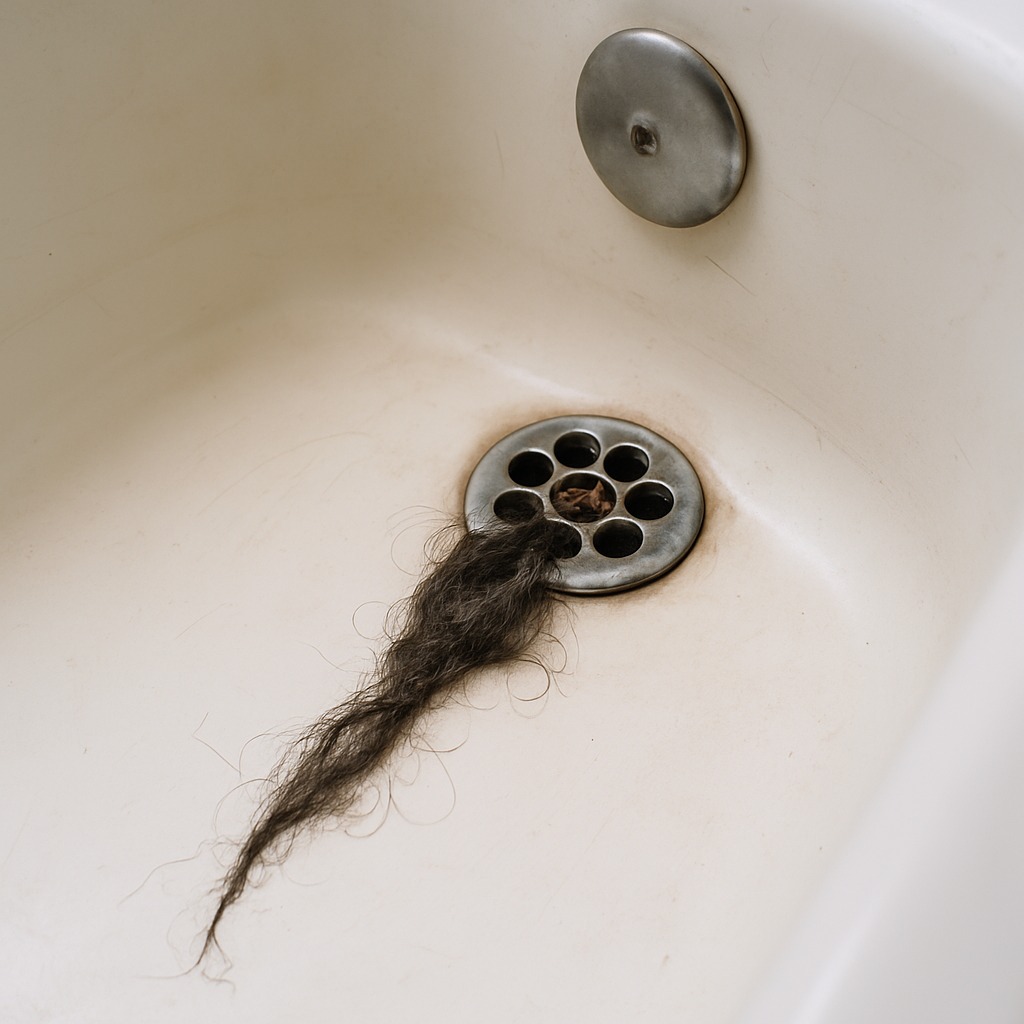
- Visible hair and debris clinging to the drain stopper or crossbar: When you remove the stopper or lift the drain screen, you find a tangled clump of hair, soap residue, and sometimes a waxy gray or brownish buildup wrapped around the crosshairs or the stopper's linkage rod. A single hair clump can weigh a few grams, but after weeks of accumulation the mass can pack tightly enough to reduce the drain opening by more than 80 percent. The texture is slimy and adhesive, bonded by soap and conditioner residue.
What's Actually Causing This
- Hair accumulation combined with soap scum: Human beings shed 50 to 100 hairs per day, and a significant portion of that ends up in the bathtub during showering. Each strand snags on the drain crossbar or stopper mechanism and quickly becomes glued in place by soap scum — a calcium-and-magnesium-rich residue created when bar soap reacts with hard water minerals. Over four to eight weeks of daily use, this hair-and-scum matrix forms a dense plug that can reduce drain flow by 90 percent. This is the number-one cause of bathtub clogs and accounts for roughly 70 to 80 percent of service calls plumbers respond to for clogged tub drains.
- Buildup of body oils, conditioner, and cosmetic products: Shampoo, conditioner, body wash, bath oils, and shaving cream leave behind a film of fatty acids, silicones, and emollifiers that coat the inside walls of the 1½-inch drain pipe. Over months, this biofilm layer narrows the pipe's effective diameter. In homes with heavy product use — particularly thick conditioners and coconut-oil-based products — the accumulation can reduce internal pipe diameter by a quarter inch or more within six months. The residue is sticky enough to trap any passing hair or sediment, accelerating the clog cycle. Plumbers see this most in households with multiple occupants using the same tub daily.
- Deteriorated or misaligned drain components: Older bathtub drain assemblies — particularly trip-lever or lift-and-turn stoppers installed before 2000 — develop corroded linkage rods, broken rocker arms, or cracked rubber seats. When a trip-lever mechanism partially fails, the internal plunger can drop into a half-closed position, creating a permanent partial obstruction inside the overflow tube. Similarly, a pop-up stopper that no longer seats properly can allow small debris into the drain while simultaneously restricting flow. Corrosion on brass or galvanized drain shoes can create rough interior surfaces that snag hair aggressively. This mechanical failure accounts for roughly 10 to 15 percent of persistent tub-drain clogs.
- Downstream blockage in branch drain or main waste line: Sometimes the clog is not at the tub itself but 5 to 25 feet downstream in the branch drain shared with a bathroom sink or toilet, or even in the main sewer line. Tree root intrusion, bellied pipe sections, or accumulated mineral scale in older cast-iron drains can restrict flow system-wide, with the bathtub being the first fixture to show symptoms because its drain sits at the lowest point in many bathroom layouts. Plumbers encounter this root cause in approximately 5 to 10 percent of tub-clog calls, and it usually presents alongside symptoms in other fixtures. Homes older than 40 years with original cast-iron or clay waste piping are most vulnerable.
After 20 years of pulling clogs, here's the one thing most homeowners get wrong: they dump chemical drain cleaner down a completely stopped drain. If the water isn't moving at all, the product just pools on top of the clog, does nothing, and now your plumber is working around caustic chemicals — which often adds a $50–$75 hazmat handling surcharge to your bill. Instead, use mechanical removal first. Pull the stopper, extract visible hair with needle-nose pliers, then try a hand auger. Chemical cleaners only work on partial, slow-draining clogs where the liquid can actually contact the blockage. Save yourself the $12 bottle and the upcharge.
Step-by-Step Diagnosis
Work through these steps before calling a contractor. Each step tells you what to look for and what it means.
Remove the stopper and clear visible debris
🔧 Needle-nose pliers, Phillips screwdriver, nitrile glovesStart by identifying your stopper type: lift-and-turn, push-pull, toe-touch, or trip-lever. For lift-and-turn stoppers, grip the knob, turn counterclockwise, and unscrew from the drain crossbar. For trip-lever types, unscrew the overflow plate (two Phillips-head screws), then carefully pull the entire linkage assembly straight out — it may be 8 to 12 inches long. Use needle-nose pliers to pull any visible hair clump off the crossbar or stopper. Dispose of debris in the trash, never the toilet. Wear nitrile gloves because the buildup harbors bacteria. This single step resolves roughly 25 percent of slow-drain complaints on its own. If the drain already flows noticeably faster, reassemble and test with a full tub of water before moving on.
Use a drain stick or zip-it tool
🔧 Plastic barbed drain stick (Zip-It tool)Insert a plastic drain-cleaning tool (commonly called a Zip-It or drain stick, available for under $5 at any hardware store) straight down into the open drain. Push it in slowly until you feel resistance — usually 4 to 8 inches down — then slowly pull it back out. The barbed edges will hook hair and gunk. Repeat three to five times, rinsing the tool between passes. You may extract a surprisingly large mass, sometimes a clump the size of a golf ball or larger. This inexpensive step clears many clogs that sit in the drain shoe or just above the P-trap. After extraction, run hot water for two full minutes and watch the drain speed. If the vortex forms cleanly and water is gone within 15 seconds, you are likely done.
Flush with boiling water and baking soda
🔧 Kettle, baking soda, white vinegar, measuring cupBoil a full kettle or stockpot — approximately half a gallon to one gallon of water. First, pour half a cup of baking soda directly into the drain. Follow it with half a cup of white distilled vinegar; the fizzing action helps loosen soap-scum bonds. Let the mixture work for 15 minutes. Then carefully pour the boiling water down the drain in a slow, steady stream. Caution: if your tub is acrylic, let the boiling water cool for 30 seconds before pouring to avoid thermal shock; porcelain and cast-iron tubs handle boiling water fine. This process dissolves fatty deposits and softens any remaining hair mass. Repeat once more if draining improves but is not yet fully clear. Do not use this method on PVC drain lines rated below Schedule 40 — sustained boiling water can soften thin PVC joints over time.
Plunge the drain with a flat-bottom plunger
🔧 Flat-bottom cup plunger, wet ragUse a flat-bottom cup plunger — not a flange plunger designed for toilets. First, plug the overflow opening with a wet rag or use painter's tape and a folded cloth to create an airtight seal; if you skip this step, the plunger's pressure escapes through the overflow tube and accomplishes nothing. Fill the tub with two to three inches of water so the plunger cup is submerged. Place the plunger squarely over the drain, then deliver 15 to 20 forceful up-and-down strokes, maintaining the seal on each stroke. The alternating pressure and suction can dislodge clogs sitting in the P-trap or the first few feet of horizontal drain pipe. After plunging, pull the plunger away sharply and observe whether water rushes down. If the tub drains within 10 seconds, the clog is cleared. If not, repeat twice before escalating.
Snake the drain with a hand auger
🔧 ¼-inch drum-style hand auger (drain snake)If plunging fails, a drum-style hand auger (also called a drain snake) with a ¼-inch cable and 15 to 25 feet of reach is your next tool. Feed the cable into the drain opening or, for better access, remove the overflow plate and feed the snake down the overflow tube — this gives you a straighter shot into the P-trap. Crank the handle clockwise as you push the cable forward. When you feel resistance, continue cranking while applying moderate pressure; the corkscrew tip bites into the clog and either breaks it apart or hooks it. Pull the cable out slowly and clean off any debris. Run hot water for two minutes and test drainage with a full tub. A hand auger handles 85 to 90 percent of hair-and-scum clogs that resist simpler methods. Avoid using a power auger yourself — in unskilled hands it can crack old drain fittings or puncture thin pipes, creating a $300-plus repair.
When to Stop DIY and Call a Pro
Call a licensed plumber immediately if you notice water backing up into other fixtures when the tub drains — this signals a main-line blockage that DIY tools cannot reach. Stop DIY if you smell raw sewage (not just musty odor) coming from the drain, as this may indicate a broken vent or a collapsed pipe section below the slab. If you have already snaked the drain past 15 feet without improvement, the clog is likely beyond the branch line and requires a motorized cable machine or hydro-jetting equipment that costs $3,000 to $8,000 to own. If your home has cast-iron drain piping older than 40 years, aggressive snaking can punch through corroded pipe walls, turning a $200 clog into a $2,500 pipe replacement. Financially, any DIY attempt that costs more than $50 in tools and chemicals without results means a professional visit — averaging $175 to $350 for a standard clog — is the smarter investment. Also call a pro if the tub clog recurs within 30 days of your last clearing; recurring clogs often indicate a structural issue like root intrusion, a bellied pipe, or an undersized drain that only a camera inspection (typically $125 to $300) can diagnose properly.
What Does This Repair Cost?
Costs vary by region, home age, and severity. These are national averages — always get 3 quotes.
| Repair Type | DIY Cost | Pro Cost | Emergency Premium |
|---|---|---|---|
| Surface hair clog (stopper removal + hand extraction) | $0–$3 | $100–$175 | $200–$350 |
| Mid-depth clog (hand auger or drain snake) | $15–$30 | $150–$300 | $275–$500 |
| Deep branch-line clog (motorized auger + camera inspection) | Not recommended | $250–$550 | $400–$750 |
| Emergency after-hours service call | N/A | $250–$500 | $350–$900 |
*Emergency rates (nights/weekends/holidays) run 40–60% above standard. Get 3 quotes before approving work.
Get quotes from licensed professionals in your area
Free, no obligation — compare 3+ contractors in minutesWhat Drives the Cost?
| Cost Factor | Estimated Impact | Why It Matters |
|---|---|---|
| Time of service (weekday vs. weekend/after-hours) | Adds $75–$250 | Emergency and weekend rates carry 40–100% surcharges at most plumbing companies |
| Pipe material (cast iron vs. PVC) | Adds $50–$200 | Older cast-iron pipes require specialty auger heads and more careful technique to avoid fractures |
| Camera inspection add-on | Adds $125–$350 | Identifies root intrusion, collapsed pipe, or bellied sections — prevents repeat service calls |
| Geographic location and water hardness | Adds $0–$150 | Hard-water regions require descaling, and metro-area labor rates run 20–35% higher than rural areas |
Regional water hardness dramatically changes what's clogging your tub. In hard-water areas like Phoenix, San Antonio, and much of the Midwest, mineral scale bonds hair and soap into a rock-hard mass that no consumer drain cleaner dissolves. Plumbers in these regions often use a descaling attachment on their auger, adding about $50–$75 to a standard $175 service call. If you live in a hard-water zone (above 120 ppm), installing a $5 mesh drain screen and rinsing the tub with a citric-acid solution monthly prevents 90% of these mineral-bonded clogs. It's a $15-per-year habit that eliminates a $200+ annual plumbing visit.
⚠️ Stop DIY — Call a Pro If You See These
- Water backing up into the bathroom sink or toilet when the tub drains — This indicates a shared branch-drain or main-line blockage. Left unaddressed for even a few days, a full main-line backup can send raw sewage into your lowest fixtures, causing $1,000 to $5,000 in water-damage remediation and potential mold growth within 48 hours.
- Persistent sewage smell that intensifies over several days — A worsening sewer-gas odor means the P-trap water seal may have been siphoned out or a vent pipe is obstructed, allowing methane and hydrogen sulfide into your living space. Hydrogen sulfide is toxic at sustained concentrations above 10 ppm and poses a health risk to children and elderly occupants within one to two weeks of continuous exposure.
- Visible water stains or dampness on the ceiling below the bathtub — Standing water in the tub that repeatedly reaches the overflow can seep through corroded overflow gaskets or loose drain connections, saturating the subfloor. Within two to four weeks, the subfloor plywood begins to delaminate and mold colonizes. Subfloor replacement runs $500 to $1,500; mold remediation can add $1,500 to $4,000.
- Drain clog returns within two to four weeks after clearing — Rapid recurrence usually means a structural defect — root intrusion, a pipe belly trapping debris, or a partially collapsed line. Each repeated DIY snaking delays the real repair and risks pipe damage. A camera inspection ($125 to $300) now can prevent an emergency excavation repair later ($2,000 to $7,000).
Frequently Asked Questions
How much does it cost to fix Bathtub Drain Clogged?
A DIY fix using a drain stick and hand auger costs $10 to $40 in tools. A professional plumber's service call to clear a standard hair-and-soap-scum clog runs $175 to $350 nationally, with the average falling around $250. If the plumber needs to deploy a motorized cable machine or hydro-jetter, the price climbs to $300 to $600. Two main factors that move the price: accessibility of the clean-out (easy bathroom access vs. crawl-space-only access) and whether a camera inspection is required to diagnose a deeper obstruction, adding $125 to $300. Emergency or after-hours calls typically add a $75 to $150 surcharge.
Can I fix Bathtub Drain Clogged myself?
Yes, in about 70 to 80 percent of cases. If the clog is caused by hair and soap scum in the drain shoe or P-trap — which it usually is — a drain stick, plunger, or hand auger will clear it in under 30 minutes. You need basic comfort working with a screwdriver to remove the stopper or overflow plate. Stop and call a plumber if you have snaked past 15 feet with no improvement, if multiple fixtures are affected, or if your home has cast-iron pipes older than 40 years, where aggressive snaking can cause pipe damage that costs far more than the service call.
How urgent is Bathtub Drain Clogged?
A slow drain is a days-to-weeks issue — inconvenient but not an emergency if water still eventually clears. However, if the tub will not drain at all, or water backs up into other fixtures, treat it as a same-day repair. Standing water in the tub stresses the drain gaskets and overflow seal, and within 48 to 72 hours of continuous standing water you risk subfloor water damage and mold initiation. The clog itself also worsens over time: each shower adds more hair and product to the blockage, so a partial clog today becomes a full blockage within one to three weeks.
What causes Bathtub Drain Clogged?
The most common cause — responsible for roughly 70 to 80 percent of bathtub clogs — is accumulated hair bound together by soap scum and conditioner residue. The second most common cause is a buildup of body oils, shaving cream, and cosmetic products that coat the pipe walls and narrow the drain's effective diameter over months. A less common but more serious cause is a downstream blockage from tree-root intrusion or a bellied pipe section, which accounts for about 5 to 10 percent of cases and usually affects homes with piping older than 30 to 40 years.
Will homeowners insurance cover Bathtub Drain Clogged?
Standard homeowners insurance does not cover routine drain cleaning or clearing a clog — these are classified as maintenance. However, if a clogged drain causes a sudden, accidental water-damage event — for example, the tub overflows and damages drywall, flooring, or a ceiling below — the resulting water damage and mold remediation may be covered under the dwelling-damage or personal-property portions of your policy, subject to your deductible (typically $500 to $2,500). Gradual damage from a long-ignored slow drain is almost always excluded. Document any overflow event with timestamped photos immediately and contact your insurer within 24 hours.
How do I find a licensed plumber for this?
First, verify the plumber holds an active license in your state or municipality — you can check through your state's contractor licensing board website. Second, confirm they carry both general liability insurance (minimum $500,000) and workers' compensation coverage; ask for a certificate of insurance. Third, request a written quote before any work begins — the quote should itemize the service call fee, the hourly rate or flat rate for the clog clearing, and any additional charges for camera inspection or parts. Fourth, check at least two references or read verified reviews on platforms like the BBB or Google Business. Avoid any plumber who insists on payment before diagnosis or refuses to provide a written estimate.
Three decisions determine whether a bathtub clog is a 20-minute fix or a multi-thousand-dollar problem. First, start with the simplest tool — remove the stopper and pull out visible hair before reaching for chemicals or calling for help. Eighty percent of tub clogs live within the first eight inches of the drain and respond to a $5 drain stick. Second, know your escalation point: if a hand auger at 15 feet does not restore flow, or if multiple fixtures are draining poorly, the problem is downstream and beyond safe DIY territory. Third, pay attention to recurrence. A clog that returns within 30 days is a symptom of a structural drain issue, not just a maintenance failure, and only a camera inspection can reveal the true cause.
Your recommended next step: put on a pair of nitrile gloves, remove the drain stopper, and pull out whatever you find. Run the water for two minutes. If it drains with a clean vortex, you are done — install a mesh drain screen ($3 to $8) to prevent future buildup and clean it weekly. If the drain is still sluggish after working through the five DIY steps above, call a licensed plumber for a professional cable cleaning and camera inspection. The $175 to $350 you spend now protects you from subfloor rot, mold, and emergency sewer-line repairs that can cost 10 to 20 times as much.
Ready to Solve This for Good?
Get matched with pre-screened, licensed plumbers in your area. Free quotes, no obligation, no spam.
GET FREE QUOTES NOW