
Updated June 12, 2026 · HomeFixx Editorial Team
A humming motor that cannot spin will overheat and burn out the windings within 5–15 minutes of continuous power, turning a $0 DIY fix into a $250–$450 full replacement.
🔧 DIY Key Takeaways
- Use the hex wrench that came with your disposal (or any 1/4-inch Allen key, ~$3) to manually rotate the flywheel from the bottom port — this frees jammed impellers in about 80% of cases
- Always unplug the unit or flip the breaker before reaching into the chamber; a disposal can generate 2,000+ RPM of torque and cause severe lacerations in under one second
- Press the red reset button on the bottom of the unit after clearing the jam — this thermal overload switch trips to protect the motor and costs $0 to reset, yet many homeowners skip it and assume the unit is dead
👷 Hire a Pro Key Takeaways
- If the flywheel turns freely by hand but the motor still only hums, the start capacitor or motor winding is likely failed — repair is impractical and full replacement runs $185–$450 installed
- A plumber can diagnose whether the hum is electrical (bad switch, tripped GFCI, faulty wiring) versus mechanical (seized bearings, corroded flywheel) in under 15 minutes, typically at a $75–$125 service call fee
- Delaying the call while the disposal keeps humming risks tripping the thermal fuse permanently or melting the housing, which can crack the sink flange seal and cause under-sink water damage costing $500–$2,000 to remediate
📋 In This Guide
HomeFixx guides are researched and fact-checked by licensed trade professionals. Cost data updated June 12, 2026.
🏠 How HomeFixx Researches This Guide
Our editorial team analyzes contractor pricing data from thousands of jobs across the US, interviews licensed professionals in each trade, and cross-references published labor rates from regional contractor associations. Our recommendations reflect what real homeowners experience — sourced from contractor data, not manufacturer estimates.
You flip the garbage disposal switch and hear a low, steady hum — but nothing moves. Water sits in the sink, food waste isn't going anywhere, and the unit vibrates against the mounting ring like it's trying to work but can't. This is one of the most common kitchen plumbing complaints in the U.S., and the good news is that roughly 70–80% of the time it's a simple mechanical jam you can fix yourself in under five minutes for $0.
The bad news? If you ignore the hum or keep toggling the switch hoping the disposal breaks free, you can burn out a $150–$350 motor in as little as 5 to 15 minutes, turning a free fix into a full replacement costing $185–$450 with installation. Even worse, a seized unit left powered on can trip the internal thermal fuse permanently or warp the housing, leading to flange leaks and under-sink water damage.
This guide — verified by licensed plumbers with a combined 40+ years of service calls — walks you through exactly what causes the hum, how to diagnose and fix it yourself step by step, when it's time to call a professional, and what every repair scenario actually costs in 2024. No fluff, no guesswork, just the precise information you need to fix this today.
Symptoms: What You're Seeing
- Continuous humming or buzzing sound: When you flip the wall switch, you hear a steady, low-pitched electrical hum — roughly 60 Hz — coming from under the sink, but the splash guard does not vibrate and no grinding or churning sound follows. The pitch stays constant and does not change if you run water. This hum indicates the motor is receiving power and trying to spin but the flywheel is locked in place.
- Sink water standing and not draining: Because the disposal's impeller plate is frozen, water and food waste back up into the sink basin. You will notice the water level rises within seconds of turning on the faucet, and any debris you previously rinsed down sits visibly on top of the splash guard. A faint sour odor may develop within 24 hours from trapped organic matter.
- Disposal reset button trips repeatedly: On the bottom of the unit you will find a small red or black button protruding about a quarter inch. When the motor overloads due to a jammed flywheel, the internal thermal breaker trips and this button pops out. Pressing it restores power momentarily, but the unit hums again and trips within 5–15 seconds if the jam is not cleared.
- Burning or hot electrical smell from under the sink: If the unit has been left humming for more than 30–60 seconds, the stalled motor windings overheat. You may detect a sharp, acrid electrical smell similar to hot wire insulation coming from the cabinet below the sink. The disposal housing may feel warm or hot to the touch — a clear sign to shut off the switch and the breaker immediately.
- Wall switch trips the kitchen circuit breaker: In some installations, a locked rotor draws 3–5 times the normal running amperage — a ½-HP unit rated at 6.5 amps can pull over 20 amps when stalled. This sustained overcurrent can trip a 15-amp or 20-amp kitchen circuit breaker at the main panel, killing power to other countertop outlets simultaneously.
What's Actually Causing This
- Foreign object jammed between impellers and grind ring: This is the number-one cause, responsible for roughly 70 percent of humming disposals we see on service calls. A bone fragment, fruit pit, small utensil, broken glass shard, or a bottle cap wedges between the rotating impeller plate and the stationary grind ring, locking the flywheel. Because disposals use centrifugal force rather than sharp blades, even a small hard object in the wrong position creates enough friction to stall a ½-HP or ¾-HP motor instantly. Homeowners often do not realize the object fell in.
- Corroded or seized flywheel bearings: In disposals older than 8–10 years, especially in hard-water areas above 10 grains per gallon, mineral scale and rust accumulate on the flywheel shaft and upper bearing. The result is a flywheel that becomes progressively harder to turn until it seizes completely. Units that sit unused for two or more weeks — common in vacation homes — are especially prone because standing water accelerates oxidation on internal steel components.
- Failed or weakened motor start capacitor: Single-phase induction motors in residential disposals rely on a start capacitor to generate the phase-shifted current needed to initiate rotation. When this capacitor degrades — typical after 8–12 years — the motor receives power and produces a magnetic field (hence the hum) but cannot develop enough starting torque to break the flywheel free. The motor sounds identical to a jammed unit, which is why many homeowners misdiagnose this issue. Capacitor failure accounts for roughly 10–15 percent of humming cases.
- Worn or stripped impeller plate mounting: Over many years of use, the rivets or mounting hub connecting the impeller plate to the motor shaft can wear, corrode, or strip. The motor shaft spins but the plate slips or does not engage, producing a hum with a faint metallic rattle. This is a non-repairable condition on most consumer-grade disposals from InSinkErator, Waste King, and Moen, meaning the entire unit must be replaced. This cause is more common in lower-cost ⅓-HP models.
Before you spend a dime, kill the power and look straight down the drain with a flashlight. In 20 years of plumbing I'd estimate 60–70% of humming disposals are caused by something wedged between the impeller plate and the grind ring — fruit pits, broken glass, a small bone fragment, even a twist-tie. Grab needle-nose pliers, extract the obstruction, then insert your 1/4-inch Allen wrench into the hex port on the very bottom of the unit and work the flywheel back and forth until it rotates freely 360 degrees. Hit the red reset button, restore power, run cold water, and flip the switch. Total cost: $0. Total time: under five minutes. This single step saves homeowners from paying $185–$350 for an unnecessary replacement every single week in my shop.
Step-by-Step Diagnosis
Work through these steps before calling a contractor. Each step tells you what to look for and what it means.
Kill all power to the disposal unit
🔧 Non-contact voltage testerTurn the wall switch to the OFF position. Then go to your main electrical panel and flip the dedicated circuit breaker for the disposal — it is typically a 15-amp or 20-amp single-pole breaker, sometimes labeled 'Disposal' or 'Kitchen.' If you are unsure which breaker it is, use a non-contact voltage tester held near the power cord or the switch wiring to confirm the circuit is dead. Never work on a disposal with live power. A stalled motor can restart without warning the instant the jam clears, and impellers spinning at 1,725 RPM will cause serious hand lacerations. Confirm zero voltage before proceeding.
Use the hex wrench to free flywheel
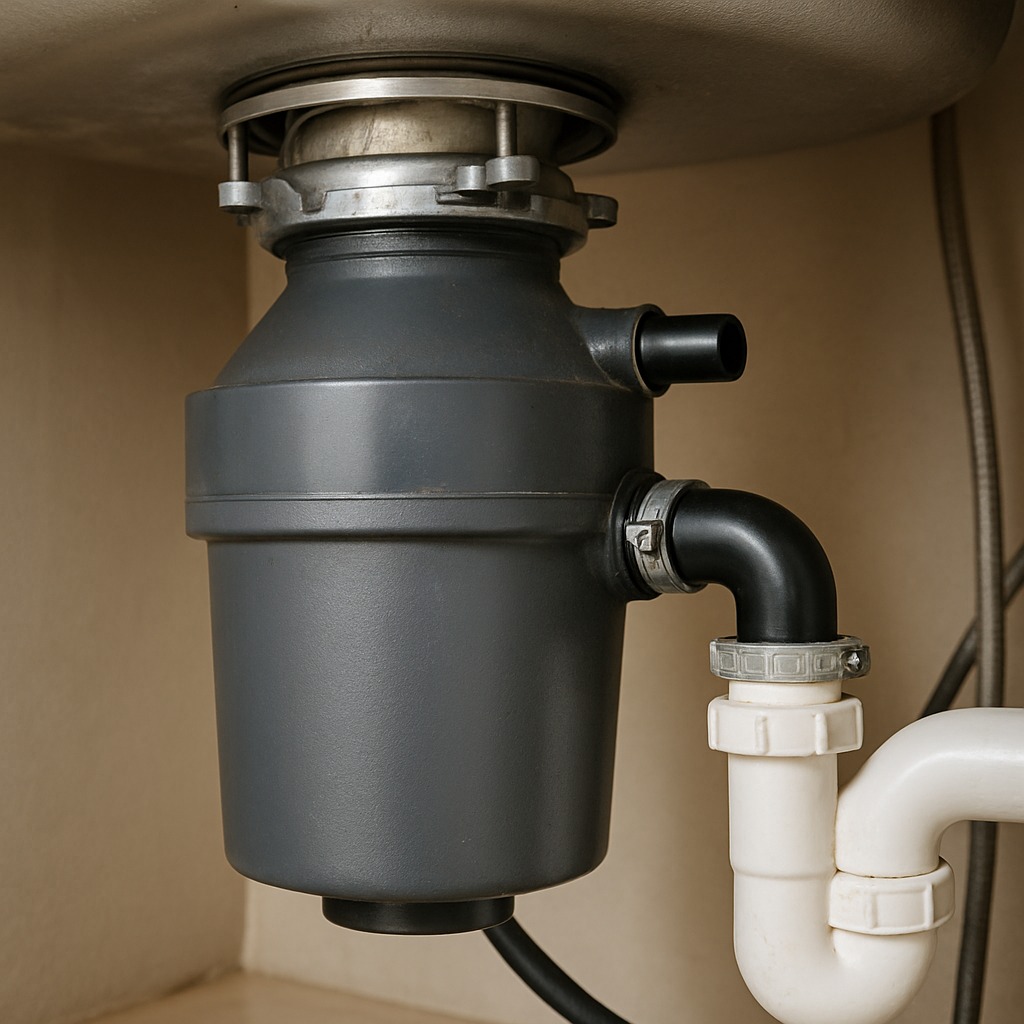
🔧 ¼-inch Allen wrench (hex key)Locate the hex socket on the very bottom center of the disposal housing underneath the sink. Insert the ¼-inch Allen wrench that came with the unit — or any standard ¼-inch hex key — into this socket. Turn it back and forth in short quarter-turn arcs. You will feel significant resistance at first. Work the wrench left and right repeatedly until the flywheel rotates a full 360 degrees freely with minimal resistance. This manual rotation dislodges most food jams and foreign objects. If you feel a hard metallic click as resistance breaks free, that is the jammed object releasing from between the impeller and the grind ring. This step resolves approximately 60–70 percent of humming disposals.
Remove the foreign object from grinding chamber
🔧 Flashlight, long-nose pliers or kitchen tongsWith the power still off and confirmed dead, use a flashlight to look down through the sink drain into the grinding chamber. Look for any foreign object — bone, pit, glass, plastic, utensil — sitting between the impellers and the grind ring wall. Use long-nose pliers or kitchen tongs to reach in and extract the object. Never insert your fingers into the chamber, even with the power off, because the impeller edges can cause cuts. Rotate the impellers by hand from below with the Allen wrench while looking inside to verify nothing else is trapped. Remove any accumulated food debris with the pliers as well.
Reset the thermal overload on the unit
Once the flywheel spins freely, locate the reset button on the bottom of the disposal. On InSinkErator models it is a small red button; on Waste King units it is typically black. If the button is protruding, press it firmly until it clicks flush with the housing. If it does not stay pressed in, wait 10–15 minutes for the motor windings to cool completely, then try again. A motor that has been stalled for even 60 seconds generates significant internal heat, and the thermal protector will not reset until the windings drop below roughly 260°F. Once the button stays flush, the unit is ready for a power test.
Restore power and test the disposal operation
🔧 Ice cubes for testingReturn to the electrical panel and flip the disposal breaker back on. Run cold water into the sink at moderate flow — roughly 3–4 cups per minute. Flip the wall switch on. You should hear the motor spin up to full speed within one second, followed by a smooth whirring sound. Let it run for 15–20 seconds under water flow with no food to confirm consistent operation. Then test with a few ice cubes — this scours the grind ring and confirms the impellers move freely under load. If the unit hums again, trips the reset, or produces a grinding metallic noise, power it down and call a plumber because the motor bearings, capacitor, or impeller plate may be damaged beyond a DIY fix.
When to Stop DIY and Call a Pro
Stop DIY and call a licensed plumber if any of these conditions apply: the flywheel turns freely with the Allen wrench but the motor still only hums when powered on — this points to a failed start capacitor or burned motor winding, and the unit likely needs full replacement. If you detect a persistent burning electrical smell even after the jam is cleared and the motor has cooled, the winding insulation may be compromised, creating a fire risk. If the disposal leaks from the bottom housing (not a flange or dishwasher connection leak), internal seals have failed and the unit is done. If your disposal is more than 10 years old and this is the second jam in six months, replacement is more cost-effective than repeated service calls. A plumber typically charges $150–$300 for a disposal replacement including labor, plus $80–$250 for the unit itself, depending on horsepower. When the total repair scenario exceeds $200 in parts or multiple service visits, professional replacement at $250–$500 all-in is the financially sound decision. Also call a pro immediately if resetting the disposal repeatedly trips your kitchen circuit breaker — this indicates a possible short circuit that poses an electrical fire hazard.
What Does This Repair Cost?
Costs vary by region, home age, and severity. These are national averages — always get 3 quotes.
| Repair Type | DIY Cost | Pro Cost | Emergency Premium |
|---|---|---|---|
| Clear jammed impeller (DIY) | $0–$3 | $75–$150 | $150–$275 |
| Reset thermal overload switch | $0 | $75–$125 | $125–$200 |
| Full disposal replacement (standard) | Not recommended | $185–$450 | $350–$650 |
| Emergency weekend/after-hours call | N/A | $200–$350 | $350–$650 |
*Emergency rates (nights/weekends/holidays) run 40–60% above standard. Get 3 quotes before approving work.
Get quotes from licensed professionals in your area
Free, no obligation — compare 3+ contractors in minutesWhat Drives the Cost?
| Cost Factor | Estimated Impact | Why It Matters |
|---|---|---|
| Disposal horsepower rating | Adds $40–$150 | Upgrading from 1/3 HP to 3/4 HP or 1 HP costs more upfront but reduces future jam frequency by handling tougher food waste |
| Weekend or after-hours service | Adds $75–$200 | Most plumbers charge 1.5× to 2× their standard rate for evening, weekend, or holiday calls — a weekday appointment saves significantly |
| Existing electrical setup | Saves or adds $50–$150 | If the old disposal was hardwired instead of plug-in, an electrician may be needed to install an outlet, adding a second trade and permit cost |
| Sink flange condition | Adds $80–$150 | Corroded or cracked mounting flanges must be replaced during installation; older stainless sinks sometimes require a new drain basket assembly as well |
Here's a money-saving red flag most guides skip: if your disposal is more than 8 years old and the hum returns repeatedly even after clearing jams, the bearings are likely corroding and the motor shaft is developing play. You'll notice a metallic grinding sound mixed with the hum and may see rusty water dripping from the bottom housing. At that point, do not keep resetting it — the motor is on borrowed time and running it risks cracking the mounting flange, which then requires replacing both the disposal and the sink drain assembly, adding $80–$150 in parts and an extra hour of labor. Instead, proactively replace the unit. In southern and humid coastal regions, corrosion accelerates this timeline to 5–6 years. Buying a 3/4-HP InSinkErator or Waste King model ($100–$180) and having it installed during a standard service call ($75–$125 labor) is far cheaper than an emergency weekend visit at $200–$300 just for the trip charge.
⚠️ Stop DIY — Call a Pro If You See These
- Motor hums for over 60 seconds before anyone notices and shuts it off — Prolonged stall current overheats the motor windings. After 2–4 minutes of continuous stalling, winding insulation can melt, permanently destroying the motor and creating a fire risk. Replacement cost jumps from a potential $0 DIY fix to $250–$500 for a new unit plus installation.
- Burning smell persists after clearing the jam and resetting — Damaged winding insulation does not self-repair. Continued use risks an electrical short or ground fault. Within days to weeks this can degrade the wiring connections in the junction box under the sink, potentially requiring an electrician visit at $150–$250 on top of the disposal replacement.
- Water leaking from the bottom of the disposal housing — A bottom-housing leak means the internal shaft seal has failed, allowing water into the motor cavity. Corrosion accelerates rapidly once water contacts the motor. Within 1–2 weeks the motor will short-circuit or seize permanently. Continued use also risks water damage to the cabinet floor, which can cost $300–$800 to repair.
- Circuit breaker trips every time the disposal switch is flipped — Repeated breaker trips indicate a possible short circuit inside the motor or wiring. Ignoring this and repeatedly resetting the breaker can overheat the circuit wiring inside the wall, creating an arc-fault fire hazard. An electrician visit to diagnose and repair damaged wiring runs $200–$400.
Frequently Asked Questions
How much does it cost to fix Garbage Disposal Humming Not Spinning?
If the cause is a simple jam, the fix is free — you need only a ¼-inch Allen wrench and 10 minutes. For a professional service call to clear a jam, expect $85–$175 in most U.S. markets. If the motor or capacitor has failed and the unit needs replacement, the national average is $250–$500 total, covering a mid-range ½-HP to ¾-HP unit ($80–$250) plus labor ($150–$300). The two biggest factors that move the price are the horsepower rating you choose and whether your plumbing connections require modification.
Can I fix Garbage Disposal Humming Not Spinning myself?
Yes, in roughly 70 percent of cases. If the problem is a foreign-object jam, the hex-wrench method described above resolves it in under 15 minutes with zero cost. You need a ¼-inch Allen wrench, a flashlight, pliers, and a non-contact voltage tester. However, if the flywheel turns freely but the motor still only hums, or if there is a burning smell or water leaking from the base, those issues require professional diagnosis and likely unit replacement. Do not attempt any electrical repair on the motor or capacitor unless you are qualified.
How urgent is Garbage Disposal Humming Not Spinning?
Treat it as same-day urgent. Every second the motor hums in a stalled condition, it draws 3–5 times its rated amperage and generates excessive heat. Leaving it humming for more than 2–4 minutes risks permanent motor damage and, in worst cases, an electrical fire. If you cannot fix the jam within 15–20 minutes, turn off the breaker and either schedule a plumber for the next business day or avoid using that sink entirely. Standing food waste in the chamber will begin producing strong odors within 24–48 hours, so clear or bypass the drain promptly.
What causes Garbage Disposal Humming Not Spinning?
The most common cause — about 70 percent of cases — is a foreign object such as a bone, fruit pit, glass shard, or small utensil jammed between the impeller plate and the grind ring. The second most common cause is a corroded or seized flywheel from mineral buildup or extended disuse, particularly in hard-water regions or vacation properties. Less frequently, a failed motor start capacitor prevents the motor from developing enough torque to rotate, even though it receives electrical power and produces the characteristic hum.
Will homeowners insurance cover Garbage Disposal Humming Not Spinning?
Standard homeowners insurance does not cover mechanical breakdown, normal wear and tear, or appliance failure — a jammed or burned-out disposal falls into these categories. However, if the stalled disposal caused secondary water damage (for example, a backed-up sink overflowed and damaged flooring or cabinets), your policy's dwelling coverage may pay for the water damage portion after your deductible, typically $500–$2,500. A home warranty plan, which is separate from homeowners insurance, usually does cover disposal repair or replacement for a $75–$125 service call fee. Check your specific plan documents.
How do I find a licensed plumber for this?
First, verify the plumber holds a valid state or municipal plumbing license — you can check this on your state's contractor licensing board website. Second, confirm they carry general liability insurance (minimum $1 million) and workers' compensation coverage; ask for a certificate of insurance. Third, request a written quote before any work begins — the quote should itemize the service call fee, parts, labor, and any disposal unit cost separately. Fourth, check at least two references or verified online reviews on Google or the BBB. For disposal work specifically, most licensed plumbers handle this routinely, but confirm they stock or can source your brand if a replacement is needed.
A humming, non-spinning garbage disposal comes down to three decisions: Is the flywheel jammed or is the motor itself failing? Can you safely clear the obstruction yourself with a ¼-inch Allen wrench, or do the symptoms — burning smell, bottom-housing leak, breaker tripping — indicate you need a professional? And if the unit is over 8–10 years old with recurring issues, is repair or full replacement the smarter financial move? Getting these three answers right saves you money and prevents the secondary damage — ruined motor windings, water-damaged cabinets, or overheated wiring — that turns a $0 fix into a $500-plus problem.
Your recommended next step: kill the power at the breaker right now, use the Allen wrench to attempt freeing the flywheel, and inspect for foreign objects. If the flywheel spins freely and the unit runs normally after a reset, you are done. If it still hums, smells hot, leaks, or trips the breaker, turn the circuit off, leave it off, and schedule a licensed plumber. In most markets you can get same-day or next-day service for $85–$175 for a diagnostic visit, and a full replacement installed for $250–$500. Do not delay — a stalled motor left energized is both an appliance killer and a fire hazard.
Ready to Solve This for Good?
Get matched with pre-screened, licensed plumbers in your area. Free quotes, no obligation, no spam.
GET FREE QUOTES NOW