
Updated June 12, 2026 · HomeFixx Editorial Team
A humming disposal draws locked-rotor amperage that can burn out the motor or trip a breaker fire risk within 1–5 minutes of continuous operation.
🔧 DIY Key Takeaways
- Use the Allen wrench that came with your unit (or a standard 1/4-inch hex key, ~$3) to manually rotate the flywheel from the bottom reset hole — this clears 70% of jams in under 2 minutes
- Before calling anyone, press the small red reset button on the bottom of the unit; an overheated motor auto-trips this thermal breaker, and resetting it after a 5-minute cooldown costs $0 and solves roughly 15% of humming cases
- Grab a wooden broom handle (never your hand) and push against the impeller blades from inside the drain opening to dislodge bone fragments, fruit pits, or glass — a $0 fix that prevents a $150–$250 service call
👷 Hire a Pro Key Takeaways
- If the flywheel turns freely with the Allen wrench but the motor still only hums, the start capacitor or motor windings are likely failed — full unit replacement runs $150–$350 installed and is almost always cheaper than a motor rebuild
- A disposal that hums and trips the breaker repeatedly may indicate a wiring short inside the splash guard housing; a licensed plumber will check for ground faults before re-energizing, avoiding a potential electrical fire risk
- If your disposal is 8+ years old and has seized twice in 12 months, pros recommend replacing rather than repairing — a new InSinkErator Badger 5 installed typically costs $180–$250, while repeated service calls at $95–$175 each add up fast
📋 In This Guide
HomeFixx guides are researched and fact-checked by licensed trade professionals. Cost data updated June 12, 2026.
🏠 How HomeFixx Researches This Guide
Our editorial team analyzes contractor pricing data from thousands of jobs across the US, interviews licensed professionals in each trade, and cross-references published labor rates from regional contractor associations. Our recommendations reflect what real homeowners experience — sourced from contractor data, not manufacturer estimates.
You flip the garbage disposal switch and hear that familiar low hum — but nothing moves. Water sits in the sink, food scraps aren't going anywhere, and you're wondering if you just destroyed a $200 appliance. This is one of the most common plumbing calls in America, and the good news is that roughly 75% of humming-but-not-spinning disposals can be fixed in under five minutes with a simple Allen wrench and zero dollars spent.
The bad news? If you keep toggling that switch, you can burn out the motor in under five minutes of cumulative run time, turning a free DIY fix into a $150–$350 replacement job. And if water is backing up while you troubleshoot, you're also risking an under-sink leak that can damage cabinetry and subfloor — repairs that climb to $500–$1,200 fast.
This guide walks you through exactly what's happening inside your disposal, a contractor-verified diagnostic sequence that covers every possible cause, real cost data from licensed plumbers across the U.S., and clear rules for when it's time to stop wrenching and pick up the phone. Let's get your kitchen back online.
Symptoms: What You're Seeing
- Steady electrical hum from under the sink: When you flip the wall switch or press the disposal's splash guard button, you hear a continuous low-pitched hum—roughly 60 Hz, the same frequency as the AC power line—but the grinding plate never turns. The motor is energized and trying to spin but is mechanically locked. The sound is distinctly different from silence (no power) or the normal grinding roar. You can sometimes feel a slight vibration through the sink flange or countertop if you rest your hand near the drain opening.
- Standing water in the sink basin: Because the flywheel is jammed and the impellers are not spinning, food waste and water cannot pass through the grind chamber and into the drain line. Water backs up into the sink and sits stagnant, sometimes with small food particles floating on the surface. If the disposal shares a double-bowl sink, water may rise on both sides when the connecting baffle tube is below the water line. The smell of stagnant water develops within 12–24 hours in warm kitchens.
- Foul odor from the drain opening: Trapped food waste—chicken bones, vegetable peels, coffee grounds—begins to decompose inside the sealed grind chamber. Within one to two days you will notice a sour, rotting smell radiating from the drain. The odor intensifies when hot water runs because heat accelerates bacterial growth. This is not a sewer-gas smell (which is sulfurous); it is distinctly organic and pungent, more like spoiled produce or decaying meat, depending on what was last sent down the disposal.
- Thermal overload trips repeatedly: Most disposals have a small red or black reset button on the bottom of the unit. When the motor draws excessive amperage because it cannot turn—typically above 8–10 amps on a standard 1/2-HP unit—the internal thermal overload switch cuts power automatically. You can press the button to reset, but if the jam is still present, the motor hums again for 5–15 seconds and the overload trips once more. Repeated cycling heats the motor windings and shortens the unit's remaining lifespan.
- Disposal switch trips the kitchen GFCI or circuit breaker: In severe jam situations, the locked-rotor current can spike to 30–40 amps on a 1/2-HP motor before the overload trips. If the disposal is wired through a GFCI outlet—code-required in many jurisdictions since NEC 2020 updates—the ground-fault interrupter may trip first, killing power to other countertop receptacles. Alternatively, the 20-amp dedicated circuit breaker in the panel may trip. If the breaker trips repeatedly, you will lose power to the dishwasher if it shares the same circuit, which is common in pre-2010 kitchens.
What's Actually Causing This
- Foreign object lodged between impeller and grind ring: This is the number-one cause, responsible for roughly 70% of humming-but-not-spinning calls in our experience. A hard item—bottle cap, shot glass shard, small utensil, bone fragment, or fruit pit—falls past the splash guard and wedges between the rotating impeller plate and the stationary grind ring. The clearance between these parts is only about 1/8 inch, so even a small object creates an immovable mechanical lock. The motor receives power and generates torque, but the flywheel cannot overcome the obstruction, producing the characteristic hum.
- Seized flywheel from corrosion or prolonged inactivity: Disposals that sit unused for 2–4 weeks or longer—common in vacation homes or rental units between tenants—develop corrosion on the flywheel bearing and shaft. Mineral deposits from hard water (above 10 grains per gallon) accelerate this process. The impeller plate essentially rusts in place. Even without a foreign object, the motor cannot break the corrosion bond. This cause accounts for about 15% of service calls and is more prevalent in humid climates or homes on well water with high iron content.
- Burned-out or weakened motor windings: If a jammed disposal is left running or repeatedly reset without clearing the obstruction, the motor windings overheat. Start-winding insulation rated for Class B (130°C) can degrade after just 3–5 minutes of continuous locked-rotor operation. Once the insulation breaks down, the winding develops a short, the motor loses torque, and the unit hums without spinning even after the jam is cleared. At this point the disposal is not repairable in the field—the entire unit must be replaced. This accounts for about 10% of cases.
- Capacitor failure on single-phase induction motor: Most residential disposals use a split-phase or capacitor-start motor. The start capacitor—typically 50–150 microfarads rated at 125–250 VAC—provides the phase shift needed to create starting torque. When this capacitor fails (open or shorted), the motor receives power and hums but lacks the rotating magnetic field to begin turning. Capacitor failure is more common in units older than 8 years and in climates with frequent power surges. It represents roughly 5% of humming disposals, and because replacement capacitors are rarely stocked as consumer parts, this usually leads to full unit replacement.
Here's something most DIY articles won't tell you: when your disposal hums, do NOT keep flipping the switch on and off. Every time you send power to a locked rotor, you're pulling 3–5 times the normal amperage through the motor windings. A 20-year plumber I work with says he replaces about 30% more units per year simply because homeowners cycled the switch 10–15 times trying to 'shake it loose.' Instead, kill the breaker first, use the hex wrench underneath to confirm the flywheel is free, press the red reset button, and only then restore power for one short test burst. That sequence alone saves homeowners $180–$350 in unnecessary replacement costs because the motor never gets a chance to cook itself.
Step-by-Step Diagnosis
Work through these steps before calling a contractor. Each step tells you what to look for and what it means.
Kill all power to the disposal unit
🔧 Non-contact voltage testerGo to your electrical panel and switch off the dedicated 20-amp circuit breaker that feeds the disposal—do not rely solely on the wall switch. Confirm the power is dead by flipping the wall switch on and listening for any hum; you should hear absolute silence. If your disposal is plug-connected (hardwired units are less common in post-1990 kitchens), unplug the cord from the outlet under the sink. Use a non-contact voltage tester on the outlet or junction box to verify zero voltage. This step is non-negotiable. A running disposal spins impellers at 1,725–2,800 RPM depending on the model. Contact with a spinning impeller will cause severe lacerations. Never put your hand inside a disposal that has any possibility of being energized.
Manually rotate the flywheel from below
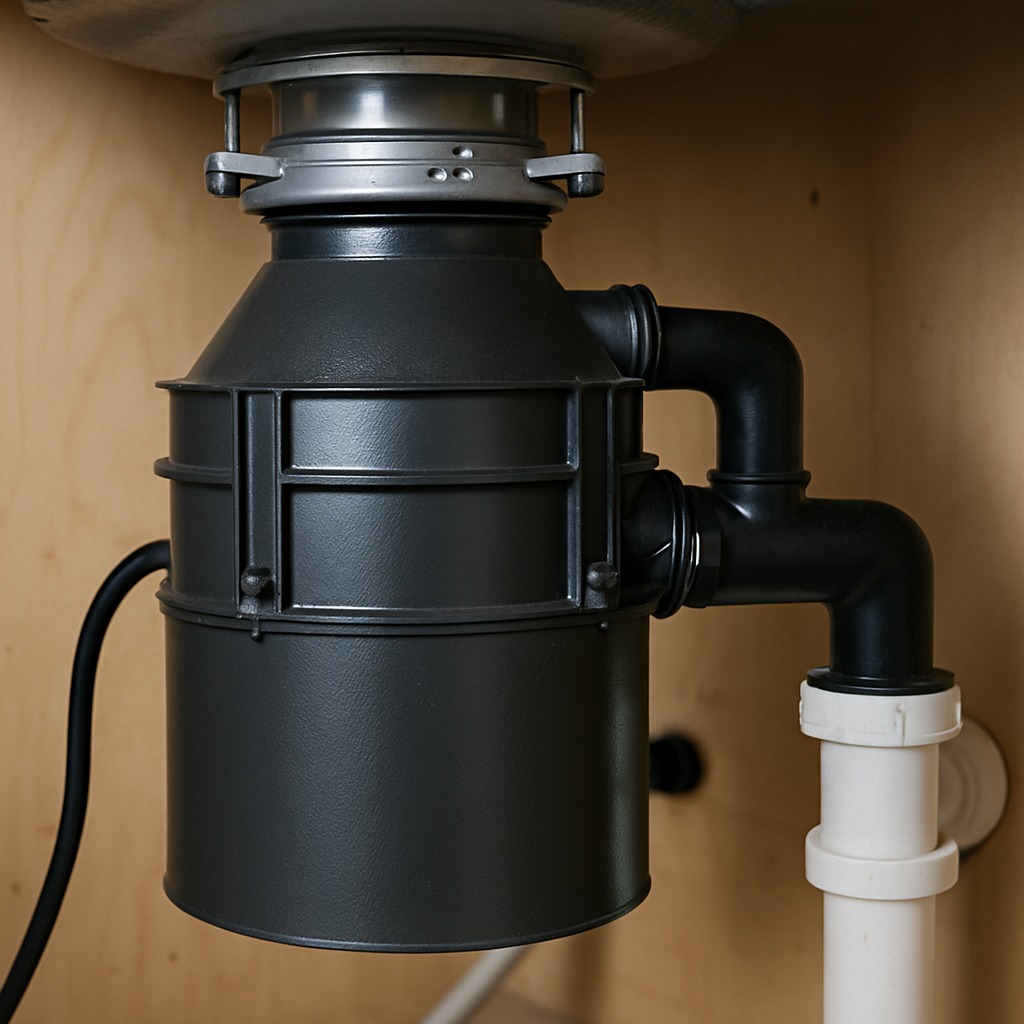
🔧 1/4-inch Allen wrench (hex key)Locate the hex socket on the very bottom center of the disposal housing—it is a 1/4-inch Allen (hex) fitting on InSinkErator models, or a 3/16-inch fitting on some Waste King and Moen units. Insert the correct Allen wrench—most InSinkErator units ship with one, but any standard 1/4-inch Allen key works. Turn the wrench clockwise and counterclockwise in a rocking motion. You should feel initial resistance if an object is jammed. Apply steady force—typically 8–15 foot-pounds is enough—and work the flywheel back and forth until it rotates freely through a full 360-degree turn. If you cannot break it free after 60 seconds of effort, do not use a breaker bar or cheater pipe; you risk cracking the grind chamber housing, which is made of glass-filled polypropylene on budget models. Free rotation in both directions confirms the jam is cleared.
Remove the foreign object from inside
🔧 Needle-nose pliers, flashlightWith power still confirmed off, shine a flashlight down into the drain opening and visually inspect the grind chamber. You are looking for anything that is not part of the disposal: glass shards, metal fragments, bones, plastic pieces, or small utensils. Use needle-nose pliers or kitchen tongs—never your fingers—to extract the object. Reach past the splash guard flaps, grip the item firmly, and pull it out. It helps to have a second person hold the flashlight while you work. After extraction, manually spin the flywheel again from below to confirm it rotates freely and nothing else is caught. Wipe down the splash guard baffle to remove any debris clinging to the rubber flaps. Inspect the grind ring teeth (the stationary ring around the perimeter) for chips or cracks; if teeth are broken off, the unit will grind poorly even after clearing the jam.
Reset the thermal overload protector button
Look at the bottom of the disposal unit—you will see a small red button (InSinkErator) or black button (Waste King, some Whirlpool models) approximately 1/4 inch in diameter. If the overload tripped, this button will be popped out about 1/8 inch from its normal flush position. Press it firmly until you feel it click and stay recessed. If the button will not stay in—it pops back out immediately—the motor windings are still too hot. Wait 10–15 minutes for the windings to cool, then try again. If it still will not hold after cooling, the motor may have an internal short, and the unit likely needs replacement. Before restoring power, also check that the wall switch is in the off position. This prevents the disposal from unexpectedly starting the moment you flip the breaker back on.
Restore power and test the disposal
Turn the circuit breaker back on at the panel. Run cold water—not hot—into the disposal at a moderate flow rate of roughly 2–3 gallons per minute. Cold water solidifies any remaining grease so it can be chopped and flushed rather than coating the drain pipe. Flip the wall switch on. The disposal should start immediately with its normal grinding roar, running at full speed. Let it run with water flowing for 15–20 seconds to flush debris through the drain line. Listen for any unusual rattling or metallic scraping, which would indicate another object or a damaged impeller. If the unit hums again without spinning, power it off within 5 seconds to protect the motor and repeat the flywheel rotation and inspection steps. If it hums a second time after re-clearing, the motor bearings or windings are likely compromised, and professional evaluation or replacement is the next step.
When to Stop DIY and Call a Pro
Call a licensed plumber if the flywheel will not rotate freely after using the hex wrench with reasonable force—say 15–20 foot-pounds—because forcing it further can crack the grind housing ($180–$350 for a new unit plus $150–$250 labor). Call immediately if you smell burning insulation, see scorch marks on the wiring or disposal housing, or if the circuit breaker trips repeatedly; these indicate potential fire risk from shorted motor windings. If the disposal is leaking from the bottom seal—not from pipe connections—the internal shaft seal has failed, and no DIY fix exists; the unit must be replaced. Also stop DIY work if you discover the disposal is hardwired without a dedicated disconnect switch, because you are now working in a junction box that may be shared with the dishwasher circuit. From a financial standpoint, if your disposal is more than 8–10 years old and requires anything beyond a simple jam clearing, replacement usually makes more sense than repair. A plumber can swap a standard disposal in 45–90 minutes for $250–$500 total, whereas a motor repair (if even possible) runs $150–$200 in labor for a part that will likely fail again within a year. When the cost to diagnose and repair exceeds 60% of a new installation, replacement is the smarter investment.
What Does This Repair Cost?
Costs vary by region, home age, and severity. These are national averages — always get 3 quotes.
| Repair Type | DIY Cost | Pro Cost | Emergency Premium |
|---|---|---|---|
| Jammed flywheel (Allen wrench reset) | $0–$3 | $95–$175 | $175–$275 |
| Thermal overload reset | $0 | $95–$150 | $150–$250 |
| Full disposal replacement (1/2 HP standard) | $80–$150 | $180–$350 | $300–$500 |
| Emergency after-hours service call | N/A | $150–$275 | $250–$400 |
*Emergency rates (nights/weekends/holidays) run 40–60% above standard. Get 3 quotes before approving work.
Get quotes from licensed professionals in your area
Free, no obligation — compare 3+ contractors in minutesWhat Drives the Cost?
| Cost Factor | Estimated Impact | Why It Matters |
|---|---|---|
| Disposal horsepower rating | Adds $50–$150 | Upgrading from 1/3 HP to 3/4 HP adds material cost but reduces future jams significantly on heavy-use households |
| Hardwired vs. plug-in connection | Adds $50–$100 for labor | Hardwired units require an electrician or additional plumber time to disconnect and reconnect safely to code |
| After-hours or weekend call | Adds $75–$200 | Emergency surcharges apply evenings, weekends, and holidays — scheduling a weekday morning visit saves the most |
| Under-sink water damage discovered | Adds $200–$1,200 | A backed-up sink that leaked during a jammed disposal can damage particle-board cabinets and subfloor, requiring secondary repairs |
Regional water hardness plays a bigger role than people realize. In hard-water areas like Phoenix, Las Vegas, and much of the Midwest, mineral scale builds up on the impeller plate and grinding ring over time, gradually reducing clearance until a small food particle that would normally pass right through becomes the jam that locks everything up. Veteran plumbers in these markets recommend running cold water for 30 seconds after every use and dropping ice cubes with a half-cup of white vinegar ($0.10 per treatment) into the disposal weekly. This cheap maintenance habit reduces scale-related jams by roughly 40% and can extend disposal lifespan from the typical 8–10 years to 12–14 years, saving you a $200–$350 replacement cycle.
⚠️ Stop DIY — Call a Pro If You See These
- Burning or acrid electrical smell from under the sink — Motor winding insulation is breaking down from overheating. Continued operation risks an electrical fire inside the cabinet. A shorted motor can melt the wiring harness within minutes, potentially costing $800–$2,000 in electrical and water damage repairs if it ignites adjacent materials.
- Water leaking from the bottom of the disposal body — The internal shaft seal has failed, allowing water to reach the motor and bearings. Within 1–2 weeks this causes complete motor failure and can corrode the mounting hardware. Continued use risks an electrical short to the metal sink, creating a shock hazard. Replacement cost rises $50–$100 if corrosion damages the mounting flange.
- Circuit breaker trips instantly upon switching on the disposal — The motor is drawing a dead short—potentially 40+ amps on a 20-amp circuit. This is not a jam; this is a failed motor or damaged wiring. Each breaker trip stresses the breaker mechanism, and after 15–20 trips, the breaker itself can fail to provide protection. Rewiring plus disposal replacement can run $400–$700.
- Visible rust flakes or metallic particles in the drain water — The grind chamber or flywheel is corroding through. Structural failure of the chamber can send metal fragments into the drain line, potentially damaging the P-trap or lodging in the dishwasher drain hose check valve. A corroded-through chamber will leak within 2–6 weeks, and the resulting water damage to the cabinet floor averages $300–$600 in repairs.
Frequently Asked Questions
How much does it cost to fix Garbage Disposal Humming But Not Spinning?
If it is a simple jam, the fix is free if you do it yourself with an Allen wrench. A plumber service call to clear a jam typically runs $85–$175 depending on your market—metro areas like NYC or San Francisco skew $150–$200, while mid-size cities average $85–$125. If the motor is burned out and the disposal needs replacement, expect $250–$500 total for a standard 1/2-HP to 3/4-HP unit installed. The two biggest cost factors are the horsepower rating of the replacement unit (1 HP models cost $80–$150 more than 1/2 HP) and whether your plumbing connections require modification—switching from a 3-bolt to an EZ-mount flange or adding a dishwasher inlet connection adds $50–$75 in labor.
Can I fix Garbage Disposal Humming But Not Spinning myself?
Yes, in about 80% of cases. If the cause is a foreign object jam, you need only a 1/4-inch Allen wrench, a flashlight, and needle-nose pliers—total time is 10–20 minutes. The key safety requirement is killing power at the breaker, not just the wall switch. If you can rotate the flywheel freely from below and the disposal runs after a reset, you have solved it. However, if the motor will not reset, the breaker trips, or you smell burning insulation, the unit likely needs replacement, and that job involves plumbing connections and electrical wiring that many homeowners are not comfortable handling. In jurisdictions that require permits for disposal installation—check with your local building department—a licensed plumber is required.
How urgent is Garbage Disposal Humming But Not Spinning?
You should address it within 24 hours, ideally immediately. Every second the motor hums while stalled, the windings are overheating. Most thermal overloads will cut power within 5–15 seconds, but repeated resets can push winding temperatures past the insulation's 130°C rating and permanently damage the motor within 3–5 cumulative minutes of locked-rotor operation. Beyond motor damage, standing water and trapped food waste begin producing bacteria and odor within 12–24 hours. The fix itself takes only 10–20 minutes in most cases, so there is no reason to delay. If you cannot address it right away, leave the wall switch off and the breaker off to prevent anyone from accidentally energizing the jammed motor.
What causes Garbage Disposal Humming But Not Spinning?
The most common cause—roughly 70% of cases—is a foreign object jammed between the spinning impeller plate and the stationary grind ring. Bottle caps, small bones, fruit pits, broken glass, and utensils are the usual culprits. The second most common cause is a seized flywheel from corrosion, which happens when a disposal sits unused for several weeks, especially in humid climates or homes with hard water above 10 grains per gallon. The third cause is a failed start capacitor or burned-out motor windings, typically in units over 8 years old, which requires full replacement of the disposal rather than a simple repair.
Will homeowners insurance cover Garbage Disposal Humming But Not Spinning?
Standard homeowners insurance does not cover appliance repair or replacement due to wear, corrosion, or mechanical failure—these are considered maintenance issues. However, if a jammed disposal leads to a water leak that damages your cabinet, flooring, or subfloor, the resulting water damage may be covered under your dwelling coverage, subject to your deductible (typically $500–$2,500). Home warranty plans are a different matter: most home warranty contracts—such as American Home Shield or First American—do cover garbage disposal repair or replacement for a $75–$125 service call fee, provided the failure is from normal use. Check your warranty contract for exclusions on pre-existing conditions and units older than a specified age.
How do I find a licensed plumber for this?
First, verify the plumber holds an active license in your state—check your state's contractor licensing board website (for example, CSLB in California, TDLR in Texas). Second, confirm they carry both general liability insurance (minimum $500,000) and workers' compensation coverage; ask for a certificate of insurance. Third, request a written quote before any work begins—a reputable plumber will provide a flat-rate price for a disposal replacement, not a vague hourly estimate. Typical flat rates for disposal replacement run $250–$500 including parts. Fourth, check at least two references or verified reviews on Google, Yelp, or the BBB. Avoid any plumber who insists on cash-only payment or refuses to provide a written warranty on labor—30-day minimum on labor is industry standard, and most quality shops offer 90 days to one year.
A humming garbage disposal that will not spin comes down to three decisions: Is it a jam I can clear myself with an Allen wrench and pliers? Has the motor been damaged by overheating, corrosion, or a failed capacitor, meaning the unit needs replacement? And is the situation creating any electrical hazard—burning smell, tripping breaker, exposed wiring—that demands immediate professional attention? In most cases, the answer to the first question is yes, and you can resolve the problem in under 20 minutes for zero cost.
Your recommended next step: kill power at the breaker, attempt the hex-wrench flywheel rotation from below, extract any foreign object, reset the overload button, and test. If the disposal spins freely and runs normally, you are done. If it hums again, the overload will not reset, or you detect any burning smell or water leaking from the unit body, stop immediately and call a licensed plumber. A full disposal replacement typically costs $250–$500 installed and takes under 90 minutes—far less than the cost of water damage or an electrical fire from forcing a failed unit to operate.
Ready to Solve This for Good?
Get matched with pre-screened, licensed plumbers in your area. Free quotes, no obligation, no spam.
GET FREE QUOTES NOW