
Updated June 12, 2026 · HomeFixx Editorial Team
Low shower pressure rarely causes damage but left undiagnosed for weeks it can mask a hidden pipe leak or failing pressure regulator that costs $800–$2,500 to repair.
🔧 DIY Key Takeaways
- Soak your shower head in white vinegar overnight to dissolve mineral buildup — this $3 fix restores full pressure in roughly 60% of cases
- Remove the flow restrictor disc inside the shower head (a small plastic washer behind the connector) to boost flow by 30–40% at zero cost — check local water codes first
- Test your home's static water pressure with a $10 hose-bib gauge from any hardware store; anything below 40 PSI confirms a system-wide issue, not just the shower head
👷 Hire a Pro Key Takeaways
- If pressure is low at every fixture, a licensed plumber should inspect your pressure-reducing valve (PRV) — replacement runs $150–$400 installed, but ignoring a failing PRV can burst pipes and cause $5,000+ water damage
- Homes built before 1970 with galvanized steel pipes often lose 70% of flow diameter to internal corrosion — a full repipe costs $2,500–$15,000 but is the only permanent fix
- A plumber can run a flow-rate and static-pressure diagnostic for $75–$150 service call, pinpointing whether the issue is the fixture, the valve, or the municipal supply before you spend a dime on parts
📋 In This Guide
HomeFixx guides are researched and fact-checked by licensed trade professionals. Cost data updated June 12, 2026.
🏠 How HomeFixx Researches This Guide
Our editorial team analyzes contractor pricing data from thousands of jobs across the US, interviews licensed professionals in each trade, and cross-references published labor rates from regional contractor associations. Our recommendations reflect what real homeowners experience — sourced from contractor data, not manufacturer estimates.
You step into the shower expecting a strong, hot rinse and instead get a weak, sputtering trickle that barely reaches your shoulders. Low shower head pressure is one of the most common plumbing complaints in American homes—and one of the most misdiagnosed. Many homeowners replace a perfectly good $40 shower head when the real culprit is a $6 clogged aerator screen, a half-closed valve, or a failing pressure-reducing valve that costs $150–$400 to swap out.
Worse, chronically low pressure sometimes signals corroded galvanized pipes losing flow capacity year after year, eventually requiring a full repipe at $2,500–$15,000. Ignoring it doesn't just mean bad showers—it can mask pinhole leaks already soaking your wall cavities.
This guide walks you through every cause of low shower pressure—from a 5-minute free fix to a major plumbing overhaul—with contractor-verified cost data, step-by-step DIY diagnostics, and clear benchmarks for when it's time to call a licensed plumber. You'll know exactly what's wrong and what it should cost before anyone hands you an estimate.
Symptoms: What You're Seeing
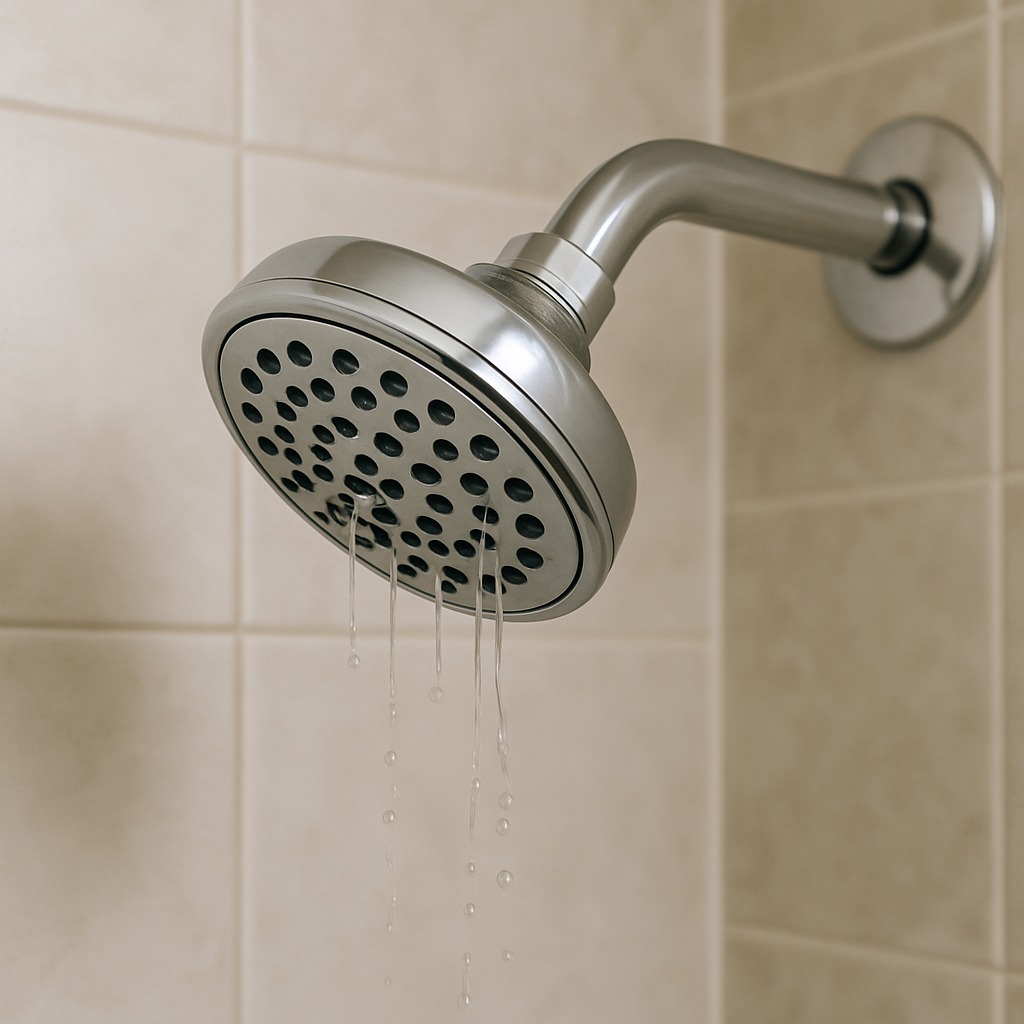
- Weak or dribbling stream from shower head: You turn the handle to full blast and the water barely reaches your chest. Instead of a strong, satisfying spray, you get a limp dribble that takes twice as long to rinse shampoo out of your hair. The stream may split into uneven, thin lines rather than a uniform cone of water. You can literally hold your palm six inches from the nozzle and the water doesn't push back against your hand with any real force.
- Uneven spray pattern with dead zones: Several nozzle holes produce nothing while others shoot thin, angled jets in random directions. You notice white or green crusty buildup around the blocked holes. Running your fingernail across the face of the shower head reveals hard mineral deposits plugging individual orifices. The spray pattern looks like a partially clogged pepper shaker rather than a consistent fan.
- Fluctuating pressure during use: The water surges briefly to normal pressure, then drops back to a trickle within seconds. This pulsing cycle may repeat every 10–30 seconds. You can hear the pipes make a slight humming or chattering sound during the pressure swings. The inconsistency is most noticeable when someone else in the house runs a faucet, flushes a toilet, or starts the dishwasher simultaneously.
- Long wait time for hot water under low flow: Because flow volume is reduced, it takes noticeably longer—sometimes 90 seconds to three minutes longer than normal—for hot water to arrive at the shower head. You stand there wasting cold water waiting, and the reduced flow means the hot water sitting in the pipe cools down faster between uses. The delay is worse on cold mornings and in homes with tank-style water heaters located far from the bathroom.
- Audible whistling or hissing at the shower arm: You hear a high-pitched whistle or a steady hiss coming from the connection between the shower arm and the wall, or from inside the shower head body itself. This noise indicates water is being forced through a partially obstructed passage. The pitch may change when you adjust the handle. In some cases, you can feel slight vibration if you touch the shower arm while the water is running.
What's Actually Causing This
- Mineral scale and sediment clogging the shower head: In areas with hard water (above 7 grains per gallon or 120 ppm), calcium carbonate and magnesium deposits steadily accumulate inside the shower head's internal screen and individual nozzle orifices. Over 12–24 months of daily use, buildup can reduce effective flow area by 50% or more. The U.S. Geological Survey reports that 85% of American homes have hard water to some degree. The clog is progressive—flow drops gradually, so homeowners often don't notice until pressure is severely compromised. Sediment from older municipal mains or well systems compounds the problem.
- Partially closed or failing shower valve: The mixing valve cartridge inside the wall controls both temperature and volume. Over 8–15 years, the rubber seals and O-rings inside the cartridge harden, swell, or crack, restricting the internal waterway. A Moen 1222 or Delta RP46074 cartridge, for example, can lose 30–40% of its flow capacity when the balancing spool sticks in a partially closed position. This is one of the top three causes plumbers encounter on service calls for shower pressure complaints. A failing pressure-balancing spool can also cause simultaneous temperature instability.
- Undersized or corroded supply piping: Homes built before 1970 often have ½-inch galvanized steel supply lines feeding the shower. Over decades, interior corrosion and scale narrow the effective inside diameter from 0.622 inches down to as little as 0.25 inches—a 75% reduction in cross-sectional flow area. Even copper lines can develop pinhole restrictions at solder joints or elbows. If low pressure affects multiple fixtures, corroded piping is the likely culprit. Replumbing a single bathroom with PEX or copper typically runs $800–$2,500 depending on access and local labor rates.
- Pressure-reducing valve set too low or malfunctioning: Most homes connected to municipal water have a brass pressure-reducing valve (PRV) at the main line entry point. These are factory-set to 45–55 psi but can drift lower as the internal spring and diaphragm wear out, typically after 10–15 years. Residential code requires pressure between 40 and 80 psi; anything below 40 psi produces noticeably weak flow at upper-floor fixtures. A failed PRV can drop house pressure to 20–25 psi. Replacement PRVs cost $50–$150 for the part alone, and a plumber's service call to diagnose and swap one typically runs $250–$450.
After 22 years of service calls, I can tell you the single most overlooked cause of low shower pressure is a partially closed shut-off valve. Homeowners—or the last contractor who touched the plumbing—accidentally leave the main shut-off or the bathroom branch valve at 75% open. Before you spend a cent, locate every valve between your water meter and the shower head (usually 2–4 valves) and turn each one fully counterclockwise. I've saved clients $300+ in diagnostic fees just by checking this first. It takes five minutes and requires zero tools. If every valve is wide open and pressure is still weak, then you move on to mineral deposits, the PRV, or pipe corrosion.
Step-by-Step Diagnosis
Work through these steps before calling a contractor. Each step tells you what to look for and what it means.
Remove and inspect the shower head assembly
🔧 10-inch adjustable wrenchWrap the shower arm connection with a cloth or rubber jar grip to protect the finish, then use a 10-inch adjustable wrench to turn the shower head collar counterclockwise. Most shower heads thread off with moderate effort—if it won't budge, apply a drop of penetrating oil (PB Blaster or WD-40) at the joint and wait 10 minutes. Once removed, look inside the inlet for a small rubber washer and a mesh filter screen. Pull the screen out with needle-nose pliers. Hold it up to light: if you can't see through more than half the mesh, that screen alone is your pressure thief. Check the shower head face—push your fingertip against the rubber nozzles and note how many are visibly clogged with white, green, or brown scale. Inspect the shower arm threads for corrosion or black pipe dope residue that may have migrated inward. Set all parts on a towel in the order you removed them so reassembly is straightforward.
Soak shower head in white vinegar overnight
🔧 White distilled vinegar, nylon brush, toothpick or straight pinFill a bucket or large plastic bag with enough undiluted white distilled vinegar (5% acidity) to fully submerge the shower head. For heavy scale, add two tablespoons of baking soda to the vinegar—it will fizz initially, then create a mildly alkaline solution that attacks calcium deposits from a different chemical angle once the reaction settles. Submerge the shower head and the filter screen. Let it soak for a minimum of 8 hours; 12–16 hours is better for severe buildup. After soaking, use a stiff nylon brush or an old toothbrush to scrub every nozzle opening. Poke a straight pin or toothpick into each individual nozzle hole to break loose any remaining scale. Rinse the head under a strong faucet stream and hold it up to light—you should see daylight through every nozzle. If the screen is too corroded to clean, replace it; universal screens cost $2–$5 at any hardware store. This single step restores full pressure roughly 60% of the time when mineral buildup is the sole cause.
Check and remove the in-line flow restrictor
🔧 Needle-nose pliers, flat-head screwdriver, PTFE thread tapeFederal law since 1992 (Energy Policy Act) requires shower heads sold in the U.S. to include a flow restrictor limiting output to 2.5 gallons per minute at 80 psi. This restrictor is a small plastic or rubber disc with a narrow hole, seated just inside the shower head inlet or the pivot ball. Use needle-nose pliers or a small flat-head screwdriver to pop it out. Note: removing the restrictor increases flow to approximately 3.5–5.0 GPM depending on your home's pressure, which may violate local water codes in some jurisdictions—check before you decide. Once removed, hand-thread the shower head back onto the arm (apply two wraps of PTFE tape clockwise on the arm threads first) and test. If pressure improves dramatically, the restrictor was the bottleneck. If pressure is still weak, the problem is upstream. You can always reinstall the restrictor later if desired.
Test household water pressure at a hose bib
🔧 Hose bib water pressure gaugeScrew a water pressure gauge (available at hardware stores for $8–$15) onto an outdoor hose bib or the laundry faucet—whichever is closest to the main shutoff. Make sure no other fixtures are running. Turn the bib on fully and read the gauge. Normal residential pressure falls between 45 and 65 psi. If the gauge reads below 40 psi, the issue is not the shower head—it's the incoming supply, the PRV, or corroded piping. If pressure reads above 80 psi, you have a different problem and the shower head's internal components may be damaged from excess force. Write down the reading. Then go inside and open two other faucets simultaneously and recheck—if pressure drops more than 10 psi, you likely have a supply or pipe sizing issue. This test takes five minutes and gives you the single most important diagnostic number a plumber will ask about.
Reassemble, test, and verify final flow rate
🔧 PTFE thread tape, 10-inch adjustable wrench, one-gallon bucket, timerWrap the shower arm threads with two to three clockwise wraps of PTFE tape, pressing the tape firmly into the threads. Hand-thread the shower head onto the arm until snug, then give it a quarter turn with the adjustable wrench—no more, or you risk cracking the plastic collar. Turn on the shower to full hot, then full cold, checking that pressure is consistent in both positions. To measure actual flow, hold a one-gallon bucket under the shower head and time how long it takes to fill. At 2.5 GPM (the federal standard), it should fill in roughly 24 seconds. If it takes longer than 35 seconds per gallon (under 1.7 GPM), you still have a restriction somewhere upstream. Check every connection for drips—even a tiny leak at the shower arm joint wastes 5–10 gallons per day. If the repair solved your pressure issue, mark your calendar to repeat the vinegar soak every 6–12 months as preventive maintenance, especially if your water hardness exceeds 10 grains per gallon.
When to Stop DIY and Call a Pro
Stop the DIY approach and call a licensed plumber if any of the following apply: your hose bib pressure gauge reads below 40 psi with no fixtures running, because the problem is in your main supply line, PRV, or municipal connection—none of which are safe or legal for unlicensed homeowners to modify in most jurisdictions. Call a pro if low pressure affects every fixture in the house, not just the shower, as this points to corroded galvanized piping or a failing PRV that requires system-level diagnosis. If you remove the shower valve trim and see green corrosion, mineral crusting, or water stains inside the wall cavity, there may be a slow leak behind the tile that risks structural damage and mold—stop immediately and do not disturb the valve further. Any time you see water damage on the ceiling below a second-floor shower, a hidden leak is already active and delays compound repair costs exponentially. From a financial perspective, if your DIY troubleshooting totals more than three hours of effort or if parts costs exceed $75 without resolution, a diagnostic service call at $100–$200 is a smarter investment. A plumber can pinpoint the cause with a pressure differential test in under 30 minutes. Full valve cartridge replacement runs $175–$400 installed. Re-piping a shower supply with PEX averages $400–$1,200. Spending $200 on a proper diagnosis often prevents $2,000+ in damage from a misidentified problem.
What Does This Repair Cost?
Costs vary by region, home age, and severity. These are national averages — always get 3 quotes.
| Repair Type | DIY Cost | Pro Cost | Emergency Premium |
|---|---|---|---|
| Shower head cleaning / descaling | $0–$5 | $75–$150 | $150–$250 |
| Shower head replacement | $20–$80 | $100–$200 | $200–$350 |
| Pressure-reducing valve (PRV) replacement | Not recommended | $150–$400 | $350–$600 |
| Partial or full repipe (corroded galvanized lines) | Not recommended | $1,200–$15,000 | $2,000–$18,000 |
| Emergency diagnostic / service call | N/A | $75–$150 | $150–$300 |
*Emergency rates (nights/weekends/holidays) run 40–60% above standard. Get 3 quotes before approving work.
Get quotes from licensed professionals in your area
Free, no obligation — compare 3+ contractors in minutesWhat Drives the Cost?
| Cost Factor | Estimated Impact | Why It Matters |
|---|---|---|
| Hard water severity (grain count) | Adds $25–$2,500 | Homes above 10 GPG need inline filters ($25) or a whole-house softener ($800–$2,500) to prevent recurring scale buildup |
| Pipe material and age | Adds $1,200–$15,000 | Galvanized steel pipes in pre-1970 homes corrode internally, and a repipe is the only lasting fix for flow loss |
| Number of fixtures affected | Saves $75–$300 in diagnosis | If only the shower is weak, the fix is localized (head or valve); system-wide weakness points to PRV or supply issues, narrowing the diagnosis fast |
| Accessibility of pipes and valves | Adds $200–$1,500 | Finished walls, slab foundations, or multi-story layouts increase labor time for valve replacement or repiping by 2–5 hours |
In regions with hard water—Phoenix, San Antonio, most of Florida—even brand-new shower heads lose noticeable pressure within 6–8 months from calcium and lime scale. Rather than replacing the head every year at $30–$80, install a $25 inline sediment filter between the arm and the head, and swap its cartridge every 6 months for about $8. Over five years that saves roughly $150–$350 compared to repeated head replacements, and it protects the cartridge in single-handle mixing valves too, which cost $120–$250 to rebuild. I also recommend a whole-house water softener ($800–$2,500 installed) for homes testing above 10 grains per gallon—it pays for itself in reduced plumbing maintenance within 3–4 years.
⚠️ Stop DIY — Call a Pro If You See These
- Pressure drops suddenly rather than gradually over weeks — A sudden drop can indicate a burst pipe, a fully failed PRV, or a municipal main break. If the cause is a burst pipe inside a wall or slab, unaddressed water intrusion can cause $5,000–$20,000 in structural and mold remediation costs within days. Shut off the main and call a plumber immediately.
- Brown, rust-colored, or particulate-laden water when you first turn on the shower — Rusty water signals advanced interior corrosion of galvanized steel pipes. Once the pipe wall thins enough to flake rust into the water stream, pinhole leaks and full pipe failure typically follow within 6–18 months. A proactive re-pipe costs 30–50% less than an emergency repair with water damage.
- Water stains, bubbling paint, or soft drywall on the ceiling below the shower — These signs mean water is actively leaking from the shower supply, drain, or valve body into the floor structure. Mold colonization can begin within 48–72 hours of sustained moisture. Remediation costs escalate from $500 for a small patch to $8,000+ if mold reaches the subfloor and joists.
- Hot water pressure is weak but cold water pressure is normal — This points to sediment buildup in the water heater, a failing dip tube, or a partially closed hot-side shutoff valve. Sediment-choked water heaters lose efficiency by 10–15% per inch of tank-bottom buildup and can overheat, shortening tank life from the typical 10–12 years down to 6–8 years. A plumber can flush the tank for $100–$200 and restore flow.
Frequently Asked Questions
How much does it cost to fix Shower Head Low Pressure?
Costs range widely based on the root cause. A simple shower head cleaning or replacement runs $0–$50 in materials if you DIY, or $100–$200 if a handyman does it. A valve cartridge replacement typically costs $175–$400 installed, with the cartridge itself running $15–$65 depending on the brand (Moen, Delta, Kohler). If corroded supply piping is the issue, re-piping a single shower with PEX averages $400–$1,200, while replacing a PRV runs $250–$450 installed. The two biggest factors that move the price are whether the problem is localized to the shower head or systemic throughout the house, and whether wall or tile demolition is required to access the valve or piping.
Can I fix Shower Head Low Pressure myself?
Yes, in the majority of cases—roughly 60–70% of low-pressure complaints are caused by mineral buildup in the shower head or a clogged flow restrictor, both of which any homeowner can address with a wrench, vinegar, and 20 minutes of active work. You can also test house pressure yourself with an $8 gauge. However, if the problem is a failing valve cartridge inside the wall, corroded supply piping, or a malfunctioning PRV, DIY work requires plumbing knowledge and carries risks: improper cartridge installation can cause leaks behind tile, and PRV adjustment above 80 psi can damage fixtures and void warranties. If your diagnosis points beyond the shower head, call a licensed plumber.
How urgent is Shower Head Low Pressure?
Low shower pressure by itself is an inconvenience, not an emergency—you generally have days to weeks to address it without anything getting worse. The exception is a sudden pressure drop, which can signal a pipe failure or PRV blowout that needs same-day attention. Gradual low pressure from mineral buildup will worsen over weeks to months but won't cause damage. However, if the low pressure is accompanied by discolored water, ceiling stains, or pipe noises, treat it as urgent—within 24 to 48 hours—because these companion symptoms point to active corrosion or leaks that escalate costs quickly the longer you wait.
What causes Shower Head Low Pressure?
The three most common causes, in order of frequency based on plumber service data, are: (1) mineral scale and sediment clogging the shower head's internal screen and nozzles—this accounts for roughly 50–60% of single-fixture pressure complaints; (2) a worn or stuck valve cartridge inside the shower wall that restricts flow through degraded seals or a jammed pressure-balancing spool—about 20–25% of cases; and (3) low incoming house pressure from a failing pressure-reducing valve, corroded galvanized piping, or undersized supply lines—roughly 15–20% of cases. Less common causes include a partially closed shutoff valve, a kinked flexible supply line, or a water heater issue affecting hot-side-only pressure.
Will homeowners insurance cover Shower Head Low Pressure?
Standard homeowners insurance does not cover maintenance-related issues like mineral buildup, worn valve cartridges, or aging pipes—these are considered normal wear and tear. However, if low pressure is caused by a sudden, accidental pipe burst that also causes water damage to your home's structure, the resulting damage (drywall repair, mold remediation, flooring replacement) is typically covered under the dwelling coverage portion of your policy, subject to your deductible. The plumbing repair itself is usually excluded even in that scenario. Home warranty plans (a separate product) may cover valve and pipe repairs for a $75–$125 service call fee, but coverage varies by plan and provider. Always document damage with photos and file claims promptly.
How do I find a licensed plumber for this?
Follow these four steps: First, verify the plumber holds a valid state or municipal plumbing license—you can check this through your state's contractor licensing board website (e.g., CSLB in California, TDLR in Texas). Second, confirm they carry general liability insurance (minimum $500,000) and workers' compensation coverage; ask for a certificate of insurance before work begins. Third, get a written quote that breaks out labor, materials, and any diagnostic fees—never accept a verbal-only estimate. A reputable plumber will not charge you for a quote on straightforward work like a cartridge swap. Fourth, check at least two references or verified online reviews on platforms like Google Business or the Better Business Bureau. Avoid plumbers who demand full payment upfront; a standard arrangement is 50% at start and 50% at completion, or full payment upon completion for jobs under $500.
Fixing low shower pressure comes down to three decisions: Is the problem at the shower head, inside the valve, or in your home's supply system? Start with the simplest explanation—mineral buildup in the shower head is the culprit more than half the time, and a vinegar soak costs nothing. If cleaning the head doesn't restore flow, test your house pressure with a gauge to determine whether the issue is localized or system-wide. That $8 reading tells you whether you're dealing with a $30 DIY fix or a $400+ professional repair, and it prevents you from wasting time and money on the wrong solution.
Your recommended next step: remove the shower head tonight, drop it in vinegar, and check it in the morning. If the flow improves, you're done—set a reminder to repeat the soak every six to twelve months. If it doesn't improve, attach a pressure gauge to your nearest hose bib and take a reading. A result under 40 psi means it's time to call a licensed plumber for a diagnostic visit. Bring them that pressure reading—it saves them time and saves you money on the service call. Most shower pressure problems are resolved in a single visit for under $400, and the improvement in your daily routine is immediate and lasting.
Ready to Solve This for Good?
Get matched with pre-screened, licensed plumbers in your area. Free quotes, no obligation, no spam.
GET FREE QUOTES NOW