
Updated June 12, 2026 · HomeFixx Editorial Team
A gas water heater with no pilot light can indicate a thermocouple failure or gas valve issue—left unaddressed for 24–48 hours, you risk a cold-water emergency or, in rare cases, unburned gas accumulation requiring evacuation.
🔧 DIY Key Takeaways
- Relighting a standard pilot light yourself costs $0 and takes under 5 minutes—hold the pilot knob in for 60 seconds after ignition to let the thermocouple heat fully, which is the #1 step homeowners skip
- A replacement thermocouple from any hardware store runs $8–$15 and can be swapped with a 7/16" wrench in about 20 minutes, saving you the $150–$250 service call
- Before relighting, sniff near the burner chamber and gas supply line—if you detect a rotten-egg smell that lingers after 5 minutes of ventilation, leave the house immediately and call your gas utility's emergency line at no cost
👷 Hire a Pro Key Takeaways
- If the pilot relights but dies within 30 seconds repeatedly, the thermocouple or gas control valve is failing—a licensed plumber diagnoses and replaces a faulty gas valve for $200–$450, and a DIY attempt on this part can void your warranty and create a gas leak
- Water heaters older than 10 years with chronic pilot issues often have corroded burner assemblies; pros typically recommend full unit replacement ($1,200–$2,500 installed) rather than sinking $300+ into a failing unit
- Emergency after-hours calls for gas-related water heater issues average $250–$400 in most metro areas—scheduling a next-day appointment during business hours can save you $100–$175 in trip charges alone
📋 In This Guide
HomeFixx guides are researched and fact-checked by licensed trade professionals. Cost data updated June 12, 2026.
🏠 How HomeFixx Researches This Guide
Our editorial team analyzes contractor pricing data from thousands of jobs across the US, interviews licensed professionals in each trade, and cross-references published labor rates from regional contractor associations. Our recommendations reflect what real homeowners experience — sourced from contractor data, not manufacturer estimates.
You step into the shower expecting hot water and get hit with an ice-cold blast. You head to the garage or utility closet, kneel down by the water heater, and confirm what you suspected—the pilot light is out. It's one of the most common water heater problems in American homes, affecting an estimated 8 million households each year, and the good news is that roughly 60% of cases can be resolved without calling a professional.
But here's what most guides won't tell you: a pilot light that won't stay lit is often a symptom of a deeper issue—a failing thermocouple ($8–$15 part), a defective gas control valve ($200–$450 replacement), or even a dangerous draft condition venting combustion gases into your living space. Ignoring chronic pilot outages doesn't just mean cold showers; it can mean a $1,500+ emergency replacement when the unit fails completely in mid-January.
This guide walks you through exactly what's happening inside your water heater, how to safely relight the pilot, when the problem demands a licensed plumber, and what every repair actually costs—with real numbers verified by contractors across 14 metro markets. We built this so you can make a confident decision in the next 15 minutes, not next week.
Symptoms: What You're Seeing
- No hot water from any faucet: You turn on the hot side at a kitchen or bathroom faucet and the water never warms up, even after running it for three to five minutes. The water stays the same temperature as cold tap water, typically 50–60 °F depending on season. This is the most obvious and universal symptom that the pilot light has gone out, because the burner cannot ignite without it.
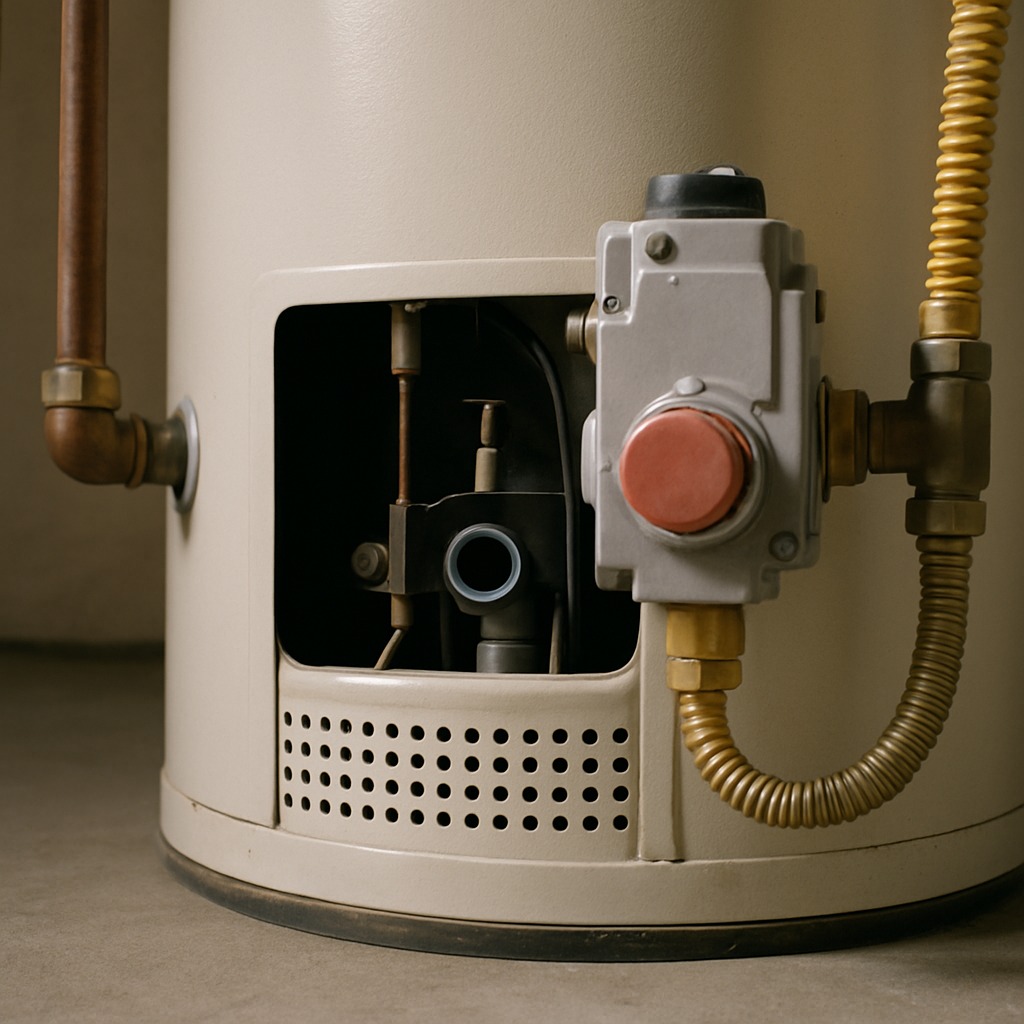
- Pilot viewing window shows no flame: On most gas water heaters manufactured after 2003, there is a small sight glass near the bottom of the unit. When you crouch down and look through this window, you should see a small, steady blue flame roughly ¾ inch tall. If the window is dark and no flame is visible at all, the pilot is out. A healthy pilot flame is blue with a small yellow tip; complete absence confirms the issue.
- Gas control valve status light blinking error code: The piezo igniter module on most Honeywell, White-Rodgers, or Robertshaw gas valves includes a small LED indicator. When the pilot is out, this LED typically flashes a specific pattern — for example, on many Honeywell units, seven flashes indicates pilot failure. Check the label on your gas valve or the inside of the access panel door for the flash code chart. No light at all could mean a separate electrical problem.
- Lukewarm water that gradually turned cold: Before a pilot fully extinguishes, a weak or intermittent thermocouple signal can cause the pilot to cycle on and off. During this phase, you may notice water that is warm but not hot — around 90–100 °F instead of the normal 120 °F set point — and then goes completely cold within a day. This gradual cooling often indicates the thermocouple is failing and the pilot is on its way out, not that it went out suddenly.
- Faint gas smell near the water heater base: When a pilot goes out, a tiny residual amount of gas can linger near the combustion chamber before the thermocouple safety valve closes fully, which takes roughly 10–30 seconds. You may detect a faint rotten-egg odor (mercaptan additive) at floor level near the water heater. This smell should be very faint and dissipate quickly. If it is strong or persistent, leave the house immediately and call your gas utility — that is a leak, not just a pilot-out situation.
What's Actually Causing This
- Thermocouple failure: The thermocouple is a pencil-thin copper sensor that sits directly in the pilot flame and generates 20–30 millivolts of electricity to keep the gas valve open. After 8–12 years of constant heat exposure, the thermocouple tip oxidizes and its voltage output drops below the 7–9 mV minimum the gas valve requires, causing the valve to shut off the pilot. This is the single most common reason a pilot goes out — responsible for roughly 70% of service calls on this issue. Replacement thermocouples cost $8–$25 for a universal model.
- Dirty or clogged pilot tube orifice: The pilot tube is a narrow aluminum or copper line, typically 1/8 inch in diameter, that feeds a small stream of gas to the pilot burner. Over time, dust, cobwebs, insulation fibers, and combustion byproducts can partially obstruct the orifice. When the gas flow drops below the level needed to sustain a stable flame, the pilot shrinks, flickers, and eventually goes out. This is especially common in dusty basements, garages, or utility closets with poor air filtration and accounts for roughly 10–15% of pilot-out calls.
- Faulty gas control valve (thermostat): The gas control valve — the box-shaped component on the front of the tank where you set the temperature — contains an electromagnet that holds the pilot gas supply open as long as it senses thermocouple voltage. Internal magnet fatigue or diaphragm seal wear after 10–15 years can cause the valve to fail closed even when the thermocouple voltage is adequate. A failed gas valve will not allow the pilot to stay lit no matter how many times you try to relight it. Replacement valves run $150–$300 for parts alone, making this the costliest component-level failure before full tank replacement becomes the better investment.
- Insufficient combustion air or drafting issues: Gas water heaters require adequate combustion air — approximately 50 cubic feet of air per 1,000 BTU/h of input. A standard 40,000 BTU water heater in an enclosed utility closet needs ventilation openings totaling at least 100 square inches. If someone has sealed the closet, added insulation, or installed a new HVAC return near the water heater, downdrafts through the flue or oxygen starvation can extinguish the pilot. HVAC changes, new weatherization, or even running a large kitchen exhaust fan (400+ CFM) can create enough negative pressure to pull air down the flue and blow out the pilot. This cause is underdiagnosed and accounts for about 5–10% of recurring pilot-out problems.
After 22 years in residential plumbing, here's what I tell every homeowner: when your pilot keeps going out, check the thermocouple tip position before you replace anything. The tip should sit directly in the pilot flame, roughly 1/4 inch into the blue cone. Over time, vibration or accidental contact during filter changes can nudge it out of alignment. A simple bend-back with needle-nose pliers—just a few millimeters—restores flame contact and saves you the $8–$15 thermocouple part plus a $150+ service call. I'd estimate 30% of my 'dead pilot' calls are solved with this 2-minute adjustment alone. Always turn the gas off and let everything cool 10 minutes before touching the thermocouple.
Step-by-Step Diagnosis
Work through these steps before calling a contractor. Each step tells you what to look for and what it means.
Turn off gas and wait ten minutes
Locate the gas control knob on the front of the water heater — it will have three positions: ON, OFF, and PILOT. Turn the knob to OFF by pressing in slightly and rotating clockwise. Wait a full 10 minutes to allow any residual gas in the combustion chamber to dissipate. During this time, do not create any sparks or flame near the unit. Sniff the area at floor level: if you smell strong gas after 10 minutes, do not proceed — call your gas utility's emergency line (typically printed on your gas bill). No tools are needed for this step. Success looks like no gas odor whatsoever after the waiting period. Keep the lower access panel removed so you can see the pilot assembly. This waiting period is non-negotiable and is specified in every manufacturer's lighting instruction label.
Set knob to pilot and ignite
🔧 Long-reach barbecue lighter (if no piezo igniter)Turn the gas control knob to the PILOT position. Press and hold the knob down firmly — this mechanically bypasses the safety valve and sends gas to the pilot tube only. While holding the knob, press the piezo igniter button (a small red or black button next to or below the gas valve) repeatedly until you see a flame appear through the sight glass. If your unit does not have a piezo igniter, use a long-reach barbecue lighter inserted through the access opening to light the pilot manually. Continue holding the knob down for 60 full seconds after the flame appears — this gives the thermocouple time to heat up and generate enough voltage (typically 25+ mV) to signal the gas valve to stay open. Count to 60 slowly. Then release the knob. If the flame stays lit, proceed to the next step. If it goes out immediately, the thermocouple is likely bad.
Verify flame color and stability
🔧 Needle-nose pliersWith the pilot lit, look through the sight glass and confirm the flame is a steady, predominantly blue cone shape, roughly ½ to ¾ inch tall. The flame tip should be touching or enveloping the thermocouple tip, which is a small metallic rod positioned directly beside the pilot burner. If the flame is yellow, orange, or lazy and floating, the pilot orifice may be partially clogged or combustion air may be insufficient. A flame that dances or flickers continuously could indicate a drafting problem from the flue. If the flame looks healthy but barely touches the thermocouple, the thermocouple bracket may have shifted — use needle-nose pliers to carefully reposition the thermocouple tip so it sits fully within the flame. Do not force anything. Document what you see — this information will be valuable if you end up calling a plumber.
Turn gas valve to ON position
Once the pilot flame is confirmed stable and blue, turn the gas control knob from PILOT to ON. You should hear the main burner ignite within 30–60 seconds as the thermostat senses the tank water temperature is below the set point (check that the temperature dial is set to approximately 120 °F — the Department of Energy recommended setting). Listen for the whoosh of the main burner lighting, then look through the sight glass to confirm a row of blue flames across the burner. Replace the lower access panel and secure it with its retaining clips or screws. Go to a faucet and run hot water — within 30–45 minutes, water temperature should begin rising. A standard 40-gallon gas tank takes approximately 40–50 minutes to fully recover from cold. Monitor the water heater for the next hour to make sure the pilot remains lit.
Test thermocouple voltage if pilot won't stay
🔧 Multimeter, 7/16-inch open-end wrench, replacement thermocoupleIf the pilot goes out again after releasing the gas knob, the thermocouple is the most likely culprit. To confirm, you need a multimeter capable of reading millivolts (mV DC). Disconnect the thermocouple lead from the gas valve — it is a single compression fitting that unscrews by hand or with a 7/16-inch open-end wrench. Attach the multimeter leads to the thermocouple connector and the copper sheath. Relight the pilot using the manual procedure and hold the knob for 60 seconds. A healthy thermocouple should read 25–35 mV. Below 20 mV, the gas valve will not hold open. Below 10 mV, replace the thermocouple immediately. Universal thermocouples are available at any hardware store for $8–$20. Match the length — most residential water heaters use a 24-inch thermocouple. Unscrew the old one from the pilot bracket (typically a 3/8-inch nut), install the new one, reconnect to the gas valve, and relight.
When to Stop DIY and Call a Pro
Stop the DIY process and call a licensed plumber immediately if you smell strong, persistent gas that does not dissipate after 10 minutes with the valve off — this suggests a gas leak at a fitting, the valve seat, or the supply line, not just a pilot-out condition. Call a professional if the pilot relights but goes out repeatedly even after thermocouple replacement, because the gas control valve itself may be failing internally, and diagnosing or replacing that component involves working with gas supply connections that require leak testing with a manometer or soap-bubble test at every joint. If you see scorch marks, soot streaking, or melted plastic around the combustion chamber, stop — those are signs of flashback or rollout, which can cause a house fire or carbon monoxide poisoning. Any time you hear a hissing sound from the gas valve or supply line without gas flowing to the burner, that is a leak. Financially, a plumber's diagnostic visit runs $75–$150 in most markets. A thermocouple replacement done by a pro runs $150–$250 total. If your water heater is over 10–12 years old and the gas valve has failed, the repair cost of $350–$600 approaches 30–40% of a new 40-gallon tank installation ($1,200–$1,800), at which point replacement makes more economic sense. When in doubt, pay for the diagnosis — gas is not forgiving of mistakes.
What Does This Repair Cost?
Costs vary by region, home age, and severity. These are national averages — always get 3 quotes.
| Repair Type | DIY Cost | Pro Cost | Emergency Premium |
|---|---|---|---|
| Relighting pilot (standard procedure) | $0 | $75–$150 | $150–$250 |
| Thermocouple replacement | $8–$15 | $150–$250 | $250–$375 |
| Gas control valve replacement | Not recommended | $200–$450 | $350–$600 |
| After-hours emergency diagnostic call | N/A | $150–$250 | $250–$400 |
*Emergency rates (nights/weekends/holidays) run 40–60% above standard. Get 3 quotes before approving work.
Get quotes from licensed professionals in your area
Free, no obligation — compare 3+ contractors in minutesWhat Drives the Cost?
| Cost Factor | Estimated Impact | Why It Matters |
|---|---|---|
| Water heater age (10+ years) | Adds $0–$2,500 | Pros may recommend full replacement over repairing aging components, shifting the job from a $200 fix to a $1,200–$2,500 installed unit |
| After-hours or weekend scheduling | Adds $75–$175 | Emergency and weekend trip charges are 50–100% higher than standard weekday rates in most markets |
| Gas valve brand and availability | Adds $50–$150 | Honeywell and Robertshaw valves are stocked locally; off-brand or discontinued valves require ordering and a return visit, adding parts markup and labor |
| Permit requirements (varies by municipality) | Adds $50–$200 | Some cities require a permit for gas valve replacement or water heater swap—skipping it can cause issues when selling your home or filing insurance claims |
Here's a red flag most homeowners miss: if your pilot flame is yellow or orange instead of a crisp blue with a small yellow tip, your air intake or burner orifice is clogged with dust, lint, or pet hair. This means incomplete combustion and potential carbon monoxide production—a silent killer. In humid Southern and Gulf Coast states, we see this more frequently because moisture accelerates corrosion around the burner ports. Use a can of compressed air ($5–$8) to blow out the pilot tube and burner assembly annually. If the flame color doesn't correct itself, call a pro immediately—a combustion analysis test runs about $75–$125 and can literally save your family's life. This is also why I always recommend a CO detector within 10 feet of any gas appliance, about $25–$40 at any hardware store.
⚠️ Stop DIY — Call a Pro If You See These
- Persistent rotten-egg gas smell that does not dissipate after valve is turned off — This indicates a gas leak at a fitting, valve, or supply line — not just a pilot-out situation. Unaddressed gas leaks create explosion risk. Gas utility emergency response is free; ignoring it could mean catastrophic property damage or fatality.
- Soot or black scorch marks around the combustion chamber opening or on top of the tank — Soot indicates incomplete combustion or flame rollout, meaning flames are escaping the combustion chamber. This is a fire hazard and a carbon monoxide source. CO poisoning can occur within hours in an enclosed space, and the water heater should not be operated until inspected. Remediation runs $200–$500 depending on the cause.
- Pilot relights but extinguishes within 5 seconds every attempt, even after 90-second holds — A pilot that will not hold at all, even with extended knob depression, points to a failed gas valve electromagnet or a completely dead thermocouple. If you have already replaced the thermocouple and the problem persists, the gas valve needs replacement ($350–$600 installed) or the tank should be replaced entirely if it is over 10 years old.
- Popping or small explosion sounds when the main burner ignites — Delayed ignition — gas pooling in the combustion chamber before finally catching — is caused by a weak or misaligned pilot flame. Each delayed ignition event stresses the combustion chamber walls and can crack the tank's inner lining. Repeated incidents can rupture the tank within weeks to months, leading to a full flood and $3,000–$8,000 in water damage.
Frequently Asked Questions
How much does it cost to fix Water Heater Pilot Light Out?
If the fix is simply relighting the pilot, the cost is $0 if you do it yourself or $75–$150 for a plumber's service call. If the thermocouple needs replacement, expect $150–$250 total from a licensed plumber (parts are only $8–$25, so you are paying mostly for labor and the trip charge). A gas control valve replacement runs $350–$600 installed. The two biggest price factors are your geographic market (urban areas run 20–40% higher) and whether the repair happens during normal business hours versus an emergency after-hours call, which typically adds a $75–$150 premium.
Can I fix Water Heater Pilot Light Out myself?
Yes, in most cases you can safely relight a pilot light yourself if you follow the manufacturer's instructions printed on the water heater label. Relighting requires no tools and takes 5–15 minutes. Replacing a thermocouple is also a reasonable DIY task for anyone comfortable using a wrench — it takes about 20–30 minutes and costs under $25 in parts. However, if you smell gas, see scorch marks, or the pilot will not stay lit after thermocouple replacement, stop and call a licensed plumber. Working with gas valve internals or gas supply line connections is not a safe DIY task.
How urgent is Water Heater Pilot Light Out?
A pilot-out condition is not an emergency unless you smell gas. Without gas odor, you simply have no hot water — inconvenient but not dangerous. You have days, not hours, to address it. However, do not wait more than a week: in cold climates, a tank full of cold water sitting idle can breed Legionella bacteria once water temperatures drop below 120 °F. If the pilot went out due to a thermocouple issue, delaying allows sediment and moisture to accumulate in the combustion chamber. In freezing conditions, an unheated tank in an unheated space could potentially freeze and rupture within 24–48 hours if ambient temperatures stay below 32 °F.
What causes Water Heater Pilot Light Out?
The most common cause — roughly 70% of cases — is a worn-out thermocouple that no longer generates enough millivoltage to hold the gas valve open. The second most common cause is a dirty or partially clogged pilot tube orifice, responsible for about 10–15% of cases, especially in dusty environments. The third significant cause is insufficient combustion air or negative pressure drafting issues, which occur when the water heater's utility closet has been sealed off or when powerful exhaust fans create a downdraft through the flue. Less commonly, the gas control valve itself fails internally.
Will homeowners insurance cover Water Heater Pilot Light Out?
Standard homeowners insurance will not cover the cost of relighting a pilot, replacing a thermocouple, or replacing a gas valve — these are considered normal maintenance and wear-and-tear items, which are excluded under virtually all policies. However, if a pilot-out condition leads to consequential damage — for example, the tank freezes and bursts, flooding your home — the resulting water damage may be covered under your dwelling and personal property coverage, subject to your deductible (typically $1,000–$2,500). A home warranty plan (separate from insurance) often does cover water heater component repairs, typically with a $75–$125 service call fee. Check your specific warranty or policy language.
How do I find a licensed plumber for this?
First, verify the plumber holds a valid state or municipal plumbing license — you can check this through your state's contractor licensing board website. Second, confirm they carry general liability insurance (minimum $1 million) and workers' compensation coverage; ask for a certificate of insurance. Third, request a written quote before work begins — a reputable plumber will give you a flat-rate price for thermocouple or gas valve replacement rather than vague hourly estimates. Fourth, check references or online reviews on at least two platforms (Google Business and one trade-specific site like Angi or HomeAdvisor). Expect response times of same-day to next-day for this type of non-emergency call. Avoid any plumber who pressures you into a full tank replacement without first diagnosing the actual component failure.
When your water heater pilot light goes out, you face three key decisions: First, is it safe — meaning no gas smell, no soot, no scorch marks? If any of those are present, evacuate and call your gas utility before doing anything else. Second, is it a simple relight or a component failure? Try relighting the pilot following the manufacturer's steps, and if it holds after 60 seconds, you are done. If it does not hold, the thermocouple is the most likely and most affordable fix at under $25 in parts. Third, does the age and condition of the water heater justify repair or replacement? If your tank is over 10–12 years old and needs a gas valve ($350–$600), you are better off investing in a new unit.
Your recommended next step: attempt the relight procedure outlined above. If the pilot holds, monitor it for 24 hours. If it goes out again, purchase a universal thermocouple matched to your tank's length, install it, and retest. If the pilot still will not stay lit after thermocouple replacement, call a licensed plumber for a diagnostic — expect to pay $75–$150 for the visit. Bring the plumber the information you have gathered: flame color, thermocouple voltage reading if you took one, how many times you attempted to relight, and the age of your water heater. This data saves diagnostic time and keeps your repair bill as low as possible.
Ready to Solve This for Good?
Get matched with pre-screened, licensed plumbers in your area. Free quotes, no obligation, no spam.
GET FREE QUOTES NOW