
Updated June 12, 2026 · HomeFixx Editorial Team
An underground water line break can waste 500+ gallons per hour, undermine your foundation, and cause $15,000+ in property damage within 24–48 hours if left unaddressed.
🔧 DIY Key Takeaways
- Locate and shut off your main water valve immediately — this $0 step prevents hundreds of dollars in water waste per hour and stops further yard saturation
- Mark the wet area with landscape flags ($4 at any hardware store) and photograph the damage zone for your insurance claim and plumber's reference
- Call 811 before any digging — it's free, legally required in all 50 states, and skipping it can result in a $50,000+ fine if you hit a gas or electric line
👷 Hire a Pro Key Takeaways
- Licensed plumbers use electronic leak detection ($150–$350 diagnostic fee) to pinpoint the exact break location and avoid unnecessary excavation that can add $1,000+ to your bill
- A full water service line replacement from the meter to the house runs $1,800–$5,500 depending on length and depth, but eliminates recurring break risks on aging galvanized or polybutylene pipe
- Trenchless pipe bursting or pipe lining ($2,500–$4,500) can replace the line without destroying landscaping, driveways, or sidewalks — saving $1,500–$4,000 in surface restoration costs
📋 In This Guide
HomeFixx guides are researched and fact-checked by licensed trade professionals. Cost data updated June 12, 2026.
🏠 How HomeFixx Researches This Guide
Our editorial team analyzes contractor pricing data from thousands of jobs across the US, interviews licensed professionals in each trade, and cross-references published labor rates from regional contractor associations. Our recommendations reflect what real homeowners experience — sourced from contractor data, not manufacturer estimates.
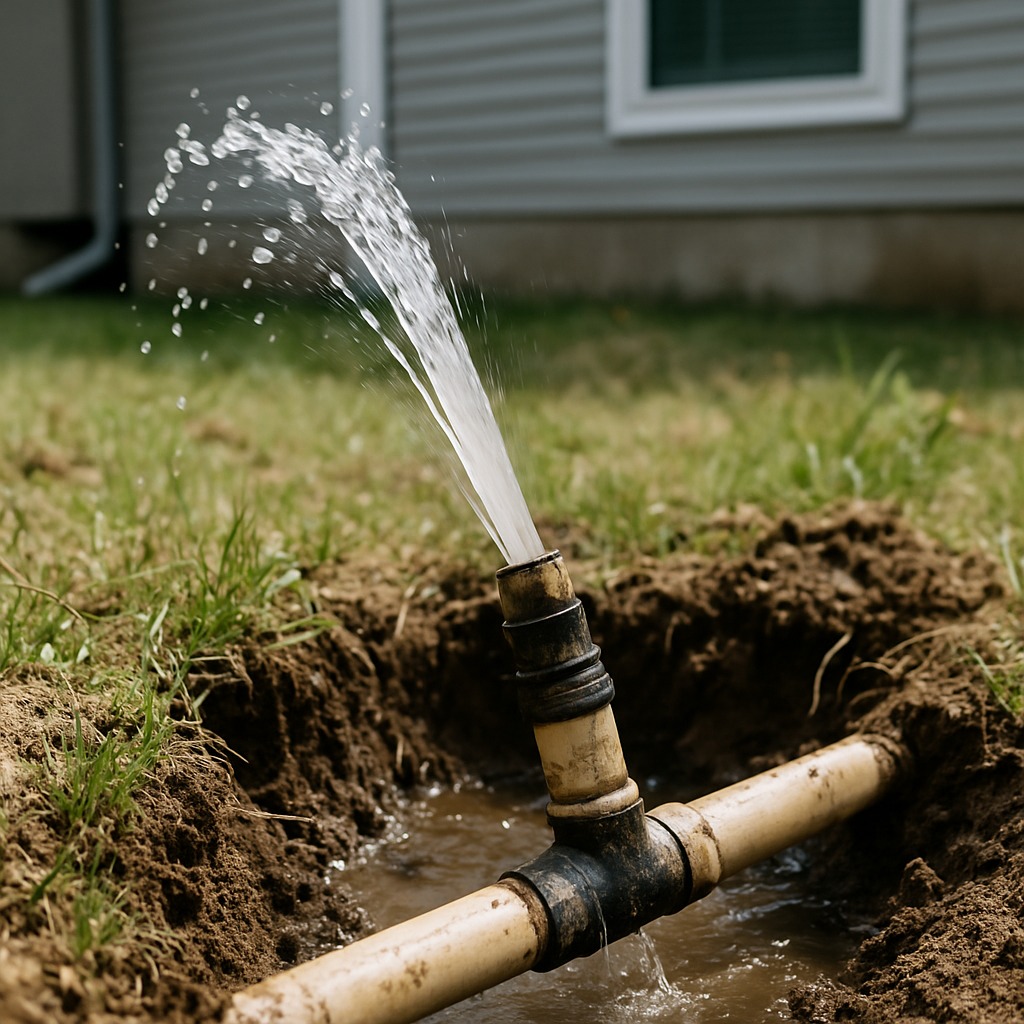
You walk outside and there's a swampy patch in your yard that wasn't there yesterday. The water meter is spinning even though every faucet is off. Your water pressure has dropped to a trickle. These are the classic signs of a broken water service line — the buried pipe connecting your home to the municipal water main — and it's one of the most time-sensitive plumbing emergencies a homeowner can face.
A yard line break wastes 300–500+ gallons of treated water per hour, driving utility bills up by $50–$200 per day. Worse, the saturated soil can shift under foundations, crack driveways, and erode landscaping within days. Repair costs range from $500 for a simple spot fix to $5,500 for a full line replacement, with after-hours emergency calls adding 50–100% surcharges. Your final bill depends heavily on pipe material, burial depth, and whether the break is under hardscape like concrete or asphalt.
This guide gives you the exact diagnostic steps, real contractor-verified cost data, and the critical decisions that separate a $600 repair from a $5,000 nightmare. We'll show you what to do in the first 15 minutes, how to determine whether the break is actually the utility's problem, and when trenchless technology can save you thousands in restoration costs.
Symptoms: What You're Seeing
- Unexplained soggy or saturated patch in yard: You walk across your lawn and one area feels spongy underfoot, like stepping on a waterlogged sponge, even though it hasn't rained in days. The grass in that zone is noticeably greener and taller than the surrounding turf. Standing water may pool on the surface, and the soil squishes audibly when you press down. This saturated zone typically sits directly above the path of your main water service line running from the meter to the house.
- Sudden drop in water pressure inside the house: You turn on the kitchen faucet or shower and the flow is noticeably weaker than yesterday. Pressure that normally runs 50-60 PSI at the hose bib now reads 25-35 PSI on a gauge. Multiple fixtures throughout the house are affected simultaneously, not just one faucet. This uniform pressure loss across the whole system is the hallmark of a main line breach rather than an isolated fixture issue or clogged aerator.
- Water meter spinning when all fixtures are off: Walk to your water meter, make sure every faucet, toilet, washing machine, and irrigation valve in the house is completely shut off, then watch the meter dial. If the low-flow indicator triangle is spinning or the digital readout is ticking upward, water is leaving the system somewhere underground. A fast-spinning dial can indicate a loss rate of 1-3 gallons per minute, meaning 1,400 to 4,300 gallons wasted per day and a substantial spike in your utility bill.
- Discolored or muddy water at faucets: When you first run the tap, you see brownish, rust-colored, or silty water flowing out. The discoloration comes from soil and sediment being drawn into the pipe through the break point, especially when pressure fluctuates. The water may carry a faint earthy or metallic smell. This is a direct sign that the integrity of the pipe wall is compromised and outside contaminants are entering the potable water supply, posing a health concern.
- Hissing or rushing water sound near the yard: Standing outside near the suspected line path, you hear a faint but persistent hissing, gurgling, or rushing noise coming from below ground. This sound is pressurized water escaping through a crack or split in the pipe and forcing through surrounding soil. The sound is most audible on quiet mornings and can sometimes be heard pressing your ear against an outdoor hose bib or the meter box itself. It is distinctly different from normal irrigation noise.
What's Actually Causing This
- Corrosion and aging pipe material: Galvanized steel lines installed before the 1970s have a typical service life of 40-50 years before internal rust and mineral buildup weaken the pipe walls to the point of failure. Copper lines last longer but still develop pinhole leaks from soil chemistry, particularly in acidic soils with a pH below 6.5. Polybutylene (PB) pipes, common from 1978-1995, are notorious for becoming brittle and cracking at fittings. Roughly 30% of main line breaks we see are simply pipes that have exceeded their expected lifespan and corroded from the inside out.
- Tree root intrusion and mechanical damage: Tree roots naturally seek moisture and can exert pressures exceeding 150 PSI against a pipe joint or fitting. Species like willows, maples, and elms send aggressive root systems 20-30 feet beyond their canopy. The roots find microscopic leaks at joints, grow into the gap, and eventually crack the pipe open. This is the single most common cause of water line breaks in established neighborhoods with mature landscaping. We see this on at least 2 out of every 10 yard line repairs.
- Ground shifting, frost heave, and soil movement: In freeze-thaw climates, the frost line can extend 36-48 inches deep. If the water line was installed above the local frost depth, ice expansion exerts lateral force on the pipe, cracking rigid materials like PVC or cast iron. Clay soils are especially problematic because they expand when wet and contract when dry, creating cyclical stress on buried pipes. New construction settling, nearby excavation, or heavy vehicle traffic over shallow lines also cause enough ground movement to shear joints or snap fittings.
- Excavation damage and third-party strikes: Homeowners or contractors hitting the water line with a shovel, post-hole digger, trencher, or backhoe accounts for roughly 15-20% of yard line breaks. The damage may not show immediately—a shovel nick on a copper or PVC line can weaken the wall enough that it fails days or weeks later under normal pressure. Failure to call 811 before digging is the root issue. Even lines buried at the correct 18-24 inch depth are vulnerable to landscape projects, fence installations, and irrigation trenching.
Twenty-year plumbers will tell you: before you agree to a full line replacement, ask your plumber to run a pressure test on the existing line after a spot repair. A lot of homeowners get upsold into a $3,500–$5,000 full replacement when the pipe is actually in decent shape and only failed at one joint or fitting. A proper pressure test costs $75–$150 and should hold 60 PSI for 15 minutes with zero drop. If it passes, a $500–$1,200 spot repair is perfectly sound. Only agree to full replacement if the test shows secondary pressure loss, which indicates corrosion or deterioration along the entire run. This single step saves homeowners $2,000–$4,000 regularly.
Step-by-Step Diagnosis
Work through these steps before calling a contractor. Each step tells you what to look for and what it means.
Shut off water at the meter
🔧 Meter key (curb key)Locate your water meter box, usually near the curb or property line. Remove the lid—you may need a flat-head screwdriver to pry it open. Use a meter key (a T-shaped wrench available at any hardware store for $8-$15) to turn the valve clockwise until it stops. On ball-valve meters, turn the handle 90 degrees so it sits perpendicular to the pipe. Confirm shutoff by opening an outdoor hose bib and verifying no water flows after the residual pressure bleeds off. This stops further water loss, prevents yard erosion, and drops your running meter to zero. Safety note: watch for spiders, scorpions, or standing water inside the meter box. Wear gloves.
Locate the break point precisely
🔧 Steel probe rod, landscape marking flagsWalk the path of the water line from the meter to where it enters the house foundation. Look for the wettest area, the greenest grass, or any spot where soil has eroded or sunk. Push a thin steel probe rod (a 4-foot piece of 3/8-inch rebar works) into the soil along the line path. Where the ground is unusually soft or saturated compared to surrounding soil, you are near the break. Mark the spot with landscape flags. If the line path is unknown, check your property survey or call 811 to have utility lines marked for free—this service is legally required before any digging and typically arrives within 2-3 business days. Never guess and dig blind; gas lines, electrical conduits, and telecom cables may run parallel.
Excavate carefully around the pipe
🔧 Flat-blade spade, hand trowel, tarp, wet-dry shop vacuumUsing a flat-blade spade, begin digging a hole approximately 3 feet wide centered on your marked spot. Dig in 4-inch layers, working carefully once you reach 12 inches deep since most residential water lines sit between 18 and 36 inches below grade. Once you see or feel the pipe, switch to hand-digging with a trowel or your hands to avoid further damaging the line. Expose at least 24 inches of pipe on each side of the break so you have room to work. Pile the excavated soil on a tarp to make backfilling cleaner. If the trench fills with water rapidly, use a submersible sump pump or a wet-dry shop vacuum to keep visibility. Wear steel-toe boots and keep the trench walls sloped if deeper than 3 feet to prevent collapse.
Cut out the damaged pipe section
🔧 Copper tube cutter or PVC ratcheting cutter, deburring tool, utility knifeOnce exposed, identify the pipe material: copper, PVC, HDPE, or galvanized. For copper, use a copper tube cutter—place it around the pipe 6 inches past each end of the visible damage and rotate until it cuts clean. For PVC (white or gray pipe), use a PVC ratcheting cutter or a fine-tooth hacksaw. Make straight, square cuts. Remove the damaged section completely. Inspect the remaining pipe ends for hairline cracks, discoloration, or additional corrosion extending beyond your cuts. If the pipe looks compromised further than you exposed, dig more and cut again. Deburr all cut ends with a utility knife or deburring tool—rough edges cause turbulence and future joint failures. Keep dirt out of the open pipe ends by stuffing a clean rag inside temporarily.
Install the repair coupling and restore service
🔧 Slip coupling, propane torch and lead-free solder (copper) or PVC primer and cement (PVC), pressure gaugeFor copper lines, the standard repair uses a slip coupling (also called a repair coupling with no internal stop). Slide the coupling over one pipe end, position the new section of matching-diameter copper pipe, and slide the coupling back to center over the joint. Solder both ends using lead-free solder and flux, heating evenly with a propane torch. For PVC, use a repair coupling with primer and PVC cement—apply purple primer to both the pipe exterior and coupling interior, then immediately apply cement and push together with a quarter-turn twist. Hold for 30 seconds. Allow PVC joints to cure a minimum of 2 hours before pressurizing (longer in temperatures below 60°F). Once cured, slowly turn the meter valve back on, opening it in quarter-turn increments over 2 minutes to avoid water hammer. Check the repair joint for any drips or weeping under full pressure for at least 15 minutes. If dry, backfill the trench in 6-inch layers, tamping each layer firmly with the back of your spade to prevent future settling. Mound the soil slightly above grade because it will settle 10-15% over the next few weeks.
When to Stop DIY and Call a Pro
Stop DIY and call a licensed plumber immediately if you cannot locate the break, if the pipe material is polybutylene or lead (both require special handling and often full replacement), if the break is within 3 feet of the meter or the house foundation where connections are complex, or if the trench floods faster than you can dewater it. If the line is deeper than 4 feet, trench safety becomes a serious OSHA-level concern—cave-ins can be fatal and shoring or trench boxes are required at that depth. If you see gas lines, electrical conduits, or fiber-optic cables in the same trench, stop immediately and call professionals who carry liability insurance. From a financial standpoint, if your leak is wasting 2+ gallons per minute, that is over 2,800 gallons per day—at average municipal rates of $0.005-$0.015 per gallon, that is $14-$42 per day in wasted water before you even count the repair. A professional water line repair typically runs $500-$2,500 depending on depth and pipe material, which pays for itself within days when you factor in water waste, potential foundation damage from saturation ($5,000-$15,000 in repair costs), and the risk of contaminated drinking water entering your home through the breach.
What Does This Repair Cost?
Costs vary by region, home age, and severity. These are national averages — always get 3 quotes.
| Repair Type | DIY Cost | Pro Cost | Emergency Premium |
|---|---|---|---|
| Spot repair (single joint or coupling) | $30–$80 | $500–$1,200 | $900–$1,800 |
| Partial line replacement (10–20 ft section) | $80–$200 | $1,200–$2,800 | $2,000–$4,200 |
| Full water service line replacement (meter to house) | Not recommended | $1,800–$5,500 | $3,500–$7,500 |
| Emergency after-hours service call + diagnosis | N/A | $150–$350 | $300–$600 |
*Emergency rates (nights/weekends/holidays) run 40–60% above standard. Get 3 quotes before approving work.
Get quotes from licensed professionals in your area
Free, no obligation — compare 3+ contractors in minutesWhat Drives the Cost?
| Cost Factor | Estimated Impact | Why It Matters |
|---|---|---|
| Pipe depth (3 ft vs. 6+ ft frost line) | Adds $800–$2,500 | Deeper trenching requires heavy equipment rental, shoring, and significantly more labor hours — cold-climate homes with 5–6 ft burial depths pay dramatically more |
| Pipe material (copper vs. PEX vs. HDPE) | Adds or saves $300–$1,500 | Copper runs $3–$8/ft installed while PEX or HDPE costs $1.50–$4/ft — material choice also affects permit requirements and long-term durability |
| Hardscape obstruction (driveway, sidewalk, patio) | Adds $1,000–$4,000 | Breaking and restoring concrete or asphalt over the line can double the total project cost — trenchless methods can avoid this entirely |
| Trenchless vs. open-trench method | Saves $1,500–$4,000 in restoration | Pipe bursting or lining avoids surface destruction but costs $500–$1,000 more for the plumbing work itself — net savings come from not rebuilding landscaping and hardscape |
Here's something most guides miss entirely: your water utility may be responsible for the break depending on where it occurred. The line from the water main in the street to the meter is almost always the utility's responsibility, while the line from the meter to your house is yours. Before you pay a dime, call your water provider and ask them to verify the break location relative to the meter. In roughly 15–20% of cases we see, the break is on the utility side and the repair is completely free to the homeowner. Also, check whether your municipality offers a water service line protection program — many cities now partner with companies like HomeServe offering $5–$9/month coverage that reimburses up to $8,500 per incident. If you have older pipe, that coverage pays for itself immediately.
⚠️ Stop DIY — Call a Pro If You See These
- Water bill doubles or triples with no change in usage — A 1-gallon-per-minute leak wastes 43,200 gallons per month, adding $200-$650 to your water bill depending on local rates. Left unaddressed for 2-3 months, you could face $600-$2,000 in excess charges that most utilities will not fully credit back.
- Foundation cracks appearing on the side nearest the water line — Persistent underground water saturates the soil against your foundation, causing differential settling. Within weeks to months, this can produce stair-step cracks in brick or block walls and sticky doors and windows. Foundation repair costs range from $5,000 to $15,000 or more, dwarfing the cost of a water line fix.
- Sinkhole or ground depression forming along the pipe path — Pressurized water erodes soil particles and carries them away, creating voids underground. The surface eventually collapses into these voids, sometimes suddenly. A sinkhole near a driveway or walkway can undermine the slab, creating a tripping hazard and structural failure that costs $2,000-$8,000 to fill and stabilize properly.
- Persistent muddy or low-pressure water despite no utility work in the area — Sediment intrusion through a pipe breach means bacteria, soil pathogens, and contaminants are entering your drinking water. E. coli contamination from soil is a real health risk. Prolonged low pressure below 20 PSI also creates a backflow condition that can pull contaminated groundwater into the line through the break, violating safe drinking water standards.
Frequently Asked Questions
How much does it cost to fix Water Line Break In Yard?
The national average for a water line repair in the yard runs $500-$2,500 for a spot repair of the damaged section. On the low end, a shallow PVC break in accessible soil with easy digging runs $350-$700 including labor and materials. On the high end, a deep copper or galvanized line under a driveway, mature tree roots, or rocky soil can hit $3,000-$5,000. The two biggest cost drivers are depth of the pipe (deeper means more excavation labor at $50-$100 per hour) and pipe material (copper and HDPE cost more in fittings and require more skilled labor than PVC). Full line replacement from meter to house averages $1,500-$5,000 for a 50-75 foot run.
Can I fix Water Line Break In Yard myself?
Yes, if the break is on your side of the meter, the pipe is standard PVC or copper at a depth of 3 feet or less, and you have basic plumbing skills including soldering or PVC cementing experience. You need to call 811 first, confirm no other utilities share the trench, and verify your local code allows homeowner repairs on the water service line—some jurisdictions require a licensed plumber and permit for any work on the main service line. If the break is on the utility's side of the meter, that is their responsibility and you should not touch it. If you are not confident making a watertight joint that will hold 60+ PSI permanently underground, hire a professional.
How urgent is Water Line Break In Yard?
This is a same-day urgency issue. Every hour the leak runs, you lose 60-180 gallons of treated water (at typical leak rates of 1-3 GPM), your water bill climbs, and the saturated soil around your foundation and landscaping erodes further. Within 24-48 hours of a significant break, you can see noticeable ground erosion, sinkhole formation, and potential foundation soil washout. Shut the water off at the meter immediately to stop the bleeding, then get the repair scheduled within 24 hours. If the water is off, you have a day or two to arrange the fix, but you are without water service to the house during that time.
What causes Water Line Break In Yard?
The three most common causes are corrosion and age (pipes older than 40-50 years, especially galvanized steel and polybutylene, fail from internal deterioration), tree root intrusion (roots from species like willows and maples infiltrate joints and crack pipe walls, accounting for roughly 20% of breaks), and ground movement from frost heave or soil settling (clay soils expand and contract seasonally, stressing rigid pipe materials). Excavation damage from digging without calling 811 is also a frequent cause, responsible for about 15-20% of the breaks we repair.
Will homeowners insurance cover Water Line Break In Yard?
Standard homeowners insurance policies typically do not cover the repair of the water line itself, as it is considered a maintenance issue. However, most policies will cover resulting water damage to your home's structure or foundation if the break causes interior flooding or structural damage. Some insurers offer a water service line endorsement (add-on coverage) for $50-$100 per year that covers the pipe repair up to $10,000-$15,000. Check your policy declarations page or call your agent. Some municipal water utilities also offer service line warranty programs through companies like HomeServe for $5-$10 per month. File the claim before you start repairs so the adjuster can document the damage.
How do I find a licensed plumber for this?
First, verify the plumber holds a valid state or local plumbing license—check your state's contractor licensing board website by entering their license number. Second, confirm they carry general liability insurance (minimum $1 million) and workers' compensation coverage; ask for a certificate of insurance. Third, get a written quote that itemizes excavation, pipe materials, labor, backfill, and any permit fees—a reputable plumber will visit the site before quoting. Fourth, check at least 3 recent references or verified online reviews specifically for water line work, not just general plumbing. Avoid any contractor who quotes over the phone without seeing the job or demands full payment upfront. A reasonable deposit is 10-30% with the balance due on completion.
When you discover a water line break in your yard, three decisions matter most: First, shut the water off at the meter immediately to stop the leak, prevent further soil erosion, and halt your climbing water bill. Second, accurately determine whether the break is on your side of the meter (your responsibility) or the utility's side (their responsibility)—this single determination dictates who pays for the repair. Third, honestly assess whether the repair is within your skill level based on pipe material, depth, and local code requirements, or whether it demands a licensed plumber with excavation experience and proper insurance.
Your recommended next step is straightforward: turn off the water at the meter right now, then call 811 to have utility lines marked before anyone digs. While waiting for markings (typically 2-3 business days), get written quotes from two to three licensed plumbers who specialize in water service line repairs. Compare their quotes, verify their licenses and insurance, and schedule the repair. Every day you wait costs you water, money, and increases the risk of foundation damage that is far more expensive to fix than the line itself.
Ready to Solve This for Good?
Get matched with pre-screened, licensed plumbers in your area. Free quotes, no obligation, no spam.
GET FREE QUOTES NOW