
Updated June 13, 2026 · HomeFixx Editorial Team
Persistently low shower pressure often signals corroded pipes or a failing pressure regulator that can escalate to pipe bursts or water heater damage within weeks if ignored.
🔧 DIY Key Takeaways
- Unscrew your showerhead and soak it in white vinegar for 8–12 hours to dissolve mineral buildup — this $3 fix resolves roughly 40% of low-pressure complaints
- Check your main shut-off valve and any inline valves near the water heater — a valve accidentally left half-closed costs $0 to fix and is the #1 missed cause plumbers find on service calls
- Remove and inspect the flow restrictor disc inside your showerhead using needle-nose pliers — a clogged or overly restrictive disc drops pressure by 30–50%, and a replacement disc costs under $5
👷 Hire a Pro Key Takeaways
- A licensed plumber can pressure-test your entire system in 30 minutes ($85–$175 service call) and pinpoint whether the issue is localized to one fixture or a whole-house supply problem — misdiagnosing this yourself can lead to $500+ in unnecessary work
- If your home has galvanized steel pipes (common in pre-1970 homes), internal corrosion may be restricting flow system-wide — a full repipe costs $2,500–$15,000 but prevents inevitable pipe failure and potential water damage exceeding $10,000
- A failing pressure reducing valve (PRV) at your main line costs $250–$500 to replace professionally, but ignoring it risks sending unchecked municipal pressure (80–150 psi) into your plumbing, blowing seals on appliances and fixtures
📋 In This Guide
HomeFixx guides are researched and fact-checked by licensed trade professionals. Cost data updated June 13, 2026.
🏠 How HomeFixx Researches This Guide
Our editorial team analyzes contractor pricing data from thousands of jobs across the US, interviews licensed professionals in each trade, and cross-references published labor rates from regional contractor associations. Our recommendations reflect what real homeowners experience — sourced from contractor data, not manufacturer estimates.
You step into the shower expecting a strong, steady stream and instead get a disappointing trickle that barely rinses shampoo out of your hair. Low water pressure in the shower is one of the most common — and most misdiagnosed — plumbing complaints in American homes. Whether it's a $0 valve adjustment, a $3 vinegar soak, or a sign of corroding pipes that could cost $2,500+ to replace, the fix depends entirely on accurate diagnosis.
This guide goes beyond the generic advice you'll find elsewhere. We break down every cause of low shower pressure — from clogged showerheads and faulty cartridges to failing pressure regulators and hidden leaks — with contractor-verified solutions and real 2024 cost data from licensed plumbers across the U.S. You'll learn exactly what to check yourself before spending a dime, and precisely when the problem demands professional tools and expertise.
Ignoring low shower pressure isn't just an annoyance. It can mask developing leaks, corroding supply lines, or a water heater on its last legs — problems that escalate from a minor repair into thousands in water damage. Let's find out what's really going on behind your shower wall.
Symptoms: What You're Seeing
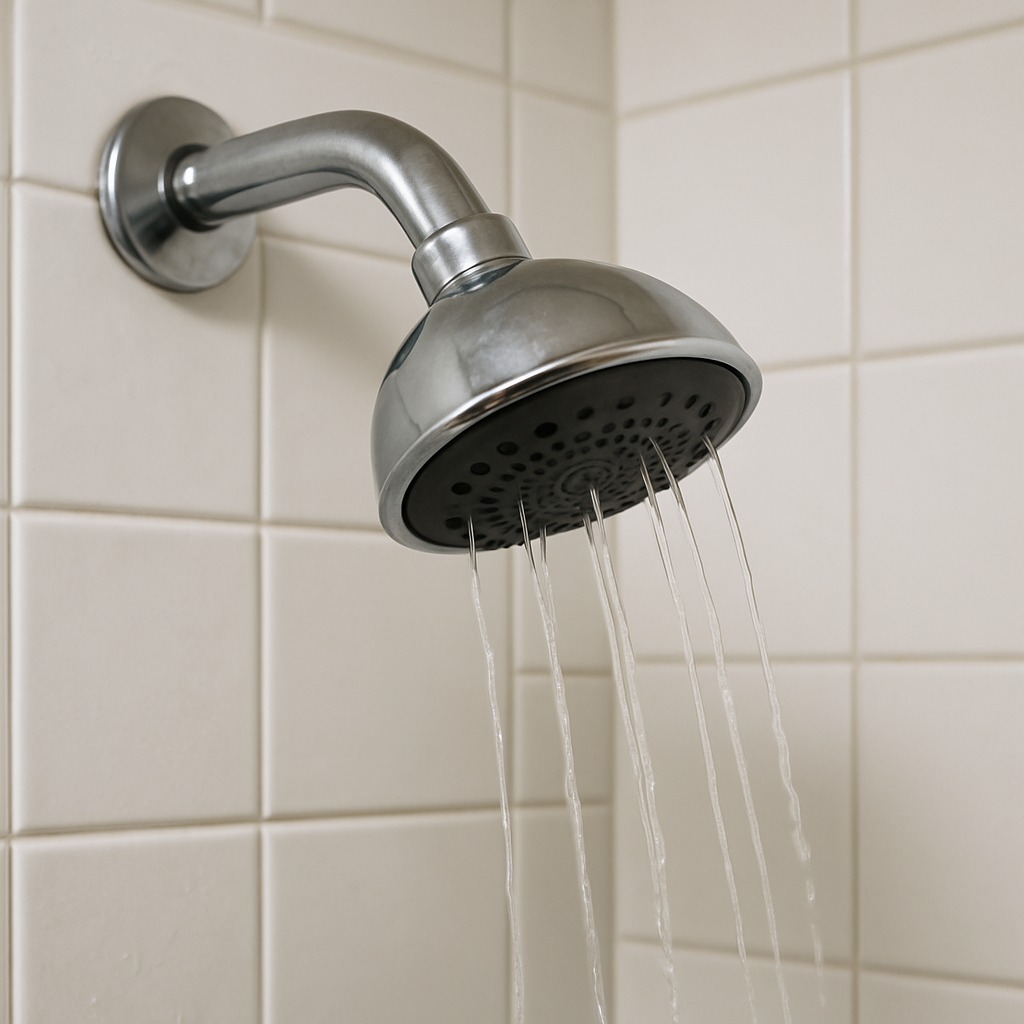
- Weak or dribbling showerhead stream: You turn the handle to full open, but the water barely arcs past the showerhead face—it dribbles straight down rather than projecting outward. The stream feels like someone is holding a thumb over a garden hose compared to what you remember. Flow feels noticeably weaker than other fixtures in the house, and you may hear a faint hissing or whistling from the showerhead as water struggles through partially blocked nozzles.
- Uneven spray pattern from showerhead: Instead of a full, uniform fan of water, you get scattered jets shooting at odd angles while entire sections of the showerhead produce nothing. You can visibly see white or greenish mineral crust clogging individual nozzle holes. Running your finger across the face, you feel gritty calcium deposits. This symptom worsens gradually over months, and is especially common in homes with hard water above 10 grains per gallon.
- Fluctuating pressure during use: Water pressure surges and drops rhythmically while you shower—strong for a few seconds, then weak, then strong again. You may hear pipes shuddering or a thumping sound inside the wall known as water hammer. This pulsing pattern often worsens when another fixture—toilet, dishwasher, washing machine—kicks on elsewhere in the house. It signals a supply issue rather than a simple showerhead clog.
- Longer time to reach hot water temperature: You used to wait 30 seconds for hot water; now it takes two to three minutes. The reduced flow rate means hot water travels more slowly from the water heater through the pipes. You feel lukewarm water longer than expected, and the overall shower temperature never seems as consistently hot as it once did. This symptom frequently accompanies corroded galvanized steel supply lines in pre-1980 homes.
- Low pressure isolated to one shower only: Every other faucet and fixture in the house delivers strong, normal pressure—typically 45 to 80 psi—but one particular shower is noticeably weak. This tells you the problem is localized: the showerhead, the shower valve cartridge, or the dedicated supply line feeding that fixture. You can confirm by testing flow from the tub spout below—if the tub spout runs strong but the shower doesn't, the diverter or shower riser pipe is the likely culprit.
What's Actually Causing This
- Mineral-clogged showerhead: In areas with hard water—water hardness above 7 grains per gallon, which covers roughly 85 percent of U.S. households—calcium carbonate and magnesium deposits gradually accumulate inside the showerhead body and across the nozzle openings. Over 12 to 24 months, these deposits can reduce flow by 30 to 50 percent. The showerhead's internal flow screen also traps sediment. This is the single most common cause of low shower pressure and the easiest to fix, yet homeowners often overlook it for years.
- Partially closed or failing shut-off valve: The shower's supply valves—either the main house shut-off, a branch shut-off near the bathroom, or the fixture shut-off behind an access panel—may not be fully open. Gate valves, common in homes built before 2000, develop internal corrosion and the gate can break loose, partially blocking flow even when the handle appears fully open. A gate valve turned just one-quarter closed reduces flow by roughly 40 percent. This cause is especially common after recent plumbing work when a valve was closed and not fully reopened.
- Worn or obstructed shower valve cartridge: The mixing cartridge inside a single-handle shower valve controls hot and cold water blending. Over 8 to 15 years, the cartridge's internal ports corrode, rubber seals swell, and debris collects inside the valve body. A failing cartridge can restrict flow to as little as 1.2 gallons per minute—well below the standard 2.5 GPM—even at full open. Moen 1222 and Delta RP19804 are among the most commonly replaced cartridges. Symptoms include both reduced pressure and difficulty adjusting temperature.
- Corroded or undersized supply piping: Galvanized steel pipes, installed in millions of homes between the 1940s and 1980s, corrode from the inside out. After 40-plus years, the effective internal diameter of a ¾-inch galvanized pipe can shrink to ¼ inch due to rust scale buildup. This restricts flow system-wide but is most noticeable at the fixture farthest from the water meter or at upper-floor showers where gravity already reduces pressure by roughly 0.43 psi per foot of elevation. Replacing corroded galvanized lines with ¾-inch copper or PEX is the permanent fix and typically costs $2,500 to $6,000 for a full re-pipe of a single bathroom's supply lines.
After 20 years in residential plumbing, the first thing I check isn't the showerhead — it's the hot-water shut-off at the water heater. Sediment buildup inside the heater's dip tube can break apart and lodge in the mixing valve or supply lines feeding your shower. Flushing the water heater tank ($0 DIY, $125–$200 if you hire it out) once a year prevents this. I've seen homeowners spend $400+ on new shower valves and cartridges when the real culprit was a $15 dip tube clogged with calcium flakes. Always isolate hot vs. cold pressure independently before replacing any parts — run each supply line into a bucket and measure flow rate in gallons per minute. Anything below 2.0 GPM on either side points upstream, not at the showerhead.
Step-by-Step Diagnosis
Work through these steps before calling a contractor. Each step tells you what to look for and what it means.
Test static water pressure at the hose bib
🔧 Hose-bib pressure gauge (0-200 psi)Before touching the shower, screw a pressure gauge onto your outdoor hose bib or laundry faucet. Make sure no water is running anywhere in the house—turn off the ice maker, tell everyone to stop using water. Read the gauge. Normal residential pressure is 45 to 80 psi. Below 40 psi means the problem is your municipal supply or pressure regulator, not the shower itself. Above 80 psi means you may have a failing pressure-reducing valve (PRV) that is over-pressurizing then compensating. Write the number down. If pressure reads 45 to 80 psi, the problem is localized to the shower fixture and you can proceed with the following steps. This test takes two minutes and saves you from chasing the wrong problem.
Remove and clean the showerhead thoroughly
🔧 Adjustable wrench, needle-nose pliers, PTFE tapeWrap the shower arm with a cloth to protect the finish, then use an adjustable wrench to unscrew the showerhead counterclockwise. Inspect the inlet screen—a small mesh disc inside the showerhead's threaded connection. Remove it with needle-nose pliers and rinse under running water. Next, submerge the entire showerhead in a container of white distilled vinegar (5% acidity) for 8 to 12 hours. For stubborn calcium deposits, use a 50/50 mix of CLR and water for 2 hours maximum—longer can damage chrome finishes. After soaking, use a toothpick or safety pin to clear each individual nozzle. Rinse thoroughly, reinstall the screen, wrap the shower arm threads with 3 to 4 clockwise wraps of yellow PTFE tape, and hand-tighten the showerhead plus one-quarter turn with the wrench. Turn on the water and check flow. Many homeowners see a 40 to 60 percent improvement from this step alone.
Check and fully open all shut-off valves
🔧 FlashlightLocate every valve between the water meter and the shower. Start at the main shut-off (usually near the meter or where the main line enters the house) and confirm it is fully open—turn it counterclockwise until it stops. For gate valves, that means multiple full turns; for ball valves, the handle should be parallel to the pipe. Next, look for a branch shut-off in the basement, crawl space, or behind a bathroom access panel. If your home has individual fixture shut-offs behind the shower wall (accessible via a panel on the opposite side), open those fully too. A gate valve that was left one full turn closed can cut pressure by 50 percent or more. If a valve handle is frozen or the valve is leaking from the packing nut, do not force it—call a plumber, because breaking a corroded gate valve can cause a flood. Mark each valve with a tag indicating its position so future tradespeople can find them.
Inspect and remove the flow restrictor disc
🔧 Flathead screwdriver, needle-nose pliersFederal regulations since 1992 require showerheads to limit flow to 2.5 GPM at 80 psi, and many modern heads ship with restrictors set to 2.0 or even 1.75 GPM. While eco-friendly, in homes with baseline pressure below 50 psi, these restrictors can make flow feel unacceptably weak. After removing the showerhead (as in Step 2), look inside the inlet for a colored plastic or rubber disc with a small hole in the center—this is the flow restrictor. Use a flathead screwdriver to pry it out gently. Note: removing the restrictor may increase water usage by 0.5 to 1.0 GPM and may void the showerhead warranty. Reinstall the head, turn on the water, and compare. If pressure improves significantly, the restrictor was your bottleneck. Some homeowners drill out the restrictor hole slightly larger rather than removing it entirely, keeping some conservation benefit while improving perceived pressure.
Flush the shower valve and supply lines
🔧 Allen wrench set, Phillips screwdriver, cartridge puller (if needed), bucketIf cleaning the showerhead and checking valves didn't fix the issue, debris may be lodged in the shower valve itself. Turn off the water supply to the shower—use the fixture shut-offs or the main. Remove the shower handle (usually a single Allen-head screw or Phillips screw under a decorative cap) and pull out the cartridge or stem. Place a bucket or towels below the valve opening. Have a helper slowly turn the water back on for 3 to 5 seconds, then shut it off. This flushes sediment, pipe scale, and debris out of the supply risers and through the valve body. You may see rust-colored water and small particles—that's the obstruction. Repeat the flush 2 to 3 times until water runs clear. Inspect the cartridge for swollen rubber seals or visible corrosion. If the cartridge shows wear, replace it—a Moen 1222 cartridge costs $25 to $35, and a Delta RP19804 costs $15 to $25. Reinstall the cartridge, handle, and trim, then restore water and test. You should feel a noticeable improvement in flow if debris was the culprit.
When to Stop DIY and Call a Pro
Call a licensed plumber if your static pressure test reads below 40 psi at the hose bib—this points to a failing pressure-reducing valve (PRV replacement costs $350 to $600 installed) or a municipal supply issue beyond DIY scope. Stop all DIY work immediately if you discover a corroded gate valve that is frozen or leaking, because forcing it can snap the valve body and flood the house—emergency water damage remediation averages $3,000 to $7,000. If you've cleaned the showerhead, flushed the valve, and verified valves are open but pressure is still under 2.0 GPM, the problem is likely inside the walls—corroded galvanized pipes or an undersized supply riser. Opening walls for re-piping requires permits, inspection, and drywall repair. When total repair costs approach $500 or more, a professional's diagnostic accuracy pays for itself by avoiding trial-and-error parts purchases. Also call a pro if multiple fixtures in the house show low pressure simultaneously, as this may indicate a failing well pump, a partially closed curb stop at the street, or a slab leak—issues that require specialized equipment like electronic leak detectors and camera scopes to diagnose properly.
What Does This Repair Cost?
Costs vary by region, home age, and severity. These are national averages — always get 3 quotes.
| Repair Type | DIY Cost | Pro Cost | Emergency Premium |
|---|---|---|---|
| Showerhead cleaning or replacement | $0–$15 | $85–$175 | $150–$275 |
| Shower cartridge or mixing valve replacement | $15–$60 | $150–$350 | $250–$500 |
| Pressure reducing valve (PRV) replacement | Not recommended | $250–$500 | $400–$700 |
| Whole-house repipe (galvanized to copper/PEX) | Not recommended | $2,500–$15,000 | $4,000–$18,000 |
| Emergency plumber diagnostic call | N/A | $85–$200 | $175–$350 |
*Emergency rates (nights/weekends/holidays) run 40–60% above standard. Get 3 quotes before approving work.
Get quotes from licensed professionals in your area
Free, no obligation — compare 3+ contractors in minutesWhat Drives the Cost?
| Cost Factor | Estimated Impact | Why It Matters |
|---|---|---|
| Home age and pipe material | Adds $500–$12,000 | Galvanized steel pipes in pre-1970 homes often require partial or full repipe — PEX repiping costs far less than copper |
| Number of affected fixtures | Adds $0–$2,000 | Single-fixture issues are usually simple cartridge or showerhead fixes; whole-house problems point to main line, PRV, or pipe corrosion |
| Water hardness / mineral content | Adds $200–$2,500 | Hard water regions accelerate scale buildup; a whole-house softener prevents recurring blockages and extends fixture life |
| Wall or tile access requirements | Adds $150–$1,500 | If the shower valve is behind finished tile with no access panel, demolition and tile repair add significant labor and material cost |
Regional water hardness is a factor most guides ignore. In areas like Phoenix, San Antonio, or anywhere above 10 grains per gallon hardness, mineral scale can reduce pipe interior diameter by 25% within 10 years. Installing a whole-house water softener ($800–$2,500 installed) pays for itself by extending fixture and pipe life by a decade or more. I also tell homeowners to check with their municipality before calling me — cities periodically reduce main pressure for infrastructure work and don't always notify residents. A $12 pressure gauge from any hardware store threaded onto an outdoor hose bib will tell you in 5 seconds if your incoming pressure is below the 40–60 psi sweet spot. If it reads fine outside but the shower is weak, the problem is internal and you've just saved yourself a $150 diagnostic call.
⚠️ Stop DIY — Call a Pro If You See These
- Brown, rust-colored water when you first turn on the shower — Indicates advanced internal corrosion of galvanized supply pipes. Within 1 to 3 years, pipes can develop pinhole leaks that cause hidden water damage costing $5,000 to $15,000 in mold remediation and structural repair.
- Visible water stains or damp drywall around the shower valve area — Signals an active leak behind the wall, possibly from a failed valve body or cracked fitting. Left unaddressed for even 2 to 4 weeks, this can rot wall studs and subfloor, turning a $300 valve repair into a $3,000 to $8,000 structural and mold remediation project.
- Pressure drops house-wide when any single fixture runs — Points to a severely restricted main supply line, a failing PRV, or a well pump losing capacity. Continued use under these conditions can damage water-using appliances—tankless water heaters require a minimum 0.5 GPM to fire, and dishwashers need at least 20 psi to fill properly. System-wide failure risk increases weekly.
- Whistling or screeching noise from pipes when shower is running — Caused by water forcing through a nearly closed valve or a severely constricted pipe section. The high-velocity flow erodes pipe walls faster and can cause a fitting to fail under pressure—a burst ½-inch copper line at 60 psi releases roughly 4 gallons per minute, causing significant flooding within minutes if unattended.
Frequently Asked Questions
How much does it cost to fix Water Pressure Low In Shower?
The national average cost ranges from $0 to $6,000 depending on the root cause. Cleaning a showerhead costs nothing beyond vinegar you likely have. Replacing a shower cartridge runs $150 to $350 with a plumber's labor. A new pressure-reducing valve installed costs $350 to $600. At the high end, replacing corroded galvanized supply lines with copper or PEX for a single bathroom runs $2,500 to $6,000. The two biggest price factors are pipe material (copper costs 30 to 40 percent more than PEX) and wall access—if the plumber needs to open finished walls, drywall repair adds $300 to $800.
Can I fix Water Pressure Low In Shower myself?
Yes, in most cases, if the cause is a clogged showerhead, a flow restrictor, or a partially closed valve. These fixes require basic tools—an adjustable wrench, pliers, PTFE tape—and take 20 minutes to an hour. Replacing a shower cartridge is intermediate-level DIY: you need to identify the exact cartridge model, shut off water, and sometimes use a cartridge puller tool. However, if the cause is corroded pipes, a failing PRV, or anything requiring soldering or opening walls, call a licensed plumber. Incorrect soldering near framing can be a fire hazard, and unpermitted pipe modifications can void insurance coverage and cause problems at resale.
How urgent is Water Pressure Low In Shower?
Low shower pressure alone is not an emergency—you have days to weeks to address it. However, urgency escalates quickly if you notice brown or discolored water (indicating pipe corrosion that could lead to leaks within months), damp drywall around the shower (active leak requiring same-day attention), or a sudden pressure drop throughout the house (possible main line break requiring immediate professional response). A clogged showerhead can wait indefinitely, but a failing valve cartridge will continue to worsen and may eventually prevent the shower from shutting off completely, which becomes an emergency.
What causes Water Pressure Low In Shower?
The three most common causes are a mineral-clogged showerhead (accounts for roughly 40 to 50 percent of cases, especially in hard-water areas), a worn or obstructed shower valve cartridge (about 25 percent of cases, typically in fixtures over 8 years old), and partially closed shut-off valves (about 15 percent of cases, often discovered after recent plumbing work). Less common but more expensive causes include corroded galvanized supply pipes, a failing pressure-reducing valve at the main line, or undersized ½-inch supply risers in older homes that can't deliver adequate volume to upper-floor showers.
Will homeowners insurance cover Water Pressure Low In Shower?
Standard homeowners insurance does not cover repairs to fix low water pressure itself—it's considered a maintenance issue. However, if low pressure was caused by a sudden pipe burst that also resulted in water damage, the resulting damage (not the pipe repair) is typically covered under the dwelling coverage portion of your policy. Gradual pipe corrosion, mineral buildup, and wear-and-tear to valves are explicitly excluded by virtually all policies. If corroded pipes do burst and cause flooding, your insurer may deny the claim if they determine the corrosion was a pre-existing, neglected condition. Document your maintenance efforts and keep plumber receipts to support any future claim.
How do I find a licensed plumber for this?
First, verify the plumber holds an active license in your state—check your state's contractor licensing board website by searching the license number they provide. Second, confirm they carry general liability insurance (minimum $500,000) and workers' compensation; ask for a certificate of insurance and call the insurer to verify it's current. Third, get a written quote that itemizes labor, parts, and any diagnostic fee—most plumbers charge a $75 to $150 service call fee that may or may not be applied toward the repair. Fourth, check at least three references or verified online reviews on platforms like Google Business or the BBB. Avoid any plumber who demands full payment upfront or refuses to provide a written scope of work before starting.
Low shower pressure comes down to three decisions: Is the problem at the showerhead, at the valve, or in the supply piping? Start with the cheapest, simplest diagnosis—test your static pressure at the hose bib, clean the showerhead, and verify every valve is fully open. These three steps cost almost nothing and resolve the majority of cases. If those steps don't restore flow above 2.0 GPM, you're looking at a cartridge replacement or a deeper supply-line issue that requires a professional diagnosis.
Your recommended next step: go test your water pressure right now with a $10 hose-bib gauge from any hardware store. If it reads between 45 and 80 psi, pull your showerhead off tonight, drop it in a bowl of vinegar, and reinstall it in the morning. If your pressure reads below 40 psi or you see rust-colored water, skip the DIY and call a licensed plumber for a diagnostic visit. Catching corroded pipes or a failing PRV early saves thousands compared to waiting for a burst line and the water damage that follows.
Ready to Solve This for Good?
Get matched with pre-screened, licensed plumbers in your area. Free quotes, no obligation, no spam.
GET FREE QUOTES NOW